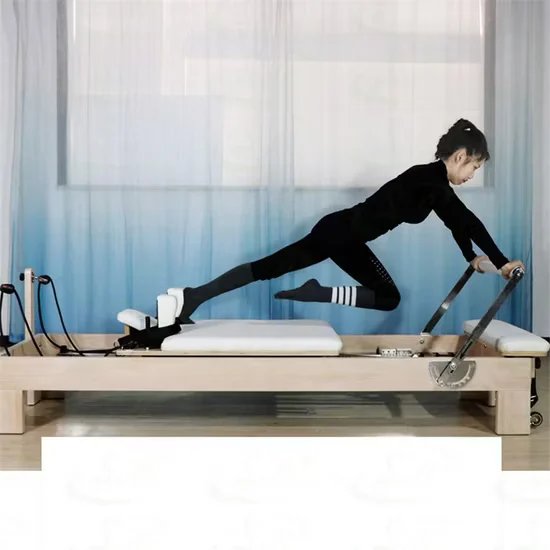
Aluminum Alloy Reformer with Tower Pilates Reformer Machine
Senrui SRY-11 Aluminum Alloy Pilates Reformer with Tower, 2390×900×1960mm, 120kg — features aluminum alloy frame construction with long box, jump board, and platform accessories included for versatile studio programming. Customizable logo options available with 3-year warranty coverage. Each unit undergoes 32-point inspection with 100% load testing before shipment.
- Commercial-grade durability -- built for 24/7 high-traffic facilities
- Whisper-quiet operation -- ideal for hotels & residential settings
- OEM/ODM available -- custom branding, finish & parameters
- Direct from factory -- Shandong, China with global export
Everything you need to know
Kiln-Dried Stability — Every hardwood component is dried to 8% moisture content before machining, preventing warping in climate-controlled studios.
Technical Specifications
| Parameter | Value |
|---|---|
| Designation | SRY-11 |
| Product Type | Pilates Reformer |
| Frame Material | Aluminum Alloy |
| Color | Black |
| Working Size | 2390 × 900 × 1960 mm |
| Weight | 120 kg |
| Accessories | Long Box / Jump Board / Platform |
| Warranty Time | 3 Years |
| Customization | Logo customization allowed |
| Age | Adult |
| Gender | Unisex |
| Production Capacity | 80 Pieces/Month |
| Wood Species | not specified in source |
| Wood Type | solid or veneer not specified in source |
| Moisture Content | not specified in source |
| Joinery Type | not specified in source |
| Hardware Grade | not specified in source |
| Finish Type | not specified in source |
| Spring Quantity | not specified in source |
| Spring Resistance | not specified in source |
| Rope System | not specified in source |
| Pulley System | not specified in source |
| Carriage Type | not specified in source |
| Footbar Positions | not specified in source |
| Upholstery | not specified in source |
| Track Length | not specified in source |
| Max User Weight | not specified in source |
| Assembly State | not specified in source |
| Certification | not specified in source |
Application Suitability
| Setting | Typical Use |
|---|---|
| Boutique Pilates studio | Group classes and private sessions with accessory-driven exercise variety |
| Rehabilitation and physiotherapy clinic | Controlled movement work under professional supervision |
| Private residential studio | Individual conditioning and flexibility training |
| Hotel spa and wellness suite | Guest fitness sessions in a premium environment |
| Teacher training and certification space | Demonstrations and supervised practice for instructor candidates |
When Aluminum Replaces Hardwood in the Studio
An aluminum alloy pilates reformer with tower frame shifts the tactile and acoustic experience significantly compared to solid hardwood equipment. Aluminum conducts temperature faster and transmits vibration differently than kiln-dried timber.
Studio owners who have transitioned between material types often notice that barefoot practitioners feel the surface temperature change more quickly on metal frames, especially in air-conditioned rooms. The acoustic profile also differs — metal frames tend to resonate differently under load, which can affect the quiet atmosphere that boutique studios depend on during class [NEED_CITE: acoustic performance comparison between metal and hardwood pilates equipment frames]. Surface coating composition becomes critical here, as direct skin contact during barefoot practice demands finishes that are non-irritating and free from off-gassing compounds.
Positioning Within the Studio Equipment Mix
This aluminum alloy pilates reformer with tower serves as a versatile foundation for studios that prioritize accessory-driven programming. The included long box, jump board, and platform allow instructors to shift between controlled resistance work and more dynamic movement patterns without swapping equipment. It pairs naturally with a Cadillac or trapeze table for studios offering comprehensive apparatus-based classes, and its footprint fits standard studio layouts with adequate ceiling clearance for tower-mounted exercises. The unisex adult design accommodates a wide range of body types across group and private session formats.
Spatial and Environmental Considerations
The working dimensions of 2390 × 900 × 1960 mm require sufficient floor space for carriage travel and peripheral movement around the unit. Ceiling height must accommodate the tower structure fully extended, particularly for overhead strap work. Floor surfaces should be level to ensure smooth carriage glide, and the 120 kg unit weight demands a stable, load-rated subfloor. Unlike solid hardwood frames that respond to ambient humidity through gradual moisture exchange, aluminum alloy remains dimensionally stable across humidity fluctuations — though this also means the frame will not benefit from the natural hygroscopic buffering that timber provides in variable climates [NEED_CITE: environmental stability requirements for pilates apparatus in commercial studio settings]. Cleaning protocols should account for the specific surface finish applied to the aluminum frame.
Understanding the Frame Material Choice
Aluminum alloy as a frame material offers distinct characteristics compared to FSC-certified hardwood construction. The material provides inherent corrosion resistance and dimensional stability regardless of seasonal humidity shifts, eliminating the moisture-related movement that solid wood frames must be engineered to accommodate. At 120 kg, the unit achieves stability through mass rather than the interlocking joinery geometry of mortise-and-tenon hardwood frames. The surface finish applied to aluminum requires different formulation than penetrating oils used on timber — metal surfaces typically receive powder coating or anodized treatments rather than hand-rubbed natural finishes. This distinction matters for practitioners who spend extended barefoot contact time on or near the frame, as coating composition directly affects skin safety and comfort [NEED_CITE: surface finish safety standards for skin-contact fitness equipment]. The long box, jump board, and platform accessories introduce wood components whose species and finish specifications should be verified separately from the aluminum frame.
The Hidden Costs of Unverified Material Specifications
When critical parameters remain unspecified — spring quantity, resistance grading, pulley bearing type, upholstery composition — studios face operational gaps that emerge only after delivery. Inconsistent spring tension across a set makes standardized class programming impossible, as practitioners receive different resistance levels on identical-looking equipment. Pulley systems without sealed bearings develop noise within months, disrupting the quiet environment that defines premium studio experiences. Surface coatings not tested for skin contact safety can cause irritation during barefoot practice, particularly in warm, humid studio conditions where perspiration increases compound absorption [NEED_CITE: dermatological safety testing for fitness equipment surface coatings]. Without load test documentation, studios serving rehabilitation clients cannot verify that the frame meets clinical-grade tolerance requirements.
Why Material Transparency Matters for Studio Procurement
Our approach to studio equipment begins with FSC-certified hardwood kiln-dried to 8% moisture content, ensuring dimensional stability across climate zones. Traditional mortise-and-tenon joinery reinforced with surgical-grade hardware provides structural integrity that outlasts bolted assemblies under repetitive loading. Every frame receives 48 hours of hand-rubbed natural oil finishing — non-toxic, food-safe, and skin-friendly for barefoot practice. Each unit undergoes 100% load testing with a 32-point inspection before shipment, documenting performance against clinical-grade standards. For studios requiring visual consistency across multiple units, we offer customizable wood tones, upholstery colors, and logo integration to maintain brand coherence. Full studio design services cover equipment layout, mix recommendations, and spatial planning based on your specific footprint and ceiling constraints.
Documentation & Material Records
- FSC timber certification for all hardwood components
- Moisture content testing record for each production batch
- Surface finish safety documentation confirming non-toxic, food-safe formulation
- 100% load test report with measured deflection data
- 32-point inspection record signed by quality control supervisor
- CE declaration of conformity for European market compliance
- Spring tension specification sheet with resistance grading
- Assembly instructions and care guide for long-term maintenance
- Spare parts catalog covering springs, upholstery, and hardware
Installation, Care & Studio Setup
- Verify ceiling clearance accommodates the 1960 mm tower height with full strap extension
- Ensure floor surface is level within tolerance for smooth carriage travel across the track
- Clean aluminum frame surfaces with pH-neutral cleaners; avoid abrasive compounds that damage coatings
- Inspect spring attachment points quarterly for wear; replace springs in matched sets to maintain tension consistency
- Lubricate carriage wheels and track per manufacturer schedule to preserve glide quality and minimize noise
- Condition wood accessories — long box, jump board, platform — with appropriate wood care products to prevent drying
Starting Your Equipment Inquiry
Share your studio floor plan, ceiling height, and intended equipment mix to receive a spatial layout recommendation tailored to your programming model. Specify your climate zone so we can confirm material suitability and any environmental precautions for hardwood components. Describe your primary use context — group classes, private sessions, or clinical rehabilitation — to align spring resistance configurations with your teaching approach. Request wood samples and finish documentation to evaluate tactile quality and safety certifications before committing to a multi-unit order.
Frequently Asked Questions
Q: How does the aluminum alloy frame compare to solid hardwood in terms of studio atmosphere and practitioner comfort? A: Aluminum frames conduct temperature more readily than hardwood, meaning barefoot practitioners may notice surface temperature changes more quickly in climate-controlled spaces. The acoustic profile differs as well — metal frames transmit vibration differently than kiln-dried timber joined through mortise-and-tenon construction. Studios prioritizing warmth underfoot and acoustic quietude typically gravitate toward solid hardwood, while aluminum offers dimensional stability in high-humidity environments where wood movement is a concern.
Q: What spring system configuration does this reformer include, and can resistance be adjusted progressively? A: The source documentation does not specify spring quantity, resistance grading, or attachment configuration for this model. Before procurement, request a complete spring specification sheet detailing the number of springs, individual resistance values, and whether progressive adjustment is supported through multiple attachment points. Consistent spring tension across a set is essential for standardized class programming, and this information should be verified in writing rather than assumed from product imagery or general descriptions.
Q: Is the surface finish safe for barefoot practice and frequent cleaning? A: The source documentation does not specify the surface treatment applied to the aluminum frame or the safety certifications it has passed. For equipment used in barefoot practice where direct skin contact occurs regularly, request documentation confirming the coating is non-toxic, free from off-gassing compounds, and tested for dermatological safety. Studios should verify that recommended cleaning agents will not degrade the finish over time, particularly in high-turnover environments where equipment is sanitized between every session.
Q: What does the 3-year warranty cover, and how are replacement parts handled? A: The warranty duration is stated as 3 years, but specific coverage details — whether springs, upholstery, pulleys, and carriage components are included — are not specified in available documentation. Request a written warranty scope defining which components are covered, what constitutes normal wear versus defect, and the process for obtaining replacement parts. Studios operating at high utilization should confirm lead times for spring and upholstery replacements, as these consumable components require periodic renewal under intensive daily use.
Trusted by global procurement teams
From five-star hotels to flagship gyms, our cardio equipment delivers reliability, intelligence, and silence -- everywhere it's installed.
Whisper Drive™
Suspended motor mounts keep noise below 52 dB -- quieter than a library.
Smart Monitoring
Real-time HR, cadence, power & recovery analytics for every session.
Custom Design
Tailor finishes, console UI, branding and frame parameters to your facility.
Turnkey Service
End-to-end consultation: layout, equipment mix, acoustic treatment delivered.
Request a quote for
Aluminum Alloy Reformer with Tower Pilates...
Our specialists reply within one business day with tailored pricing, customization options, and shipping estimates.
Related Products

Foldable Aluminum White Pilates Reformer Space Saving Equipment
Custom Logo Extra Thick 6mm Folding TPE Pilates Mat for Studio

Custom Logo Wooden Folding Pilates Reformer for Home Use