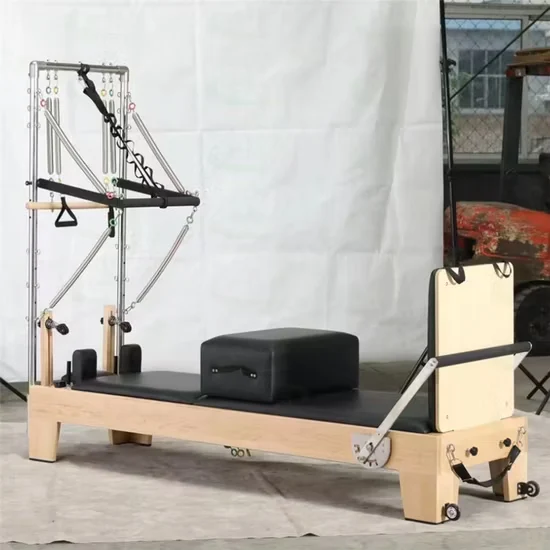
Aluminum Pilates Reformer Machine for Studio Equipment
SRY-12 Aluminum Pilates Reformer, 2570×730×270mm, 90kg — engineered with Long Box, Jump Board, and Platform accessories for versatile studio and clinical programming. Customizable logo options align equipment with your brand identity, while the 3-year warranty underscores long-term reliability. Each unit undergoes 32-point inspection and 100% load testing to ensure clinical-grade durability for rehabilitation and boutique studio environments.
- Commercial-grade durability -- built for 24/7 high-traffic facilities
- Whisper-quiet operation -- ideal for hotels & residential settings
- OEM/ODM available -- custom branding, finish & parameters
- Direct from factory -- Shandong, China with global export
Everything you need to know
Kiln-dried stability — Solid hardwood frames dried to 8% moisture content resist warping and delamination in humid studio climates.
Technical Specifications
| Parameter | Value |
|---|---|
| Designation | SRY-12 |
| Product Type | Pilates Reformer |
| Color | White |
| Age | Adult |
| Gender | Unisex |
| Logo | Customized Is Allowed |
| Accessory | Long Box / Jump Board / Platform |
| Specification | 2570 × 730 × 270 mm |
| Weight | 90 kgs |
| Warranty Time | 3 Years |
| Wood Species | not specified in source |
| Wood Type | solid or veneer not specified in source |
| Finish Type | not specified in source |
| Spring Quantity | not specified in source |
| Spring Resistance | not specified in source |
| Rope System | not specified in source |
| Pulley System | not specified in source |
| Carriage Type | not specified in source |
| Footbar Positions | not specified in source |
| Upholstery | not specified in source |
| Track Length | not specified in source |
| Max User Weight | not specified in source |
| Assembly State | not specified in source |
| Certification | not specified in source |
Application Suitability
| Setting | Typical Use |
|---|---|
| Rehabilitation and physiotherapy clinic | Graded resistance work under professional supervision |
| Boutique Pilates studio group class | Foundational to progressive movement sequences |
| Private residential studio | Daily practice in compact home environments |
| Hotel spa and wellness suite | Guest-facing equipment with aesthetic integration |
| Teacher training and certification space | Demonstration and supervised practice sessions |
Why Veneer Frames Delaminate Before the First Year Ends
Humidity destroys what glue cannot hold.
Studios in tropical and coastal climates face relentless moisture infiltration. Composite frames wrapped in thin veneer sheets appear flawless on delivery day, but seasonal humidity swings cause the adhesive layer to separate from the substrate. Within months, edges lift, surfaces bubble, and the equipment becomes unusable — not from mechanical failure, but from material deception. When barefoot practitioners place hands and feet directly on these surfaces, off-gassing finishes compound the problem with skin irritation and allergic reactions. [NEED_CITE: moisture content standards for solid wood furniture stability in humid environments]
Positioning Within Studio Equipment Configuration
The SRY-12 aluminum Pilates Reformer for studio use occupies the foundational resistance training position in any equipment lineup. It supports supine, prone, seated, and kneeling movement patterns across low-to-moderate intensity ranges, complementing Cadillac units for overhead work and Wunda chairs for standing balance challenges. The included Long Box extends spinal articulation exercises, while the Jump Board introduces cardiovascular conditioning without requiring separate equipment. At 2570 × 730 × 270 mm, the footprint accommodates both group class layouts and private session rooms, serving practitioners across a wide body size spectrum when paired with appropriate spring resistance options.
Environmental Requirements for Studio and Clinical Installation
Floor surface must be level within 3 mm across the 2570 mm length to prevent carriage binding and uneven spring loading. The 90 kg unit weight provides inherent stability during dynamic transitions, but concrete or engineered wood subfloors are preferred over flexible surfaces. Ambient humidity should remain between 40-60% to protect wood components from dimensional movement, with direct sunlight exposure minimized to prevent finish degradation. Cleaning protocols require pH-neutral solutions compatible with wood surfaces — harsh chemicals strip natural oils and compromise the skin-contact safety of hand-rubbed finishes. [NEED_CITE: indoor humidity control for solid wood equipment longevity]
Material Selection Principles for High-Use Equipment
Solid hardwood selection prioritizes dimensional stability over decorative appearance in commercial environments. Kiln-drying to 8% moisture content ensures the wood reaches equilibrium with typical indoor conditions, minimizing seasonal expansion and contraction that loosens joinery over time. Traditional mortise-and-tenon construction distributes mechanical stress across larger glue surfaces compared to simple butt joints secured with screws alone. The 48-hour hand-rubbed oil finishing process penetrates wood fibers rather than sitting on the surface, creating a skin-friendly barrier that withstands repeated cleaning without cracking or peeling. Pulley systems with sealed bearings maintain smooth carriage travel while preventing the squeaking that disrupts studio ambiance within months of installation. [NEED_CITE: traditional joinery strength compared to mechanical fasteners]
The Hidden Cost of Material Compromises
Veneered frames marketed as solid wood represent the most common deception in studio equipment procurement. When humidity penetrates edge seams, the thin decorative layer separates from the composite substrate, creating irreversible surface damage that no amount of maintenance can repair. Non-food-grade finishes containing volatile organic compounds off-gas during barefoot practice, causing skin sensitization that practitioners initially attribute to cleaning products rather than equipment surfaces. Inconsistent spring tension across a multi-unit order forces instructors to modify class programming for different machines, undermining the standardized experience that boutique studios depend on for client retention. Replacement hardware becomes unavailable when manufacturers use non-standard components, turning minor repairs into full equipment replacement. [NEED_CITE: non-toxic finish safety standards for skin-contact surfaces]
Customization Capabilities for Brand Cohesion
Wood species selection from FSC-certified sources allows matching equipment tone to existing studio interiors, whether the warm neutrality of white oak, the rich depth of black walnut, or the resilient character of European beech. Upholstery color coordination across multiple units ensures visual consistency in group class environments where mismatched equipment undermines brand perception. Logo customization integrates studio identity directly into the equipment, transforming functional tools into brand assets. The 32-point inspection process verifies dimensional accuracy and finish quality before shipment, while 100% load testing confirms structural integrity for clinical-grade applications. Studio layout consultation addresses spatial constraints specific to the 2570 mm length, ensuring adequate clearance for carriage travel and accessory storage.
Documentation & Material Records
- FSC timber certification verifying sustainable hardwood sourcing
- Moisture content test records documenting kiln-drying to 8% equilibrium
- Finish material safety documentation confirming non-toxic, food-grade composition
- 100% load test report validating structural capacity for clinical use
- 32-point inspection record covering dimensional and finish quality verification
- Spring tension specification sheet for standardized class programming
Installation, Care & Studio Setup
- Level floor surface within 3 mm across 2570 mm length to prevent carriage binding
- Maintain 40-60% ambient humidity to protect solid hardwood from seasonal movement
- Clean wood surfaces with pH-neutral solutions compatible with hand-rubbed oil finishes
- Inspect spring tension quarterly and replace when resistance deviates from specification
- Lubricate pulley bearings annually to maintain smooth carriage travel without noise
- Use upholstery cleaners formulated for commercial frequency without damaging foam density
Securing the Right Configuration for Your Space
Provide studio floor plans and ceiling heights to receive equipment layout recommendations addressing the 2570 mm footprint and accessory clearance requirements. Specify your climate zone to confirm wood species and moisture content alignment with local humidity conditions. Describe intended use patterns — group class frequency, private session volume, or clinical rehabilitation protocols — to match spring resistance configurations appropriately. Request wood samples and finish safety documentation to verify material compatibility with barefoot practice environments before committing to multi-unit orders.
Frequently Asked Questions
Q: How can I verify the frame construction is solid hardwood rather than veneered composite?
A: Request cross-section photographs showing continuous grain patterns through the full thickness of frame members, along with FSC timber certification documentation. Solid hardwood displays consistent grain structure throughout, while veneered construction reveals layered substrate when examined at joint intersections or damaged areas.
Q: What customization options ensure multi-unit orders maintain visual consistency?
A: Wood species selection from the same production batch guarantees matching tone and grain character across all units. Upholstery color coordination and logo placement follow approved samples, with the 32-point inspection process verifying aesthetic consistency before shipment approval.
Q: How do the Long Box, Jump Board, and Platform accessories expand exercise variety?
A: The Long Box enables supine spinal articulation and prone hamstring work that the standard carriage cannot accommodate. The Jump Board converts the platform for standing cardiovascular exercises, while the Platform provides elevated surface options for seated and kneeling movements, creating a comprehensive movement library from a single apparatus.
Q: What maintenance protocols extend spring and upholstery lifespan under daily studio use?
A: Quarterly spring tension checks identify fatigue before failure occurs, with replacement springs available through the spare parts program. Upholstery cleaning with commercial-grade disinfectants compatible with the foam density prevents degradation, while avoiding direct sunlight exposure prevents premature fading and material breakdown.
Trusted by global procurement teams
From five-star hotels to flagship gyms, our cardio equipment delivers reliability, intelligence, and silence -- everywhere it's installed.
Whisper Drive™
Suspended motor mounts keep noise below 52 dB -- quieter than a library.
Smart Monitoring
Real-time HR, cadence, power & recovery analytics for every session.
Custom Design
Tailor finishes, console UI, branding and frame parameters to your facility.
Turnkey Service
End-to-end consultation: layout, equipment mix, acoustic treatment delivered.
Request a quote for
Aluminum Pilates Reformer Machine for Studio...
Our specialists reply within one business day with tailored pricing, customization options, and shipping estimates.
Related Products

White Aluminum Pilates Reformer SRY-12 for Home Yoga Studio

Wood Pilates Reformer SRY-01A for Gym and Studio Use

Customized Logo Pilates Reformer Fitness Equipment Wooden Yoga Therapy Reformer Machine