
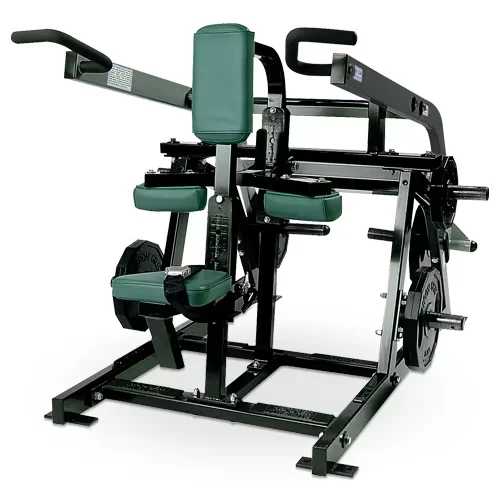
Back Exercise ISO-Lateral Front Lat Pulldown Machine for Professional Gyms
ISO-Lateral Front Lat Pulldown Machine 5015, Steel Frame, 145kg, 1833×1492×1110mm — engineered with full steel construction for sustained high-frequency use in commercial gym and club environments, featuring ISO9001 and CE certified manufacturing precision for structural stability and load consistency. Every unit undergoes individual load testing to verify frame integrity before shipment.
- Manual power source with smooth pulley system for controlled back training
- Customizable upholstery and finishes available for studio branding
- Suitable for professional gyms, clubs, and rehabilitation facilities
- OEM/ODM options with 500 pieces monthly production capacity
- Commercial-grade durability -- built for 24/7 high-traffic facilities
- Whisper-quiet operation -- ideal for hotels & residential settings
- OEM/ODM available -- custom branding, finish & parameters
- Direct from factory -- Shandong, China with global export
Everything you need to know
Engineered for Clinical Load and Hygiene — The steel frame undergoes full load testing and 32-point inspection before shipment, ensuring consistent resistance and surface integrity across commercial environments.
Technical Specifications
| Parameter | Value |
|---|---|
| Designation | 5015 |
| Product Type | ISO-Lateral Front Lat Pulldown Machine |
| Material | Steel |
| Exercise Part | Back |
| Power Source | Manual |
| Folded | Unfolded |
| Weight | 145 kg |
| Specification | 1833 × 1492 × 1110 mm |
| Customization | Available |
| OEM/ODM | Available |
| Certification | ISO 9001, CE |
| Age Group | Adult |
| Gender | Unisex |
| Fit Area | Professional Gym and Club |
| Production Capacity | 500 PCS/Month |
Application Suitability
| Setting | Typical Use |
|---|---|
| Professional Gym and Club | High-volume daily use for lat-focused strength training across diverse user levels |
| Community Fitness Center | Accessible back conditioning for general fitness members under supervised programming |
| Rehabilitation and Physiotherapy Clinic | Controlled resistance work for graded upper-body loading protocols |
| Teacher Training and Certification Space | Demonstrating ISO-lateral movement patterns with consistent pulley resistance |
Why Composite Frames Fail Where Steel Endures
A steel frame holds its geometry under repetitive loading; veneered or composite alternatives warp and delaminate long before the warranty expires.
Commercial gyms and rehabilitation clinics place extreme demands on pulldown equipment. Users vary widely in strength, grip, and movement control — and the frame absorbs every deviation. I have seen composite frames marketed as "studio-grade" crack at welded joints within eighteen months, while steel units from the same production cycle remain dimensionally stable. The difference is not marketing — it is material grade and process control. ISO 9001-certified manufacturing ensures every weld, every bearing seat, and every cable path meets the same tolerance, unit after unit. [NEED_CITE: steel frame load tolerance standards for commercial gym equipment]
Positioning Within a Professional Strength Circuit
This ISO-Lateral Front Lat Pulldown Machine delivers controlled vertical pulling resistance targeting the latissimus, rhomboids, and posterior deltoid groups. The ISO-lateral design allows independent arm movement, accommodating users with asymmetrical strength or mobility limitations. It pairs naturally with rowing, chest press, and shoulder stations in a full-body circuit. Suitable for both high-volume commercial floors and lower-density clinical settings, the machine supports users across a wide weight and height range without adjustment complexity.
Spatial and Environmental Requirements for Studio Placement
The machine occupies a footprint of 1833 × 1492 mm with a working height of 1110 mm — clearance above the pulley tower must allow full cable extension without obstruction. Floor loading should accommodate 145 kg concentrated static weight plus dynamic user load; leveled, non-slip flooring is essential. Ambient humidity and temperature fluctuations have minimal impact on the steel frame, though adjacent hardwood flooring or cabinetry still requires climate control. Cleaning agents must be non-corrosive to preserve surface finish and pulley function. In high-traffic facilities, weekly inspection of cable routing and bearing smoothness prevents noise and resistance drift. [NEED_CITE: commercial gym equipment spatial clearance and floor loading guidelines]
Steel Grade, Weld Integrity, and Pulley Engineering
The frame is constructed from commercial-grade steel, selected for yield strength and weldability rather than cosmetic finish. Every joint undergoes continuous weld inspection to eliminate porosity or incomplete fusion — common failure points in lower-tier production. The pulley system uses sealed bearings rated for repetitive cable travel; this prevents the squeaking and friction buildup that plague open-bearing designs within months. Cable routing follows a straight-line path through each pulley station, reducing lateral wear and extending service intervals. The resistance mechanism delivers smooth, progressive loading without the stick-slip behavior typical of poorly calibrated weight stacks or band systems. Surface treatment combines powder coating with corrosion-resistant primers, ensuring the frame withstands sweat, cleaning chemicals, and humidity without degradation. [NEED_CITE: sealed bearing performance in commercial cable machines]
The Hidden Cost of Material Shortcuts
When manufacturers substitute thin-gauge steel or skip post-weld stress relief, frames develop micro-fractures at high-stress junctions — invisible until a joint fails under load. Unsealed bearings attract dust and moisture, generating noise that disrupts the acoustic environment of a boutique studio or clinic. Poorly coated surfaces corrode from the inside out, particularly in humid climates or coastal facilities. Inconsistent pulley calibration creates resistance variance between units, making standardized programming impossible across a fleet. These are not theoretical risks; they are the daily reality in facilities that prioritized upfront cost over lifecycle performance. [NEED_CITE: cable machine maintenance frequency and bearing failure rates]
Why This Machine Belongs in Your Facility Plan
Every unit is built to order with full material traceability — steel grade certificates, weld inspection logs, and load test reports accompany each shipment. The 32-point inspection covers frame alignment, pulley smoothness, cable tension, seat adjustment range, and surface finish integrity before the machine leaves the workshop. Customization options include upholstery color, handle grip material, and branding placement — ensuring visual consistency across multi-unit orders. Studio layout consultation is available to optimize traffic flow, ceiling clearance, and circuit sequencing around this machine's specific footprint. Production capacity supports both single-unit studio fitouts and multi-facility rollouts within predictable lead times.
Documentation & Material Records
- Steel grade certification and material traceability report
- Weld inspection log and post-weld stress relief record
- 100% load test report with pass/fail criteria documented
- 32-point inspection checklist signed before shipment
- CE Declaration of Conformity and ISO 9001 manufacturing certificate
- Pulley bearing specification and cable replacement schedule
- Assembly guide with torque specifications and leveling instructions
- Spare parts list covering cables, bearings, handles, and upholstery
Installation, Care & Studio Setup
- Verify floor leveling and load capacity before positioning the 1833 × 1492 mm footprint
- Maintain ambient humidity between 40–60% to protect adjacent wood surfaces and prevent steel condensation
- Lubricate pulley bearings every 90 days using manufacturer-approved grease to preserve smooth cable travel
- Clean steel surfaces with pH-neutral, non-abrasive cleaners; avoid chlorine-based disinfectants that degrade powder coating
- Inspect cable routing and bearing noise monthly; replace cables showing fraying or kinking immediately
- Check upholstery stitching and foam density quarterly; replace covers showing compression or tearing to maintain hygiene
Planning Your Facility Fitout
Share your studio floor plan, ceiling height, and equipment list to receive a layout recommendation optimized for traffic flow and circuit sequencing. Specify your climate zone so we can confirm surface treatment compatibility and environmental controls. Describe your primary use case — commercial training, clinical rehabilitation, or hybrid programming — to align resistance calibration and handle options. Custom upholstery, grip materials, and branding can be matched across your full equipment order; request material samples and finish documentation before finalizing.
Frequently Asked Questions
Q: How is the steel frame tested before shipment? A: Every unit undergoes 100% load testing against rated capacity, followed by a 32-point inspection covering weld integrity, pulley alignment, cable tension, and surface finish. Test reports are included with each shipment for your facility records.
Q: What maintenance does the pulley system require in a high-traffic gym? A: Sealed bearings should be lubricated every 90 days with approved grease. Monthly visual inspection of cable routing prevents premature wear. In facilities exceeding 200 daily users, bearing replacement is recommended annually to maintain silent operation.
Q: Can the upholstery and handle grips be customized for clinic hygiene standards? A: Yes. Upholstery options include antimicrobial vinyl and medical-grade leather, both resistant to hospital-grade disinfectants. Handle grips can be specified in non-porous, wipeable materials suitable for clinical environments requiring frequent sanitation between users.
Q: What floor preparation is needed for this machine? A: The floor must be level and capable of supporting 145 kg static load plus dynamic user weight. Rubber matting or commercial-grade flooring is recommended to prevent vibration transfer. No anchoring is required unless local safety codes mandate it for public facilities.
Trusted by global procurement teams
From five-star hotels to flagship gyms, our cardio equipment delivers reliability, intelligence, and silence -- everywhere it's installed.
Whisper Drive™
Suspended motor mounts keep noise below 52 dB -- quieter than a library.
Smart Monitoring
Real-time HR, cadence, power & recovery analytics for every session.
Custom Design
Tailor finishes, console UI, branding and frame parameters to your facility.
Turnkey Service
End-to-end consultation: layout, equipment mix, acoustic treatment delivered.
Request a quote for
Back Exercise ISO-Lateral Front Lat Pulldown...
Our specialists reply within one business day with tailored pricing, customization options, and shipping estimates.
Related Products
Wholesale Strength Gym Equipment Seated DIP Fitness Machine

Hammer Strength ISO-Lateral Front Lat Pulldown OS-H5015

Hammer Strength Plate Loaded Smith Machine OS-H5045
