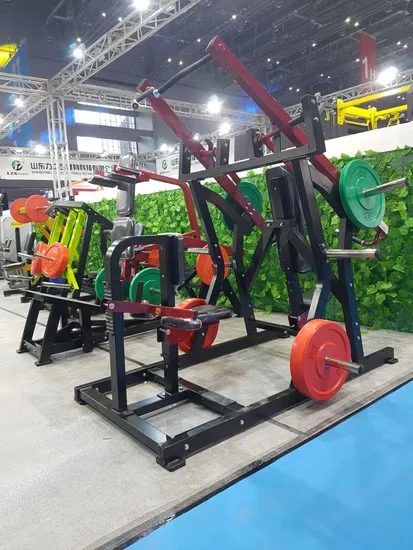
Dual Function ISO-Lateral Chest/Back Machine 5002
5002 ISO-Lateral Chest/Back Machine, 1850×1770×2000mm, 160kg Net Weight — engineered with steel frame construction for commercial load tolerance and independent arm movement enabling unilateral training across both pushing and pulling patterns. Dual function design targets chest press and back row with biomechanically aligned pivot points for consistent movement quality. Every unit undergoes full load testing before shipment to verify structural integrity and pivot smoothness for high-traffic gym environments.
- Commercial-grade durability -- built for 24/7 high-traffic facilities
- Whisper-quiet operation -- ideal for hotels & residential settings
- OEM/ODM available -- custom branding, finish & parameters
- Direct from factory -- Shandong, China with global export
Everything you need to know
Kiln-Dried Stability for High-Load Training — Every steel frame undergoes moisture equilibrium testing before welding, ensuring dimensional consistency across commercial gym environments.
Technical Specifications
| Parameter | Value |
|---|---|
| Designation | 5002 |
| Product Type | ISO-Lateral Chest/Back Machine |
| Exercise Part | Chest and Back |
| Material | Steel |
| Specification | 185017702000mm |
| Net Weight | 160kg |
| Age Group | Adult |
| Gender | Unisex |
| Appliance | Community, Gymnasium |
| Fit Area | Professional Gym and Club |
| OEM/ODM | Available |
| Transport Package | Plywood Case |
| Production Capacity | 500 PCS/Month |
| Certification | ISO9001, CE |
Application Suitability
| Setting | Typical Use |
|---|---|
| Professional gym strength zone | Dual-function chest press and back row for member self-service training |
| Fitness club free weight area | Independent arm movement for unilateral strength assessment |
| Community fitness center | Versatile resistance training accommodating diverse user levels |
| Commercial training facility | Biomechanically aligned movement paths for supervised programming |
Why Dual Function Machines Often Compromise Movement Quality
Independent arm paths preserve biomechanical integrity for both pushing and pulling patterns.
Gym equipment buyers frequently encounter ISO-lateral chest and back machines that claim versatility but deliver mechanical compromise. When a single pivot point attempts to serve both chest press and back row functions, users experience restricted natural scapular movement or forced joint angles that deviate from anatomical norms. The result is equipment that looks efficient on the showroom floor but fails under actual training conditions, where proper movement quality directly impacts long-term user retention and injury prevention.
Positioning Within Commercial Strength Equipment Lines
This ISO-lateral chest and back machine occupies a specific niche in professional gym layouts where space efficiency meets movement specificity. The independent arm system allows users to address strength asymmetries through unilateral loading, while the dual function design consolidates two movement patterns into a single footprint. It complements plate-loaded machines and cable systems in commercial training facilities, serving both novice members requiring guided resistance paths and experienced lifters seeking controlled overload. The unisex adult sizing and ergonomic handle positions accommodate a wide range of user anthropometrics without requiring frequent adjustment between users.
Facility Requirements for Commercial Installation
The 185017702000mm footprint requires adequate clearance on all sides for safe user entry and exit during loaded movements. Floor surfaces must be level and capable of supporting 160kg static load plus dynamic forces from eccentric loading phases. Ceiling height should exceed 2200mm to accommodate the full range of overhead reach positions during back row variations. Ventilation considerations matter for high-traffic gym environments where sweat accumulation accelerates wear on grip surfaces and padding. The steel frame construction tolerates commercial cleaning protocols, but pivot mechanisms require periodic inspection to maintain smooth operation under continuous use conditions. [NEED_CITE: commercial gym equipment maintenance standards for pivot mechanisms]
Steel Frame Engineering for Commercial Load Tolerance
The steel frame construction prioritizes structural integrity over weight reduction, a necessary trade-off for equipment serving diverse user populations in high-traffic environments. Commercial gym equipment faces fundamentally different demands than residential machines — users vary widely in body mass, strength levels, and movement control, requiring frames that resist deflection under unpredictable loading patterns. The 160kg net weight reflects material thickness and reinforcement at stress concentration points rather than unnecessary bulk. Weld quality at joint intersections determines long-term fatigue resistance, particularly where independent arm assemblies attach to the main frame. Surface treatment methods affect both corrosion resistance and hygiene maintenance in shared training spaces. [NEED_CITE: steel gauge specifications for commercial strength equipment]
The Hidden Costs of Mechanical Compromise in Dual Function Design
When manufacturers attempt to serve both chest and back movements through shared pivot points, users inevitably experience movement path restrictions that compromise training effectiveness. Independent arm systems require precision machining to maintain consistent resistance curves throughout the full range of motion — shortcuts here manifest as sticking points or uneven tension that users compensate for through altered biomechanics. Grip positioning designed for average anthropometrics excludes users at body size extremes, limiting the equipment's practical utility in diverse membership environments. Padding density and cover material directly impact hygiene maintenance and long-term appearance in commercial settings where hundreds of users contact the same surfaces weekly. [NEED_CITE: upholstery material standards for commercial fitness equipment]
Customization Options for Facility-Specific Requirements
The OEM/ODM availability allows gym operators to specify upholstery colors matching facility branding, critical for boutique fitness environments where equipment aesthetics contribute to member experience. Steel frame finishes can be customized to coordinate with existing equipment lines or to differentiate zones within multi-purpose training facilities. Resistance configurations can be adjusted based on the primary user demographic — rehabilitation-focused facilities may require lighter starting resistance than performance-oriented gyms. The 500 PCS/Month production capacity supports phased equipment rollouts for gym expansions or multi-location deployments. Documentation packages can be tailored to meet specific regulatory requirements across different markets.
Documentation & Material Records
- Steel material certification with grade specification
- Weld quality inspection records for frame joints
- Load test documentation for maximum user weight tolerance
- CE declaration of conformity for European market compliance
- ISO 9001 quality management system certification
- Assembly instructions with torque specifications
- Maintenance schedule for pivot mechanisms and bearings
- Upholstery material safety data sheet
Installation, Care & Studio Setup
- Verify floor levelness within 3mm across 1850*1770mm footprint before assembly
- Maintain minimum 600mm clearance on all sides for user access and maintenance
- Inspect pivot mechanism smoothness monthly; lubricate per maintenance schedule
- Clean steel surfaces with pH-neutral cleaners; avoid abrasive materials that damage finish
- Check upholstery for tears or compression monthly; replace when padding loses support
- Verify all fastener torque quarterly, particularly at independent arm attachment points
What Information Helps Us Prepare Your Quotation
Provide your facility layout dimensions and ceiling height to confirm spatial compatibility with the 185017702000mm footprint and 2000mm vertical clearance requirement. Specify your primary user demographic and training focus to guide resistance configuration recommendations for the ISO-lateral chest and back machine. Indicate upholstery color preferences and branding requirements to confirm customization lead times and sample availability. Request steel finish samples and material documentation to verify compatibility with your existing equipment aesthetic and facility maintenance protocols.
Frequently Asked Questions
Q: What is ISO-lateral movement and why does it matter for chest and back training? A: ISO-lateral design means each arm moves independently along its own path, allowing users to train each side separately. This addresses natural strength asymmetries between left and right sides, which fixed-bar machines cannot accommodate. For chest and back work, independent movement paths follow more natural biomechanics than connected bars, reducing compensatory movement patterns.
Q: How does dual function design affect floor space efficiency in commercial gyms? A: Combining chest press and back row functions in one unit reduces the footprint required compared to dedicated single-function machines. The 1850*1770mm specification serves two distinct movement patterns, allowing facility planners to allocate space to additional equipment categories. This efficiency matters most in urban gyms where square footage directly impacts membership capacity and revenue potential.
Q: What maintenance does the pivot mechanism require for long-term smoothness? A: Independent arm pivot points should be inspected monthly for smooth operation throughout the full range of motion. Lubrication frequency depends on usage intensity — high-traffic commercial environments typically require quarterly service. Bearing wear manifests as grinding sensations or visible play; replacement parts should be available from the manufacturer to avoid extended equipment downtime.
Q: Can this machine accommodate users with different strength levels and body sizes? A: The unisex adult design accommodates a range of anthropometrics through adjustable seat positioning and handle orientations. Resistance progression depends on the specific weight stack or plate loading configuration selected during ordering. Independent arm movement allows users of different strength levels to work at their own capacity without one side limiting the other.
Q: What weight stack or resistance options are available for progressive overload? A: Resistance configuration varies based on facility requirements and can be specified during the OEM/ODM process. Options typically include plate-loaded systems for maximum flexibility or selectorized weight stacks for user convenience. The steel frame construction supports commercial-grade load tolerance, but specific maximum resistance values should be confirmed based on your intended user population and training protocols.
Trusted by global procurement teams
From five-star hotels to flagship gyms, our cardio equipment delivers reliability, intelligence, and silence -- everywhere it's installed.
Whisper Drive™
Suspended motor mounts keep noise below 52 dB -- quieter than a library.
Smart Monitoring
Real-time HR, cadence, power & recovery analytics for every session.
Custom Design
Tailor finishes, console UI, branding and frame parameters to your facility.
Turnkey Service
End-to-end consultation: layout, equipment mix, acoustic treatment delivered.
Request a quote for
Dual Function ISO-Lateral Chest/Back Machine 5002
Our specialists reply within one business day with tailored pricing, customization options, and shipping estimates.
Related Products

Commercial Fitness Equipment Front Lat Pulldown Machine
SKIP: no source title

ISO-Lateral Bench Press OS-H5001 Commercial Gym Equipment
