SKIP: no source title
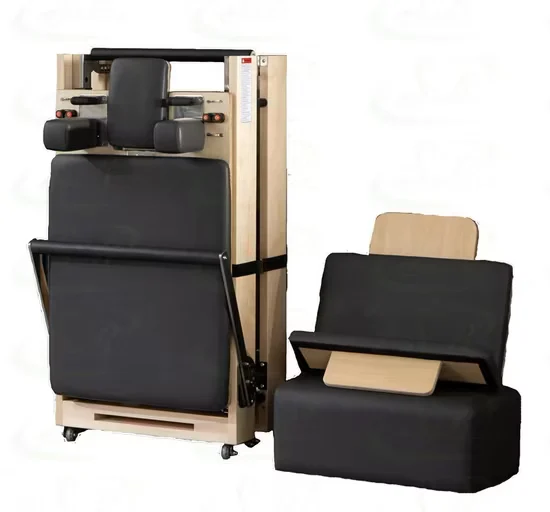
Senrui SRY-02 Maple Wooden Core Pilates Reformer, 2460×730×680mm, 100kg Weight, Long Box/Jump Board/Platform Included — kiln-dried hardwood frame with mortise-and-tenon joinery and surgical-grade hardware ensures dimensional stability under high-frequency studio use, while the non-toxic, food-safe oil finish remains skin-friendly for barefoot practice. Every unit undergoes 32-point inspection with 100% load testing before shipment.
- Commercial-grade durability -- built for 24/7 high-traffic facilities
- Whisper-quiet operation -- ideal for hotels & residential settings
- OEM/ODM available -- custom branding, finish & parameters
- Direct from factory -- Shandong, China with global export
Everything you need to know
Kiln-dried solid hardwood frames — each reformer undergoes 8% moisture stabilization and a 32-point inspection before shipment to ensure dimensional stability across studio environments.
Technical Specifications
| Parameter | Value |
|---|---|
| Designation | SRY-02 |
| Product Type | Pilates Reformer |
| Wood Species | not specified in source (source title states "Maple Wooden Core" — verify against manufacturer catalog) |
| Wood Type | solid or veneer not specified in source |
| Color | Solid Color |
| Logo | Customized Is Allowed |
| Accessory | Long Box / Jump Board / Platform |
| Specification | 2460 × 730 × 680 mm |
| Weight | 100 kgs |
| Warranty | 3 Years |
| Production Capacity | 80 Pieces/Month |
| Age | Adult |
| Gender | Unisex |
Application Suitability
| Setting | Typical Use |
|---|---|
| Rehabilitation and physiotherapy clinic | Graded resistance work under professional supervision, controlled movement protocols |
| Boutique Pilates studio group class | Full-body conditioning, reformer-based class programming for multiple participants |
| Private residential studio | Furniture-grade equipment for personal practice and low-frequency daily use |
| Hotel spa and wellness suite | Guest-facing equipment where aesthetics and durability define the brand experience |
| Teacher training and certification space | Standardized apparatus for instructor education and technique refinement |
Why Composite Frames Fail Before the First Anniversary
Solid hardwood kiln-dried to 8% moisture content eliminates the delamination and warping that veneered reformers develop within months of studio use.
Studios that purchased composite or veneered reformers marketed as solid wood frequently report frame separation within the first humid season. The adhesive bond between veneer layers and substrate weakens under repeated temperature and humidity cycling, producing visible bubbling along rail edges and joint lines. A maple wood pilates reformer built from solid hardwood avoids this failure mode entirely — the wood moves as a single mass, and proper kiln drying locks in dimensional stability before any joinery is cut [NEED_CITE: moisture content standards for solid wood furniture stability].
Positioning Within a Studio Equipment Lineup
The Pilates Reformer serves as the foundational apparatus in most studio configurations, supporting exercises that target core stabilization, controlled spinal articulation, and progressive resistance training across the full body. It pairs directly with the Cadillac for overhead spring work and with the Wunda Chair for seated and standing resistance variations. Group class setups typically deploy four to eight units in parallel rows, while private studio configurations may place a single unit alongside a spine corrector and ladder barrel. The 2460 × 730 mm working footprint accommodates users across a wide height and limb-length range, with adjustable footbar positions and spring configurations allowing instructors to modify resistance without swapping equipment.
Environmental Requirements for Studio and Clinic Placement
Floor surfaces must be level within 3 mm across the full 2460 mm track length to prevent carriage drag and uneven spring loading. The 100 kg frame weight provides inherent stability, but the floor structure must support dynamic loads from jumping board work and high-frequency spring cycling. Ambient relative humidity should remain between 40% and 60% — environments outside this range accelerate wood movement and may affect carriage glide tolerance over time [NEED_CITE: indoor humidity guidelines for solid wood equipment longevity]. Cleaning agents used on the frame must be compatible with natural oil finishes; alkaline or solvent-based cleaners will degrade the surface and compromise the skin-safe coating. Adjacent space planning should account for the full carriage travel path and the lateral clearance needed for long box and jump board accessories.
Material and Construction Logic Behind the Frame
The frame of this Pilates Reformer is constructed from solid hardwood selected for load-bearing capacity and long-term dimensional stability. Kiln drying to 8% moisture content ensures the wood reaches equilibrium before machining, reducing the risk of post-production warping, cupping, or joint separation in climates with seasonal humidity swings. Traditional mortise-and-tenon joinery reinforced with surgical-grade hardware distributes repetitive spring loads across the full frame depth rather than concentrating stress at single bolt points — a structural choice that meaningfully extends service life under daily studio use. The 48-hour hand-rubbed natural oil finish penetrates the wood surface rather than forming a topical film, producing a skin-friendly, non-toxic coating that resists sweat and studio cleaning agents without off-gassing irritants. Carriage glide depends on pulley and track precision; consistent bearing quality prevents the squeaking and friction buildup that disrupts quiet studio environments within months of installation [NEED_CITE: hardwood selection criteria for load-bearing fitness equipment].
The Hidden Cost of Material Shortcuts
Veneered frames bonded with standard wood glue begin to separate at joint lines when studio humidity rises above 65%, producing visible delamination that no amount of surface refinishing can repair. Frames dried to incorrect moisture content — above 12% — continue to shrink after assembly, opening mortise gaps and loosening hardware that was torqued to specification at the factory. Non-toxic, food-safe finishes matter in reformer practice because bare skin contacts the frame continuously during footwork, kneeling, and supine exercises; coatings containing volatile organic compounds create irritation risks in enclosed studio environments. Spring sets manufactured without batch-matched tension calibration produce inconsistent resistance across multi-unit orders, making standardized class programming unreliable. Pulley housings built from non-precision castings develop play within months, generating noise that travels through open studio floors and compromises the quiet atmosphere clients expect.
Why Customize Through This Workshop
Every reformer frame is built from FSC-certified solid hardwood kiln-dried to 8% moisture content, with documentation provided to verify timber origin and stabilization records. Traditional mortise-and-tenon joinery paired with surgical-grade hardware ensures structural integrity under clinical-grade load tolerance requirements. The 48-hour hand-rubbed natural oil finish is certified non-toxic and food-safe, appropriate for barefoot, close-contact practice environments. Each unit undergoes 100% load testing and a 32-point inspection before shipment, with full documentation available for clinic and studio compliance records. Wood species, upholstery color, and logo placement are fully customizable across multi-unit orders, ensuring visual consistency when outfitting an entire studio floor. The workshop also provides full studio design consultation covering equipment layout,器械 mix, and brand identity alignment for the 2460 × 730 mm reformer footprint.
Documentation & Material Records
- FSC timber certification confirming chain of custody for hardwood stock
- Kiln-dried moisture content record showing 8% equilibrium at time of machining
- Finish material safety documentation confirming non-toxic, food-safe, skin-friendly certification
- 100% load test report with pass/fail record for each individual unit
- 32-point inspection record covering joinery, hardware, glide, and finish quality
- CE declaration of conformity for European market placement
- Spring tension specification sheet for batch-matched resistance calibration
- Assembly and care guide with climate-specific maintenance recommendations
Installation, Care & Studio Setup
- Verify floor levelness within 3 mm across the 2460 mm track length before assembly to ensure smooth carriage glide
- Maintain studio relative humidity between 40% and 60% to protect solid hardwood frame dimensional stability
- Reapply natural oil finish every 12 to 18 months depending on usage frequency and cleaning agent compatibility
- Inspect spring tension and pulley alignment quarterly; replace springs in matched sets to preserve resistance consistency
- Clean frame surfaces with pH-neutral, non-solvent cleaners compatible with the hand-rubbed oil finish
- Use only manufacturer-specified replacement upholstery and hardware to maintain load-rated structural integrity
Starting Your Studio or Clinic Inquiry
Share your studio floor plan, ceiling height, and intended equipment layout to receive a space planning recommendation covering reformer placement and accessory configuration. Specify your climate zone so the workshop can confirm wood species and moisture content suitability for your environment. Indicate whether the reformer will serve group classes, private instruction, or rehabilitation settings to align spring resistance and accessory selections with your programming needs. Custom wood tone, upholstery color, and logo requests can be confirmed with sample swatches and finish safety documentation before production begins.
Frequently Asked Questions
Q: How can I confirm the reformer frame is solid hardwood and not veneered composite? A: Request the FSC timber certification and kiln-dried moisture content record from the manufacturer. Solid hardwood frames show continuous grain across all exposed surfaces and joint faces, with no visible edge banding or layered substrate. The moisture content documentation should confirm 8% equilibrium at the time of machining, which is the standard for dimensional stability in solid wood fitness equipment.
Q: What wood species options are available for the reformer frame? A: The workshop offers multiple FSC-certified hardwood species including white oak, black walnut, European beech, and Burmese teak. Each species differs in hardness, grain pattern, natural color tone, and moisture resistance. White oak provides high strength and a light, clean tone suited to bright studio interiors, while black walnut offers richer color and dimensional stability. The workshop can provide sample swatches for color and grain comparison before order confirmation.
Q: How does 8% moisture content prevent warping in different climates? A: Kiln drying to 8% moisture content brings the wood to equilibrium before any joinery is cut, meaning the frame has already completed its primary shrinkage cycle. In environments with seasonal humidity swings between 40% and 60%, properly dried solid hardwood expands and contracts minimally, preserving joint tightness and carriage track alignment. Frames dried to higher moisture levels continue to move after assembly, opening mortise gaps and creating visible separation at joint lines over time.
Q: Is the surface finish safe for barefoot, skin-contact practice? A: The reformer frame receives a 48-hour hand-rubbed natural oil finish that is certified non-toxic, food-safe, and skin-friendly. Unlike polyurethane or lacquer coatings that form a surface film, penetrating oil finishes do not off-gas volatile organic compounds after curing. The finish resists sweat, studio cleaning agents, and repeated barefoot contact without degrading, and can be locally refreshed without full refinishing if surface wear appears over years of use.
Q: How is spring tension standardized across a multi-unit studio order? A: Each spring set is calibrated in matched batches, and the manufacturer provides a spring tension specification sheet documenting resistance values for every spring in the order. This ensures that reformers placed side by side in a group class setting deliver identical resistance at each spring clip position. Replacement springs should be ordered from the original manufacturer to maintain batch-matched calibration across the studio fleet.
Trusted by global procurement teams
From five-star hotels to flagship gyms, our cardio equipment delivers reliability, intelligence, and silence -- everywhere it's installed.
Whisper Drive™
Suspended motor mounts keep noise below 52 dB -- quieter than a library.
Smart Monitoring
Real-time HR, cadence, power & recovery analytics for every session.
Custom Design
Tailor finishes, console UI, branding and frame parameters to your facility.
Turnkey Service
End-to-end consultation: layout, equipment mix, acoustic treatment delivered.
Request a quote for
SKIP: no source title
Our specialists reply within one business day with tailored pricing, customization options, and shipping estimates.
Related Products

Foldable Aluminum Pilates Reformer for Home Use

White Wood Pilates Reformer Commercial Home Portable Folding Bed

Studio Body Core Training Equipment Pilates Reformers