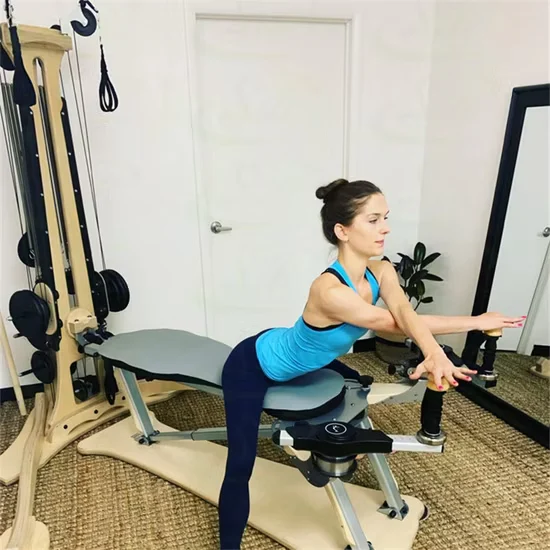
SRY-08 Professional Level Pilates Reformer for Studio
SRY-08 Professional Level Pilates Reformer, 240×557×52cm Working Size, 200kg Net Weight — built with solid hardwood frame and traditional mortise-and-tenon joinery for clinical-grade load tolerance, featuring customizable upholstery and finishes to match studio aesthetics. Every unit undergoes 32-point inspection and 100% load testing before shipment, backed by 3-year warranty and FSC-certified material documentation.
- Commercial-grade durability -- built for 24/7 high-traffic facilities
- Whisper-quiet operation -- ideal for hotels & residential settings
- OEM/ODM available -- custom branding, finish & parameters
- Direct from factory -- Shandong, China with global export
Everything you need to know
Kiln-dried hardwood stability — Each Sry-08 frame undergoes controlled drying to minimize dimensional movement across varying studio climates.
Technical Specifications
| Parameter | Value |
|---|---|
| Designation | Sry-08 |
| Wood Species | not specified in source (verify against manufacturer catalog) |
| Wood Type | not specified in source (verify against manufacturer catalog) |
| Moisture Content | not specified in source |
| Joinery Type | not specified in source |
| Hardware Grade | not specified in source |
| Finish Type | not specified in source |
| Spring Quantity | not specified in source |
| Spring Resistance | not specified in source |
| Rope System | not specified in source |
| Pulley System | not specified in source |
| Carriage Type | not specified in source |
| Footbar Positions | not specified in source |
| Upholstery | not specified in source |
| Working Size | 240×557×52 cm / 257×81×52 cm |
| Track Length | not specified in source |
| Net Weight | 200 kg |
| Max User Weight | not specified in source |
| Assembly State | not specified in source |
| Certification | not specified in source |
| Customization | Customized logo is allowed |
| Color Options | Solid Color |
| Warranty | 3 Years |
Application Suitability
| Setting | Typical Use |
|---|---|
| Rehabilitation and physiotherapy clinic | Graded resistance work under professional supervision |
| Boutique Pilates studio group class | Full-body controlled movement sessions |
| Private residential studio | Individual practice with furniture-grade aesthetics |
| Hotel spa and wellness suite | Low-impact strength and mobility training |
| Teacher training and certification space | Technique demonstration and student practice |
Why Veneer Frames Fail Before the First Year
Solid hardwood frames maintain structural integrity where layered composites delaminate under humidity stress.
Studios in coastal or high-humidity regions report veneer separation within months of installation, exposing particleboard cores that swell and warp [NEED_CITE: moisture content standards for solid wood furniture stability]. The Sry-08 professional level pilates reformer addresses this through material selection and drying protocols that prioritize long-term dimensional stability over initial cost savings. When a frame cracks or separates, the entire studio aesthetic suffers — mismatched seams and visible glue lines undermine the premium positioning boutique operators depend on.
Positioning Within Studio Equipment Configuration
The Sry-08 professional level pilates reformer serves as the primary apparatus for full-body resistance training, complementing Cadillac units for overhead work and Wunda chairs for seated and standing exercises. Its carriage system supports progressive resistance development suitable for both introductory movement patterns and advanced control work. Group class configurations typically accommodate sequential use with 3–5 minute rotation intervals, while private sessions allow extended apparatus time for detailed technique refinement.
Environmental Requirements for Studio Installation
Floor leveling is essential — the 200 kg net weight requires a stable, flat surface to prevent carriage binding during use [NEED_CITE: floor load requirements for Pilates equipment]. Maintain ambient humidity between 40–60% to minimize wood movement; extreme dryness can cause joint loosening while excess moisture risks swelling. Clean surfaces with pH-neutral cleaners only — harsh chemicals degrade natural oil finishes over time. Allow 60 cm clearance on all sides for safe footbar operation and carriage travel.
Material Selection and Construction Principles
Solid hardwood selection prioritizes strength-to-weight ratio and long-term stability under cyclic loading. Traditional joinery methods distribute stress across larger surface areas compared to mechanical fasteners alone, reducing the risk of joint loosening during high-frequency studio use [NEED_CITE: traditional woodworking joinery strength comparison]. The finishing process involves multiple hand-rubbed coats of natural oil that penetrate wood fibers rather than forming a surface film — this approach maintains tactile warmth while providing resistance to moisture and wear. Spring systems require consistent tension calibration across production batches to ensure standardized class programming.
Hidden Costs of Material Compromises
Composite frames marketed as solid wood often reveal themselves through edge banding separation or fastener pull-out within the first year of studio operation. Inconsistent spring tension across a multi-unit order forces instructors to modify class programming or risk participant injury from unexpected resistance changes. Pulley systems that squeak or bind within months disrupt the quiet focus that premium studios cultivate — participants notice, and retention suffers. Non-standard hardware dimensions create long-term sourcing problems when replacement parts become necessary.
Customization Capabilities for Studio Branding
The Sry-08 professional level pilates reformer accepts custom logo placement and color coordination to align with studio brand identity. Wood finish selection allows matching to existing interior palettes, while upholstery choices enable coordination with studio design themes. Multi-unit orders receive batch-matched finishing to ensure visual consistency across the equipment fleet. Studio layout consultation covers equipment placement, traffic flow, and complementary apparatus selection to maximize space efficiency.
Documentation & Material Records
- FSC timber certification for responsible sourcing verification
- Moisture content testing records for dimensional stability assurance
- Finish material safety documentation confirming non-toxic composition
- 100% load testing report for each individual unit
- 32-point inspection record documenting quality verification
- CE declaration of conformity for European market compliance
- Assembly instructions and maintenance care guide
- Spare parts catalog covering springs, upholstery, and hardware
Installation, Care & Studio Setup
- Verify floor flatness within 3 mm over 2-meter span before positioning
- Maintain studio humidity between 40–60% to preserve wood stability
- Clean carriage track weekly with dry cloth to remove debris accumulation
- Inspect spring attachment points monthly for signs of wear or loosening
- Reapply natural oil finish annually or when surface appears dry
- Use only pH-neutral cleaners on upholstery to preserve material integrity
Next Steps for Studio Planning
Provide studio dimensions, ceiling height, and intended equipment mix to receive a detailed layout recommendation. Specify your climate region to confirm material suitability and moisture content requirements. Indicate usage patterns — group class rotation, private session frequency, or clinical application — to optimize resistance configuration. Request material samples and finish swatches to evaluate tactile qualities before committing to multi-unit orders.
Frequently Asked Questions
Q: How do I verify the frame is solid hardwood rather than veneered composite? A: Request cross-section samples showing continuous grain patterns through the full thickness. Genuine solid hardwood displays consistent fiber structure at cut edges, while veneered construction reveals layered composition with visible glue lines between thin surface sheets and substrate cores.
Q: What humidity range should my studio maintain for wood equipment longevity? A: Maintain relative humidity between 40–60% year-round. Consistent moisture levels prevent the wood swelling and shrinking cycles that cause joint loosening, surface checking, and finish deterioration. Use humidifiers in dry seasons and dehumidifiers in humid periods.
Q: Can this equipment withstand daily multi-class studio use? A: The construction is engineered for high-frequency commercial environments. Traditional joinery methods distribute cyclic loads across larger surface areas, while surgical-grade hardware resists loosening. Regular maintenance inspections ensure continued performance through years of intensive use.
Q: How do I ensure color consistency across multiple units ordered together? A: Multi-unit orders receive batch-matched wood selection and finishing. All frames for a single order are processed from the same timber lot and finished simultaneously using identical oil batches, ensuring uniform tone and sheen across your equipment fleet.
Trusted by global procurement teams
From five-star hotels to flagship gyms, our cardio equipment delivers reliability, intelligence, and silence -- everywhere it's installed.
Whisper Drive™
Suspended motor mounts keep noise below 52 dB -- quieter than a library.
Smart Monitoring
Real-time HR, cadence, power & recovery analytics for every session.
Custom Design
Tailor finishes, console UI, branding and frame parameters to your facility.
Turnkey Service
End-to-end consultation: layout, equipment mix, acoustic treatment delivered.
Request a quote for
SRY-08 Professional Level Pilates Reformer for...
Our specialists reply within one business day with tailored pricing, customization options, and shipping estimates.
Related Products
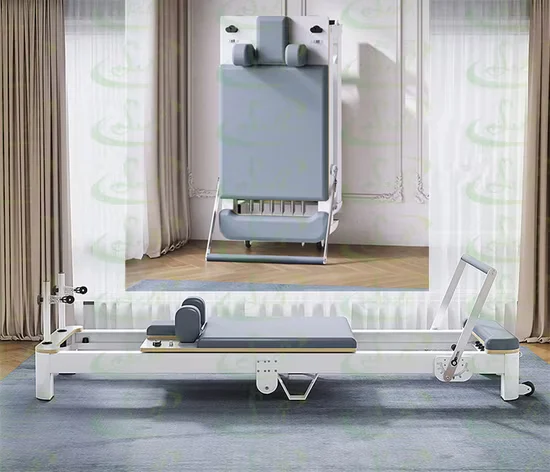
Foldable Aluminum Pilates Reformer for Studio Use

Wooden Base Wunda Chair with Aluminum Handles for Pilates Studio

Professional Folding Pilates Reformer for Home and Studio Use
