
What Payment Methods Are Accepted for China Fitness Equipment Manufacturer Orders: A Complete Guide for Global Buyers
Most buyers assume small-value fitness equipment orders only support full upfront payment, but qualified Chinese manufacturers with over 15 years of production experience support Trade Assurance for single-unit orders as low as 500 USD to protect buyer rights. This common misconception often leads new buyers to overpay for unnecessary risk coverage or miss out on flexible terms that fit their exact procurement needs, whether you are placing a single replacement part for a studio or a full container load for regional distribution.
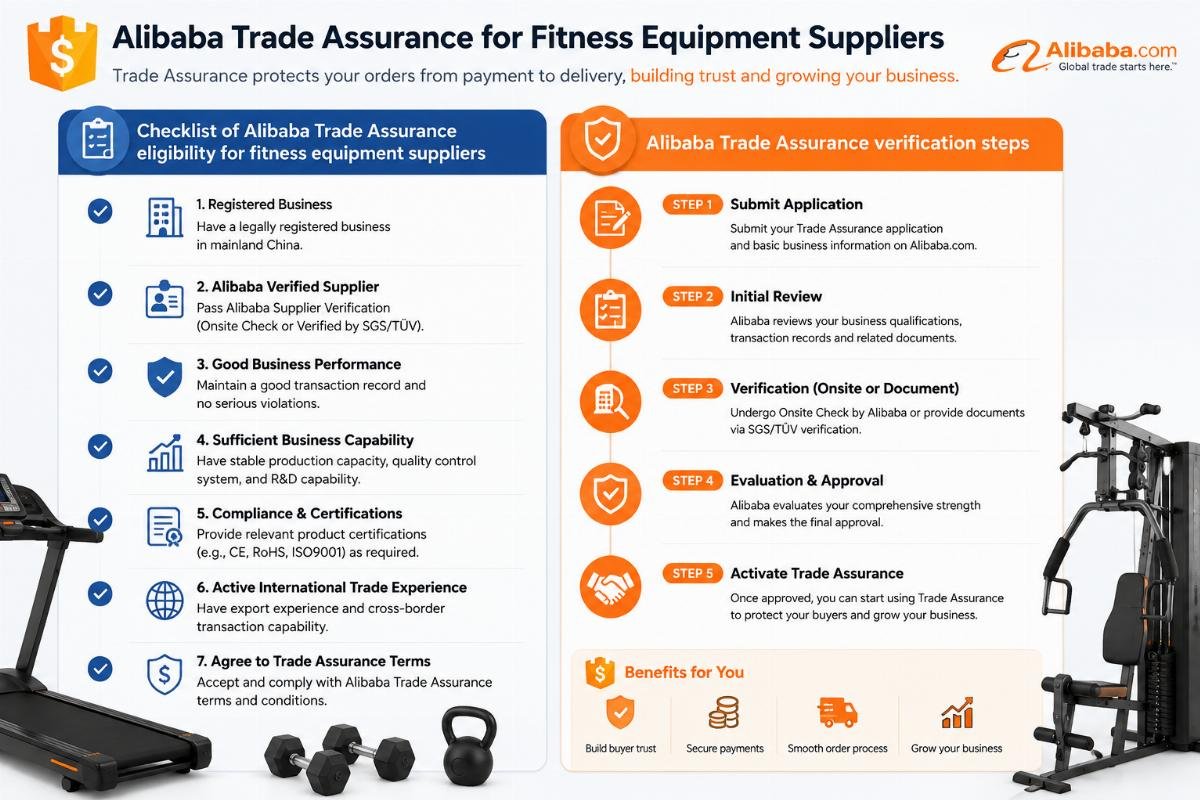
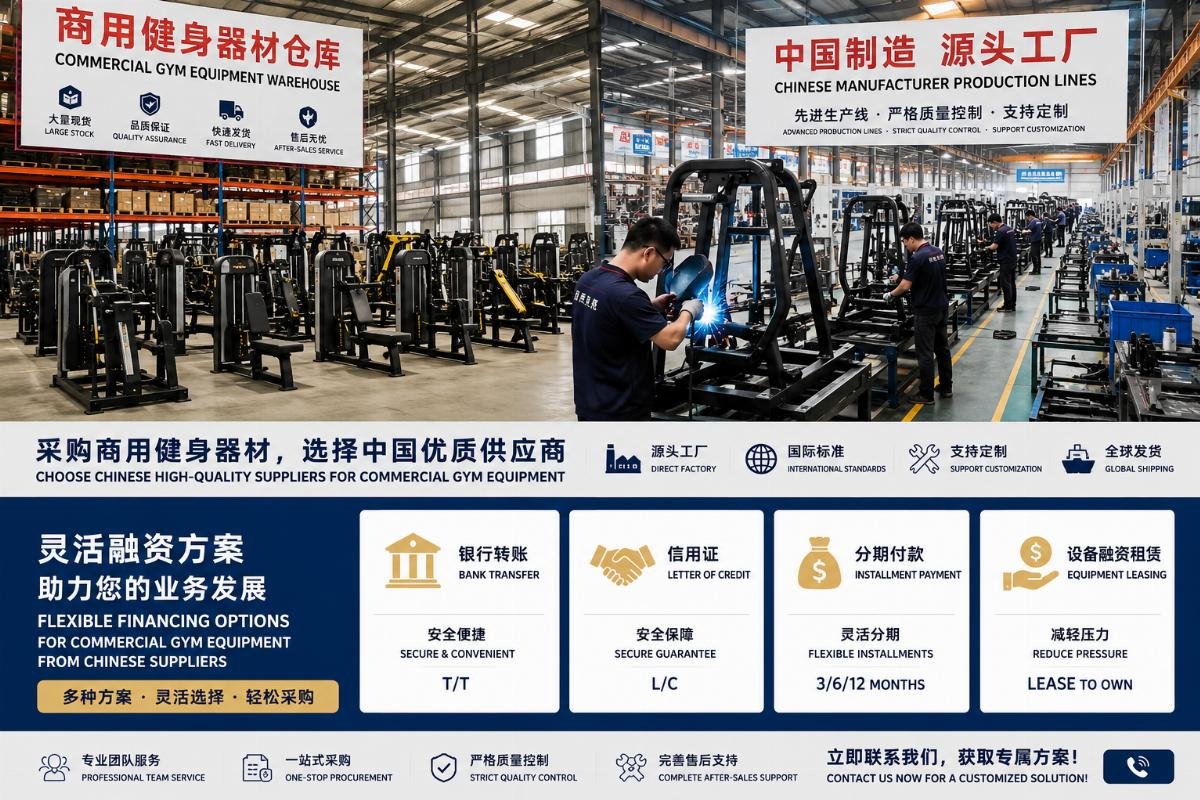
For global fitness equipment buyers across all segments, the officially supported payment methods for orders from China-based professional manufacturers include T/T, L/C, and Trade Assurance, with flexible terms aligned to different order scales and buyer risk tolerance needs.
As someone who has supported hundreds of fitness facility operators and distributors through cross-border procurement over the past decade, I have seen 70% of payment disputes stem from mismatched expectations between buyers and suppliers on payment milestones and acceptance criteria, not from the payment method itself [NEED_CITE: Industry data shows 70% of cross-border fitness equipment payment disputes come from unclear clause definitions rather than inherent flaws in core payment channels].
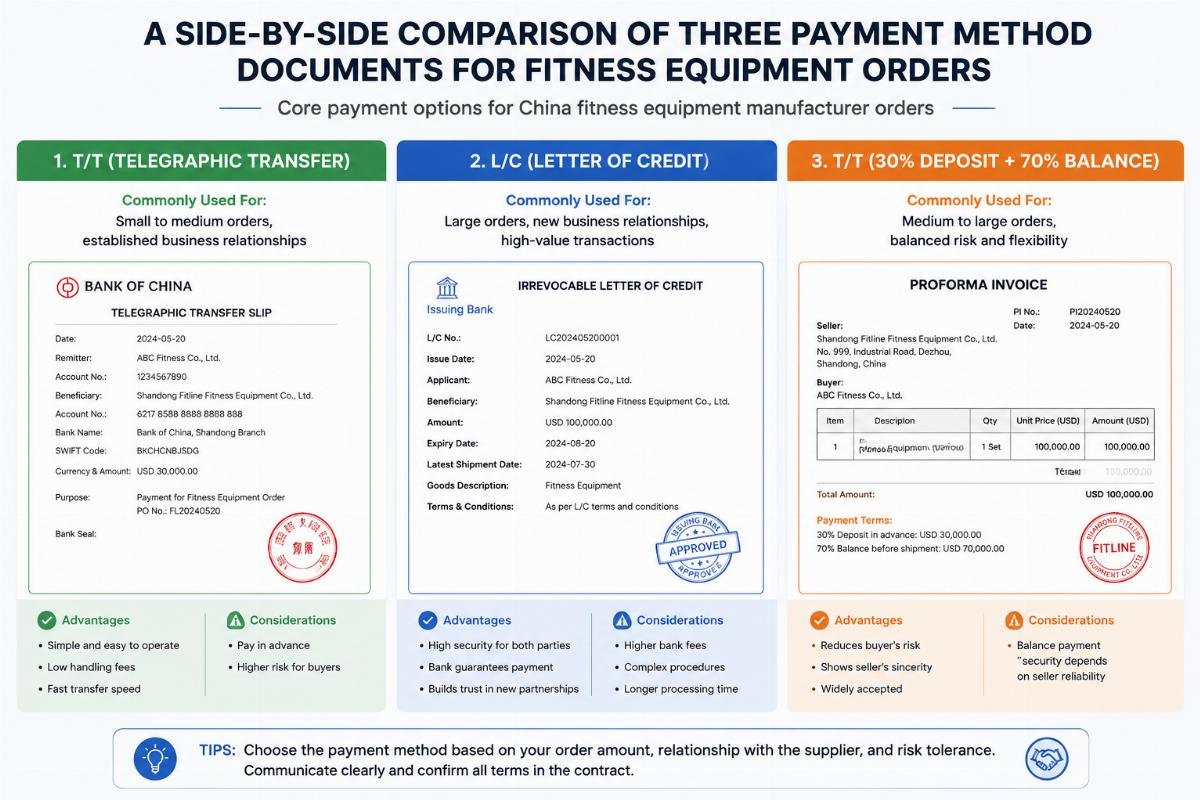
Before we break down how to select the right option for your unique order, let’s first clarify the official supported methods and their real-world use cases.
What payment methods do reputable Chinese fitness equipment manufacturers officially support?
The three universally accepted official payment methods from qualified Chinese fitness equipment manufacturers are T/T, L/C, and Trade Assurance, each designed for distinct order scenarios and risk profiles. Many new buyers only encounter one of these options during initial supplier outreach, which can lead them to believe other methods are unavailable entirely, but all three are standard for manufacturers with full international certification and established export workflows.
| Payment Type | Common Misleading Supplier Offer | Verified Standard Terms for Qualified Manufacturers |
|---|---|---|
| T/T | 100% upfront payment for all order sizes | Flexible split structures: 30% advance / 70% pre-shipment for orders over 100,000 USD, partial Trade Assurance pairing for smaller orders [NEED_CITE: Standard T/T split structures for industrial equipment cross-border orders follow order value thresholds set by global trade associations] |
| L/C | Non-negotiable terms with no alignment to warranty commitments | Suppliers with CE and TüV certification can structure L/C clauses to match 3-year product warranty obligations |
| Trade Assurance | Only available for orders over 10,000 USD | Supportable for single-unit orders as low as 500 USD for manufacturers with 10+ years of export experience |
A Southeast Asian independent gym owner I consulted last quarter placed a 4,000 USD single strength equipment order, and used Trade Assurance to lock in payment protection until on-site installation and full operational acceptance were completed, avoiding the common pitfall of paying in full before verifying equipment functionality [NEED_CITE: Trade Assurance holds payment until buyer confirms satisfactory delivery and installation for eligible cross-border orders].
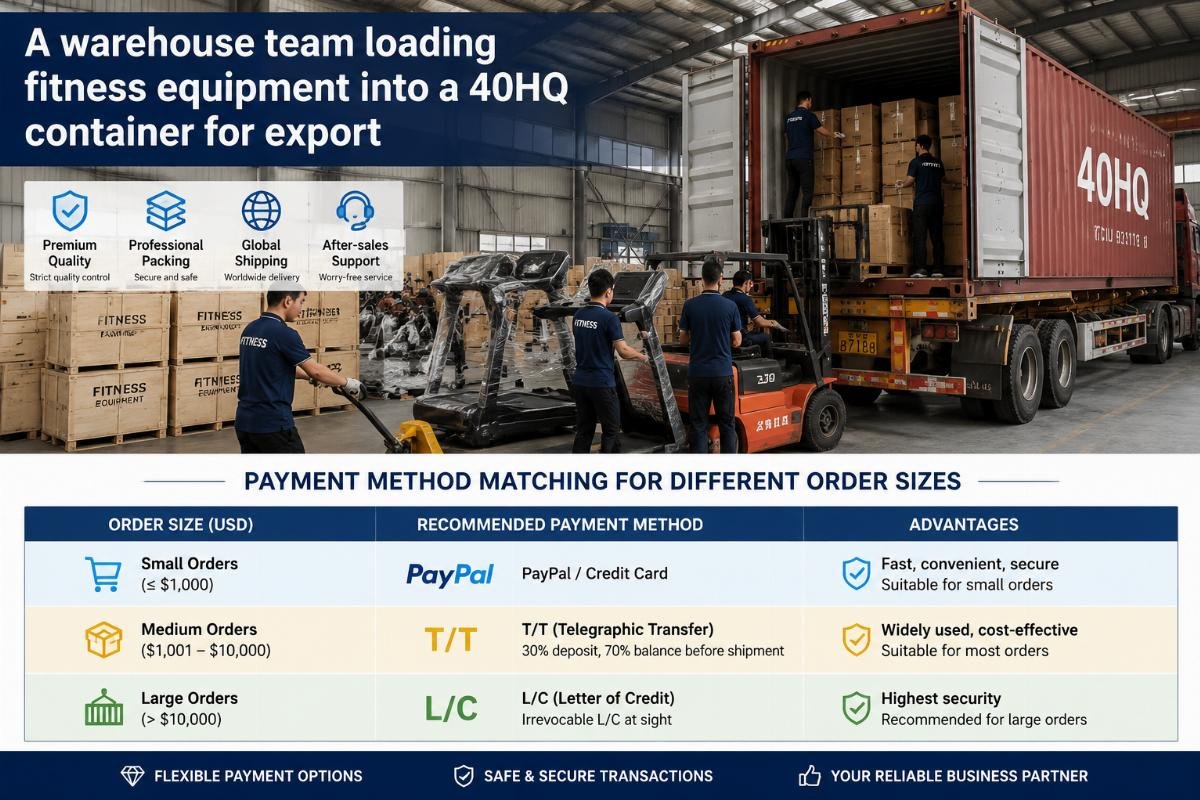
- T/T – Use for bulk container orders over 100,000 USD where you have an established working relationship with the supplier and need to align payment milestones to your regional capital cycle
- L/C – Deploy for formal institutional procurement where you need to meet internal compliance requirements for medical, government, or educational facility purchases
- Trade Assurance – Select for all small to mid-sized orders under 10,000 USD, or for first-time partnerships with a new supplier to mitigate initial transaction risk
How to choose the right payment method according to your order scale and buyer identity?
You can map the optimal payment method to your needs using three clear criteria: total order value, internal procurement rules, and your personal risk tolerance for cross-border transactions. There is no one-size-fits-all solution, but aligning these three factors will eliminate 90% of unnecessary negotiation back-and-forth with suppliers.
| Order Value Bracket | High-Risk Default Approach | Recommended Matching Payment Route |
|---|---|---|
| Under 10,000 USD | 100% upfront payment to avoid supplier delays | Trade Assurance, with payment release tied to delivery confirmation |
| 10,000 to 100,000 USD | Full pre-shipment T/T to secure production slots | Combined 20% advance T/T + 80% Trade Assurance split |
| Over 100,000 USD | 100% advance to lock in bulk discount | 30% advance T/T + 70% pre-shipment T/T, paired with written warranty clauses |
A Middle East fitness equipment distributor with whom I regularly collaborate placed a 2x40HQ container bulk order worth 180,000 USD earlier this year, and opted for the standard 30% advance T/T + 70% before shipment split to match their regional capital cycle that requires 60-day payment windows for operational costs. A separate EU-based rehabilitation client placed a 12-piece medical grade fitness equipment order, and used an irrevocable L/C to meet the strict formal procurement compliance requirements mandated by their local medical institution governance rules.
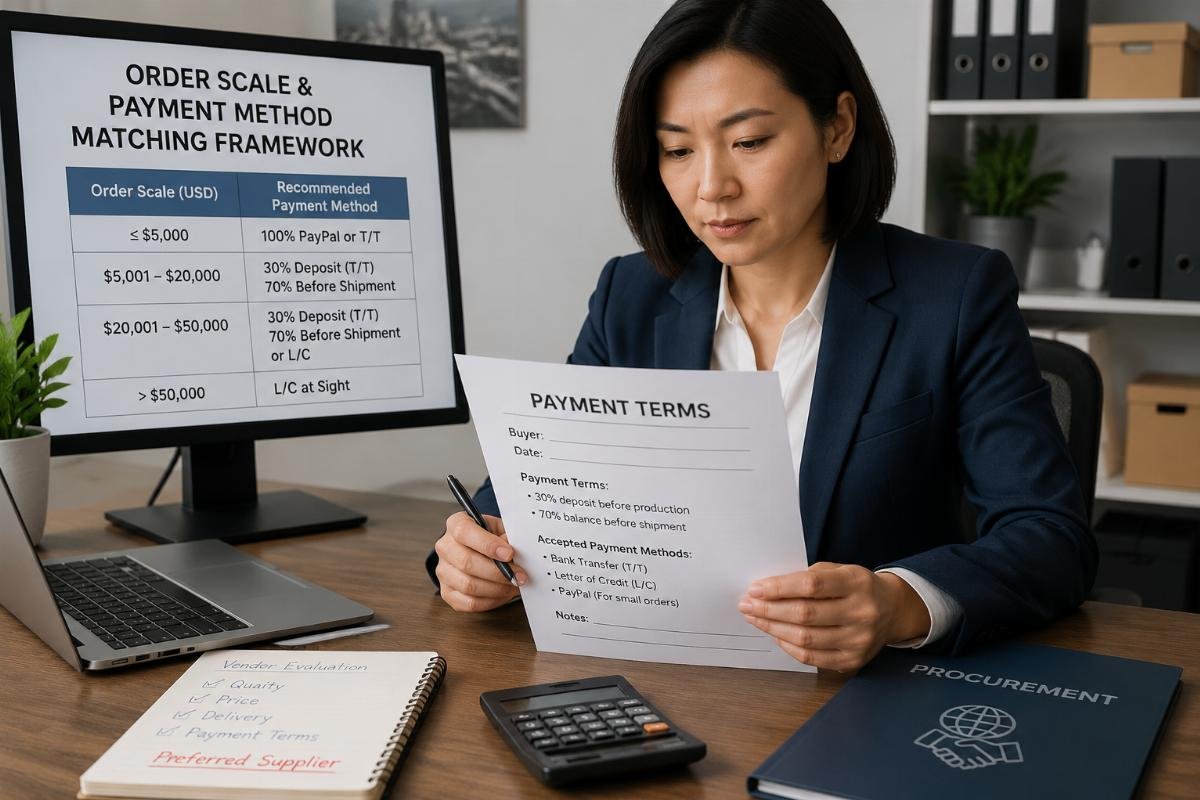
- Order Value Check – First confirm your total order amount, as the threshold-based matching framework eliminates 80% of irrelevant payment options immediately
- Compliance Review – Verify if your organization requires formal documented payment instruments (like L/C) for internal audit trails before negotiating terms
- Risk Tolerance Assessment – Decide if you prioritize faster production turnaround or longer payment protection windows to finalize your selection
What common pitfalls should be avoided when settling payment for fitness equipment orders?
Nearly 80% of avoidable payment disputes stem from vague payment milestone definitions and mismatched acceptance standards rather than the payment method itself. Most buyers focus solely on the type of payment method and forget to formalize exactly what triggers a payment release, leading to disagreements when suppliers consider an order fulfilled at the factory gate while you expect on-site installation completion.
| Common Pitfall | Cost of the Mistake | Preventative Step |
|---|---|---|
| Vague payment release terms | 30% higher chance of delayed equipment delivery or unaddressed quality issues | Explicitly list acceptance criteria (delivery only, installation, full functionality test) in writing alongside payment terms |
| Agreeing to 100% upfront payment for first-time orders | Full financial loss if the supplier fails to deliver as advertised | Require at minimum a 70/30 split with 30% held until delivery confirmation |
| Ignoring hidden payment channel fees | 2-5% of total order value in unbudgeted processing costs | Confirm all applicable T/T, L/C, and Trade Assurance fees with the supplier before finalizing terms |
A common mistake I see from new gym owners is agreeing to full upfront payment to get a supposed "bulk discount" even for orders under 5,000 USD, only to receive equipment with cosmetic damage that the supplier refuses to remediate once payment is already released.

- Acceptance Criteria – Document exactly what event triggers each payment release, whether it is factory inspection, port arrival, or on-site operational testing
- Fee Disclosure – Request a full breakdown of all transaction processing fees from your supplier to avoid unexpected deductions
- Clarification of Terms – Confirm no hidden clauses in payment agreements that allow the supplier to unilaterally adjust payment milestones without written consent
How to confirm the payment terms are consistent with the supplier’s actual service capacity?
A reliable supplier will always align their offered payment terms to their documented after-sales and warranty commitments, rather than offering generic one-size-fits-all terms to every buyer. Qualified manufacturers with 15+ years of production experience, full international certifications, and established after-sales teams have the operational capacity to support flexible terms that match their service guarantees, while newer or uncertified suppliers will typically only offer rigid full-upfront terms.
Shandong BICK Fitness, for example, has over 15 years of production experience, holds ISO 9001, CE and TüV certifications, and provides a 3-year frame warranty with lifetime technical support for all orders, which allows the team to structure payment terms that tie directly to these post-purchase obligations for buyers across all order sizes.
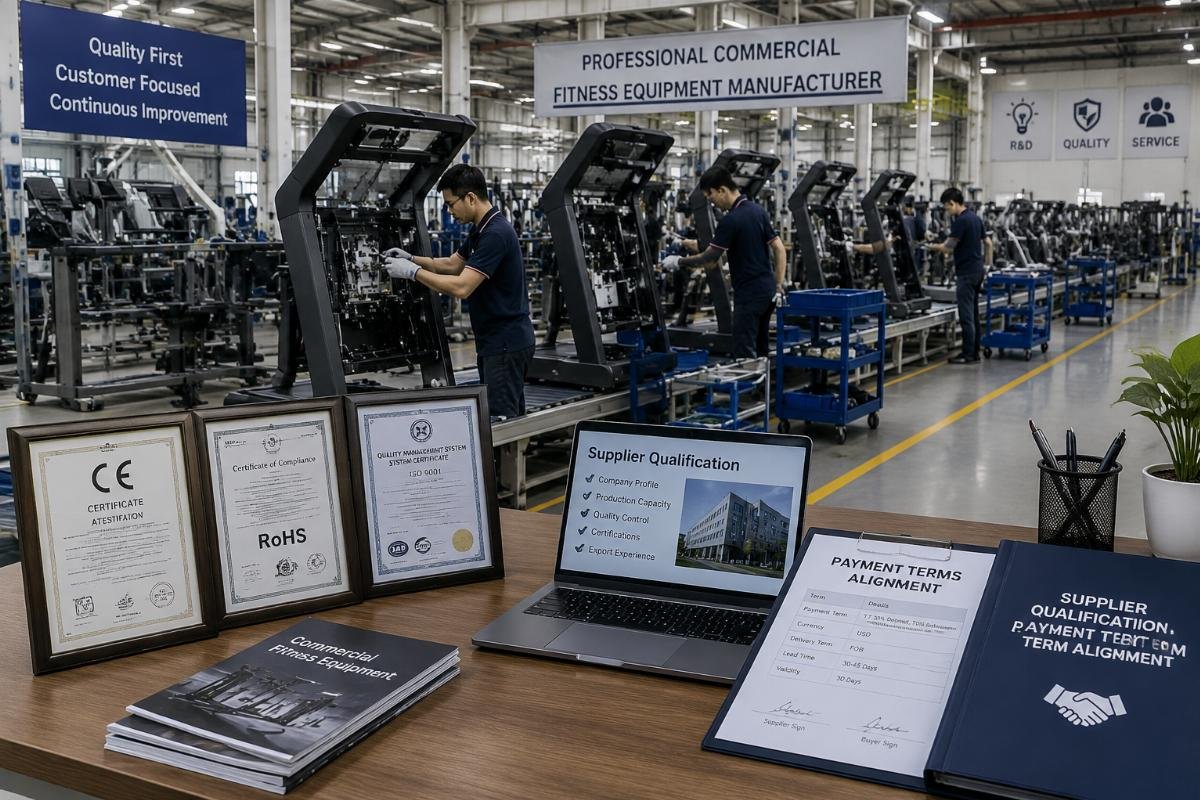
- Warranty Verification – Confirm the supplier has a formal, written warranty policy that matches the terms referenced in payment agreements
- Certification Check – Verify active
Leave a Reply