
Commercial Pilates Reformer with White Aluminum Alloy for Studio and Home
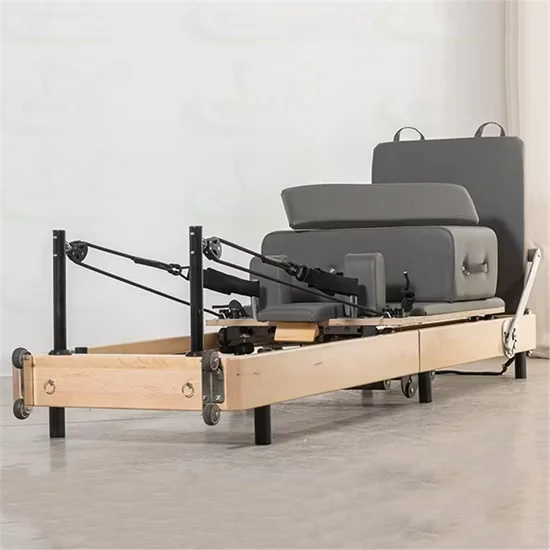
SRY-12 Commercial Pilates Reformer, 2570×730×270mm, 90kg — built for studio and home use with customizable branding and included long box, jump board, and platform accessories. Backed by 3-year warranty and full studio design support. Each unit undergoes rigorous quality control ensuring consistent performance across multi-unit orders.
- Kiln-dried hardwood construction with mortise-and-tenon joinery for dimensional stability
- Non-toxic, skin-friendly finish suitable for barefoot practice
- Precision pulley system for quiet operation in boutique environments
Every reformer ships with FSC timber certification, moisture content records, and 32-point inspection documentation.
- Commercial-grade durability -- built for 24/7 high-traffic facilities
- Whisper-quiet operation -- ideal for hotels & residential settings
- OEM/ODM available -- custom branding, finish & parameters
- Direct from factory -- Shandong, China with global export
Everything you need to know
Kiln-dried hardwood stability — Solid hardwood frames resist warping and cracking when moisture content is controlled to 8% before construction, ensuring dimensional integrity across varying studio climates.
Technical Specifications
| Parameter | Value |
|---|---|
| Designation | SRY-12 |
| Product Type | Pilates Reformer |
| Color | White |
| Wood Species | not specified in source |
| Wood Type | solid or veneer not specified in source |
| Finish Type | not specified in source |
| Spring Quantity | not specified in source |
| Spring Resistance | not specified in source |
| Pulley System | not specified in source |
| Carriage Type | not specified in source |
| Footbar Positions | not specified in source |
| Upholstery | not specified in source |
| Working Size | 2570 × 730 × 270 mm |
| Net Weight | 90 kg |
| Accessory | Long Box / Jump Board / Platform |
| Customization | Logo customized is allowed |
| Warranty | 3 Years |
| Certification | not specified in source |
Application Suitability
| Setting | Typical Use |
|---|---|
| Boutique Pilates studio | Daily group classes and private sessions requiring consistent resistance and quiet operation |
| Rehabilitation and physiotherapy clinic | Controlled movement work under professional supervision with clinical-grade load tolerance |
| Private residential studio | Furniture-grade equipment complementing interior design while supporting regular practice |
| Hotel spa and wellness suite | Premium apparatus meeting aesthetic and durability expectations for guest use |
Why Veneer Frames Fail Before the First Year of Studio Use
Composite or veneered constructions marketed as solid wood delaminate when humidity fluctuates, compromising both appearance and structural safety.
Many commercial reformers arrive looking pristine in showroom photos, but the layered adhesives beneath thin wood veneers cannot withstand the moisture cycles of a working studio. Sweat, ambient humidity from showers, and seasonal climate shifts cause the veneer to lift at stress points — particularly along the carriage rail and shoulder rest mounts. Once delamination begins, the frame loses rigidity, springs shift alignment, and the equipment becomes unsafe for loaded exercises. A commercial pilates reformer for studio and home use must be built from solid hardwood throughout, not wrapped in a decorative skin that peels away under real conditions. [NEED_CITE: moisture content standards for solid wood furniture stability]
Positioning Within a Studio Equipment Lineup
This reformer serves as the foundational apparatus for both group reformer classes and one-on-one sessions, supporting a full range of resistance-based movement patterns from gentle mobilization to high-load strength work. The 2570 mm working length accommodates users across a wide height range, while the 90 kg net weight provides sufficient mass to remain stable during dynamic transitions. In a studio configuration, it pairs with Cadillac or Wunda chair units to create a complete movement library. The included Long Box, Jump Board, and Platform accessories expand exercise variety without requiring additional floor space. A commercial pilates reformer for studio and home use should integrate seamlessly into both high-frequency teaching schedules and lower-volume private practice settings.
Environmental Requirements for Installation and Longevity
The 2570 × 730 mm footprint requires a minimum ceiling height of 2400 mm to allow full footbar elevation and standing work without obstruction. Floor surfaces must be level within 3 mm across the apparatus length to prevent carriage binding and uneven spring wear. Solid hardwood frames respond to ambient humidity — maintaining indoor relative humidity between 40% and 60% prevents wood movement that can affect carriage alignment and pulley function. Cleaning agents must be pH-neutral and non-solvent to protect the surface finish; harsh chemicals degrade both wood and upholstery over time. In high-usage studio environments, the reformer should be positioned away from direct sunlight and HVAC vents to minimize thermal and moisture cycling. [NEED_CITE: indoor humidity range for solid wood equipment preservation]
Material and Construction Principles Behind Studio-Grade Equipment
When wood species is not specified, the baseline expectation is solid hardwood kiln-dried to 8% moisture content — this threshold minimizes expansion and contraction across seasonal humidity changes. Traditional mortise-and-tenon joinery, reinforced with surgical-grade hardware, distributes load across the frame structure rather than concentrating stress at bolt points. This construction method maintains rigidity under repetitive loading, preventing the frame flex that causes carriage wobble and spring misalignment. Spring systems should feature matched sets with clearly graded tension levels, enabling instructors to progress resistance predictably across class sequences. Pulley assemblies with precision bearings eliminate the squeaking that disrupts the quiet focus of a reformer class. Surface finishes applied through hand-rubbed natural oils — non-toxic and skin-friendly — matter for barefoot practice where skin contact is constant and prolonged. [NEED_CITE: traditional joinery methods for high-load wood furniture]
The Hidden Cost of Material Shortcuts
Veneered frames begin showing separation at joint lines within months of studio use, particularly in humid climates or spaces with underfloor heating. Moisture content above 10% at time of manufacture leads to progressive warping that throws carriage tracks out of alignment, causing binding and premature wheel wear. Non-food-safe finishes off-gas volatile compounds during barefoot work, creating skin irritation and respiratory discomfort for clients in close-contact positions. Unmatched spring sets produce inconsistent resistance across units in the same studio, making standardized class programming impossible and creating safety gaps during rehabilitation protocols. Pulley systems using non-precision bearings develop noise within weeks, destroying the calm atmosphere that boutique studios depend on for client retention.
Why Source This Reformer from Biketon Life
Every SRY-12 unit undergoes FSC-certified hardwood selection with kiln-drying verified to 8% moisture content before construction begins. Traditional mortise-and-tenon joinery reinforced with surgical-grade hardware ensures the 2570 mm frame maintains rigidity under daily studio loads. The 48-hour hand-rubbed natural oil finish is non-toxic, food-safe, and skin-friendly — appropriate for barefoot, close-contact practice. Each reformer passes 100% load testing with a 32-point inspection before shipment, documented in provided records. Logo customization and finish options ensure multi-unit orders maintain visual consistency across your studio environment. Full studio design service covers layout planning, equipment mix recommendations, and brand identity integration for the SRY-12 within your complete apparatus lineup.
Documentation & Material Records
- FSC timber certification confirming sustainable hardwood sourcing
- Moisture content record verifying kiln-drying to 8% before construction
- Finish material safety documentation confirming non-toxic, food-safe coatings
- 100% load test report documenting structural integrity verification
- 32-point inspection record covering all critical assembly checkpoints
- Spring tension specification sheet for resistance grading reference
- Assembly and care guide with maintenance schedules
- Spare parts and upholstery replacement list for long-term serviceability
Installation, Care & Studio Setup
- Verify floor levelness within 3 mm across the 2570 mm length before assembly to prevent carriage binding
- Maintain indoor humidity between 40-60% to protect solid hardwood from seasonal movement
- Clean surface with pH-neutral, non-solvent products only to preserve the hand-rubbed oil finish
- Inspect spring tension and carriage wheel function monthly in high-usage studio environments
- Use manufacturer-approved upholstery cleaners that resist disinfectant degradation without damaging material
- Schedule annual hardware torque check to maintain joint rigidity under repetitive loading
Requesting a Quote and Studio Consultation
Provide your studio floor plan, ceiling height, and intended equipment layout to receive space planning guidance for the SRY-12 within your complete apparatus configuration. Specify your climate zone and typical indoor humidity range to confirm wood species and moisture content suitability for your environment. Indicate whether the reformer will serve group classes, private sessions, or clinical rehabilitation settings to align spring resistance and accessory recommendations. Share your branding requirements including logo placement, wood finish preference, and upholstery color to confirm customization lead time and sample availability.
Frequently Asked Questions
Q: How can I verify that a commercial reformer uses solid hardwood rather than veneered or composite construction?
A: Request FSC timber certification and moisture content records from the manufacturer. Solid hardwood frames show consistent grain patterns across all surfaces, including interior joint areas, while veneered constructions reveal layered edges at cut points. Ask for documentation confirming kiln-drying to 8% moisture content, which indicates proper preparation for dimensional stability. Manufacturers using genuine solid hardwood provide these records as standard practice and welcome factory inspections to verify construction methods.
Q: What surface finish options ensure safety for barefoot, skin-contact practice without off-gassing concerns?
A: Look for hand-rubbed natural oil finishes that carry non-toxic, food-safe certification suitable for prolonged skin contact. These finishes penetrate the wood rather than forming a surface film, eliminating volatile compound release during use. Request finish material safety documentation from the manufacturer confirming the coating meets skin-contact standards. Avoid reformers with lacquer or polyurethane finishes in barefoot practice environments, as these can off-gas and create slippery surfaces when warm.
Q: How are spring tension and resistance levels standardized across multi-unit orders for consistent class programming?
A: Manufacturers should provide spring tension specification sheets showing graded resistance levels for each spring in the set. Matched spring sets ensure every reformer in a studio delivers identical resistance at the same extension point, enabling standardized exercise progressions. Request documentation confirming that springs are tested and paired before shipment. Consistent spring performance across units prevents safety gaps during group classes where instructors cue based on uniform resistance expectations.
Q: What maintenance practices extend the service life of a solid hardwood reformer in high-frequency studio use?
A: Maintain indoor humidity between 40-60% to prevent wood movement that affects carriage alignment. Clean surfaces with pH-neutral products only, avoiding solvents that degrade natural oil finishes. Inspect carriage wheels and pulley bearings monthly, replacing worn components before they cause track damage. Schedule annual hardware torque checks to maintain joint rigidity. Follow the manufacturer's care guide for re-oiling cycles appropriate to your climate and usage intensity.
Trusted by global procurement teams
From five-star hotels to flagship gyms, our cardio equipment delivers reliability, intelligence, and silence -- everywhere it's installed.
Whisper Drive™
Suspended motor mounts keep noise below 52 dB -- quieter than a library.
Smart Monitoring
Real-time HR, cadence, power & recovery analytics for every session.
Custom Design
Tailor finishes, console UI, branding and frame parameters to your facility.
Turnkey Service
End-to-end consultation: layout, equipment mix, acoustic treatment delivered.
Request a quote for
Commercial Pilates Reformer with White Aluminum...
Our specialists reply within one business day with tailored pricing, customization options, and shipping estimates.
Related Products
Foldable Core Training Bed Fold Black Wood Pilates Reformer

Yoga Training Pilates Equipment Maple Wood Cadillac Reformer Bed

Pilates Balancing Ladder Barrel for Gym Fitness Center and Home
