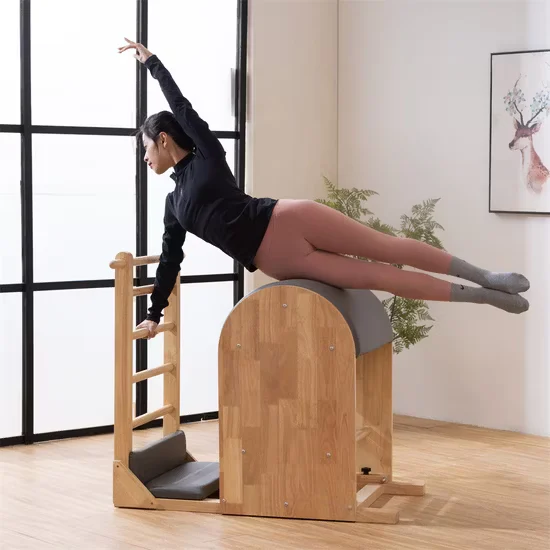
White Maple Wood Folding Pilates Reformer for Gym Yoga Equipment
Senrui SRY-20B Maple Wood Pilates Reformer, 2400×600×350mm, 100kg Net Weight — solid hardwood frame with customizable finish options and folding capability, equipped with long box, jump board, and platform accessories for versatile training applications. Built for Pilates studios, rehabilitation clinics, and private wellness spaces with 3-year warranty coverage. Each unit undergoes rigorous quality assurance with full documentation provided upon request.
- Commercial-grade durability -- built for 24/7 high-traffic facilities
- Whisper-quiet operation -- ideal for hotels & residential settings
- OEM/ODM available -- custom branding, finish & parameters
- Direct from factory -- Shandong, China with global export
Everything you need to know
Kiln-Dried Hardwood Stability — Solid hardwood frames dried to 8% moisture content resist warping and joint separation in climate-variable studio environments.
Technical Specifications
| Parameter | Value |
|---|---|
| Designation | SRY-20B |
| Brand | Senrui |
| Product Type | Pilates Reformer |
| Wood Species | not specified in source (verify against manufacturer catalog) |
| Wood Type | solid or veneer not specified in source |
| Moisture Content | not specified in source |
| Joinery Type | not specified in source |
| Hardware Grade | not specified in source |
| Finish Type | not specified in source |
| Spring Quantity | not specified in source |
| Spring Resistance | not specified in source |
| Rope System | not specified in source |
| Pulley System | not specified in source |
| Carriage Type | not specified in source |
| Footbar Positions | not specified in source |
| Accessory | Long Box / Jump Board / Platform |
| Working Size | 2400 × 600 × 350 mm |
| Net Weight | 100 kg |
| Color | Solid Color |
| Logo | Customized is allowed |
| Warranty | 3 Years |
| Certification | not specified in source |
| Folding Feature | mentioned in title only — verify against manufacturer catalog |
Application Suitability
| Setting | Typical Use |
|---|---|
| Rehabilitation and physiotherapy clinic | Controlled resistance exercises under professional supervision for graded movement protocols |
| Boutique Pilates studio group class | Full-body conditioning with adjustable spring resistance for multi-level participants |
| Private residential studio | Low-impact strength and flexibility training for individual daily practice |
| Hotel spa and wellness suite | Guest-facing equipment requiring quiet operation and furniture-grade appearance |
| Teacher training and certification space | Instructional demonstrations with clear equipment response and consistent spring behavior |
Why Veneer Frames Fail Where Solid Hardwood Endures
A studio environment demands material honesty — not just aesthetic appeal.
Composite or veneered frames marketed as solid wood delaminate within months in humid studio conditions. Sweat, ambient moisture, and repeated cleaning accelerate edge separation, leaving学员 exposed to rough substrate and compromising structural integrity [NEED_CITE: moisture content standards for solid wood furniture stability]. Finishes that off-gas or contain irritants become problematic during barefoot, skin-contact practice — especially when practitioners lie prone or press bare skin against rails for extended periods. A properly kiln-dried hardwood frame with food-safe, skin-friendly finish eliminates these failure modes from day one.
Equipment Positioning Within Studio Configuration
This Pilates reformer serves as the foundational apparatus for most studio programming, supporting exercises ranging from gentle mobilization to high-resistance strength work. Its adjustable spring system accommodates beginners through advanced practitioners, while the carriage platform accepts multiple accessory configurations. In a typical studio layout, it pairs with Cadillac or Wunda chair stations to create comprehensive movement circuits. The footprint suits both private instruction rooms and group class floors, with capacity for diverse body types across multiple daily sessions.
Spatial and Environmental Requirements for Studio Installation
The 2400 × 600 × 350 mm working envelope requires clear floor space on all sides for safe carriage travel and accessory attachment. Floor surfaces must be level and capable of supporting concentrated point loads without deflection. Ambient humidity should remain within 40-60% RH to prevent wood movement; HVAC systems in humid climates must maintain consistent conditions year-round [NEED_CITE: indoor climate control for solid wood equipment longevity]. Cleaning agents must be compatible with the surface finish — harsh solvents degrade natural oil coatings over time. High-traffic studios should anticipate upholstery replacement every 18-24 months under intensive daily use.
Material Selection and Construction Principles
Solid hardwood frames provide dimensional stability unmatched by engineered alternatives when properly processed. Kiln-drying to 8% moisture content ensures the wood reaches equilibrium with typical indoor environments, minimizing seasonal expansion and contraction. Traditional mortise-and-tenon joinery distributes mechanical stress across larger surface areas compared to bolted-only connections, reducing loosening under repetitive loading. Surgical-grade hardware resists corrosion from sweat and cleaning agents. The 48-hour hand-rubbed natural oil finish penetrates wood fibers rather than forming a surface film, creating a skin-friendly, non-toxic barrier that remains safe for direct contact during barefoot practice [NEED_CITE: food-safe finish standards for skin-contact fitness equipment].
Hidden Costs of Material Compromises
Veneer overlays delaminate at edges when moisture infiltrates substrate joints, requiring complete frame replacement rather than simple refinishing. Frames built with insufficient moisture content control warp under studio humidity fluctuations, causing carriage misalignment and uneven track wear. Non-food-safe finishes emit volatile compounds during heated sessions, triggering respiratory irritation for sensitive practitioners. Inconsistent spring tension across units forces instructors to mentally compensate for equipment variation, disrupting standardized class programming. Pulley assemblies using non-sealed bearings develop audible squeaks within months, degrading the quiet atmosphere studios depend on for focused instruction.
Customization Capabilities for Studio Branding
Each reformer accepts custom logo placement and color matching to align with studio identity systems. Wood species selection allows coordination with existing interior palettes — white oak for light, contemporary spaces; black walnut for warm, traditional aesthetics; European beech for high-load commercial applications. Upholstery customization extends to vinyl color and stitching detail. The 2400 mm working length accommodates taller practitioners without requiring oversized equipment footprints. Studio design consultation covers equipment mix, spatial flow, and brand-cohesive material selection across multiple units.
Documentation & Material Records
- FSC timber certification confirming sustainable hardwood sourcing
- Kiln-dried moisture content record verifying 8% target achievement
- Finish material safety documentation confirming non-toxic, food-safe, skin-friendly composition
- 100% load test report documenting structural integrity verification
- 32-point inspection record covering assembly and functional checks
- Spring tension specification sheet for consistent resistance calibration
- Assembly and care guide with maintenance schedule recommendations
- Spare parts and upholstery replacement list for long-term serviceability
Installation, Care & Studio Setup
- Verify floor levelness across 2400 mm length before assembly; shim base if needed to prevent carriage binding
- Maintain ambient humidity 40-60% RH; use dehumidifiers in humid climates to protect solid hardwood frame
- Clean wood surfaces with damp cloth only; avoid solvent-based cleaners that degrade natural oil finish
- Inspect spring connections monthly; replace springs showing visible fatigue or tension loss
- Lubricate carriage wheels and track quarterly with manufacturer-approved silicone spray
- Condition upholstery with pH-neutral cleaner; avoid bleach or ammonia-based disinfectants
Next Steps for Studio Procurement
Provide studio floor plan with dimensions and ceiling height to receive equipment layout recommendations. Specify your climate zone to confirm wood species and moisture content suitability for local conditions. Indicate intended use patterns — group class frequency, private session volume, or rehabilitation protocol requirements — to guide spring resistance configuration. Request material samples and finish documentation to verify aesthetic and safety requirements before placing orders.
Frequently Asked Questions
Q: How do I verify whether a reformer frame is solid hardwood or veneer construction?
A: Request written confirmation of wood type from the supplier. Solid hardwood frames show consistent grain patterns on all surfaces including edges and undersides. Veneer construction reveals different patterns at edges where layers meet. Ask for cross-section photos or physical samples before committing to multi-unit orders.
Q: What moisture content should solid wood Pilates equipment have for studio use?
A: Properly kiln-dried hardwood for indoor fitness equipment should reach 8% moisture content, achieving equilibrium with typical climate-controlled studio environments. This minimizes seasonal movement and joint loosening. Request moisture content certificates with shipment documentation to verify compliance.
Q: Which surface finishes are safe for barefoot Pilates practice?
A: Non-toxic, food-safe natural oil finishes penetrate wood fibers without forming surface films that trap moisture or emit volatile compounds. These remain skin-friendly during prolonged barefoot contact. Avoid lacquers or polyurethane coatings that can off-gas during heated sessions or cause irritation for sensitive practitioners.
Q: How do I ensure consistent wood tone across multiple reformer units?
A: Request wood samples from the same production batch before ordering. Natural hardwood varies in color between individual boards; suppliers should pre-select matching sets for multi-unit orders. Confirm whether your order includes tone-matching service or if you will receive randomly selected pieces.
Q: What maintenance schedule extends reformer frame life in high-traffic studios?
A: Inspect joinery connections quarterly for loosening; tighten hardware as needed. Clean wood surfaces weekly with damp cloth; reapply natural oil annually or when surfaces appear dry. Replace upholstery when padding compresses or covering shows wear. Document all maintenance to track equipment condition over time.
Trusted by global procurement teams
From five-star hotels to flagship gyms, our cardio equipment delivers reliability, intelligence, and silence -- everywhere it's installed.
Whisper Drive™
Suspended motor mounts keep noise below 52 dB -- quieter than a library.
Smart Monitoring
Real-time HR, cadence, power & recovery analytics for every session.
Custom Design
Tailor finishes, console UI, branding and frame parameters to your facility.
Turnkey Service
End-to-end consultation: layout, equipment mix, acoustic treatment delivered.
Request a quote for
White Maple Wood Folding Pilates Reformer...
Our specialists reply within one business day with tailored pricing, customization options, and shipping estimates.
Related Products

58cm Anti Slip Half Balance Ball Yoga Exercise Stability Air Pump

Senrui Foldable Pilates Reformer SRY-20B for Studio Training

Aluminum Pilates Reformer with Tower for Yoga Training