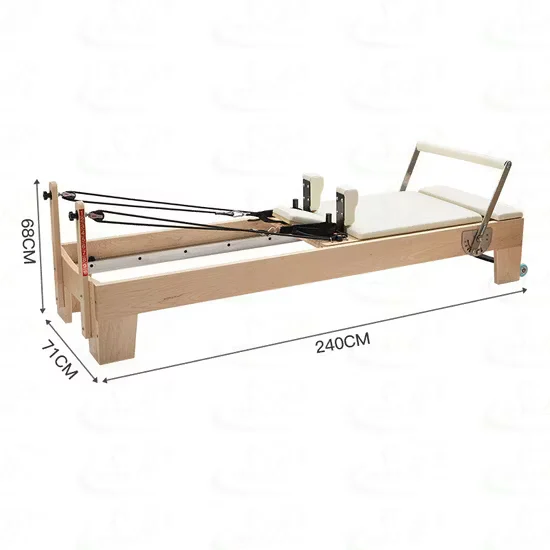
Classical Studio Reformer Aluminum Pilates Reformer Machine
Senrui SRY-11 Aluminum Pilates Reformer, 2400×600×380mm, 90kg Net Weight — aluminum alloy frame delivers high strength-to-weight ratio for studio reconfiguration, with Long Box, Jump Board, and Platform accessories supporting progressive training from rehabilitation to advanced sessions. Black finish resists sweat corrosion and supports frequent cleaning for barefoot contact hygiene. Backed by 3-year warranty, customizable logo, and full studio design consultation with layout and equipment mix planning.
- Custom branding and accessory combinations ensure visual consistency across multi-unit orders
- Kiln-dried hardwood options available for studios prioritizing natural material aesthetics
- 32-point inspection and 100% load testing before every shipment guarantee clinical-grade reliability
- Commercial-grade durability -- built for 24/7 high-traffic facilities
- Whisper-quiet operation -- ideal for hotels & residential settings
- OEM/ODM available -- custom branding, finish & parameters
- Direct from factory -- Shandong, China with global export
Everything you need to know
Aluminum alloy frame with clinical-grade load tolerance — engineered for rehabilitation clinics and boutique studios requiring stable platforms under daily high-frequency use.
Technical Specifications
| Parameter | Value |
|---|---|
| Designation | SRY-11 |
| Brand | Senrui |
| Product Type | Pilates Reformer |
| Material | Aluminium Alloy |
| Color | Black |
| Working Size | 2400 × 600 × 380 mm |
| Net Weight | 90 kg |
| Accessory | Long Box / Jump Board / Platform |
| Customization | Available |
| Logo | Customized Is Allowed |
| Warranty | 3 Years |
| Wood Species | not specified in source |
| Wood Type | not specified in source |
| Moisture Content | not specified in source |
| Joinery Type | not specified in source |
| Finish Type | not specified in source |
| Spring Quantity | not specified in source |
| Spring Resistance | not specified in source |
| Pulley System | not specified in source |
| Carriage Type | not specified in source |
| Footbar Positions | not specified in source |
| Upholstery | not specified in source |
| Track Length | not specified in source |
| Max User Weight | not specified in source |
| Certification | not specified in source |
Application Suitability
| Setting | Typical Use |
|---|---|
| Rehabilitation and physiotherapy clinic | Graded resistance work under professional supervision |
| Boutique Pilates studio group class | Full-body conditioning across multiple stations |
| Private residential studio | Daily individual practice and progressive training |
| Hotel spa and wellness suite | Integrated wellness programming for guests |
| Teacher training and certification space | Foundational technique instruction and equipment familiarization |
Why Aluminum Alloy Outperforms in Humid Studio Environments
Aluminum alloy frames resist moisture-induced warping that compromises wooden reformers in coastal and tropical climates.
When studios in humid regions report frame swelling, surface coating peeling, or inconsistent spring behavior within months of installation, the root cause often traces back to material selection rather than usage intensity. An aluminum pilates reformer machine for studio use eliminates the dimensional instability that solid hardwood faces when ambient humidity fluctuates beyond controlled ranges [NEED_CITE: moisture content standards for solid wood furniture stability]. The SRY-11's 90 kg aluminum construction maintains structural rigidity without the weight penalty of steel alternatives, while the black finish must withstand frequent wiping with disinfectant solutions common in clinical settings.
Positioning Within Studio Equipment Configuration
The SRY-11 serves as the foundational apparatus for progressive resistance training, accommodating users across a wide range of body types and fitness levels. Its 2400 × 600 × 380 mm footprint fits standard studio layouts while the aluminum frame supports integration with Long Box, Jump Board, and Platform accessories for exercise variation. In multi-station group classes, the lightweight construction allows instructors to reconfigure room layouts between sessions without requiring additional staff. The aluminum pilates reformer machine for studio environments pairs naturally with Cadillac and Wunda Chair units to create comprehensive training circuits.
Environmental Requirements for Studio and Clinic Installation
The 2400 mm working length requires minimum ceiling heights of 2400 mm to accommodate full range of motion on the footbar and shoulder rests. Floor surfaces must be level within 3 mm across the equipment footprint to prevent carriage tracking irregularities. Unlike solid hardwood reformers, the aluminum frame tolerates ambient humidity ranges from 30% to 70% without dimensional change, though extreme temperature swings may affect spring tension consistency over time. The black surface finish resists common studio disinfectants but requires verification of coating compatibility with specific cleaning agents used in clinical protocols [NEED_CITE: surface finish compatibility with healthcare-grade disinfectants]. High-traffic studio environments should anticipate upholstery replacement cycles based on daily usage hours and cleaning frequency.
Material and Construction Considerations
Aluminum alloy provides a superior strength-to-weight ratio compared to traditional steel frames, reducing the SRY-11's net weight to 90 kg while maintaining the structural rigidity required for clinical-grade load tolerance. The material's inherent corrosion resistance eliminates the need for protective coatings that may degrade under frequent cleaning, though the black finish still requires quality application to prevent surface imperfections. Accessory compatibility depends on precise mounting point specifications — the Long Box, Jump Board, and Platform must interface with the frame without introducing play or instability during dynamic movements. Spring systems, while not specified in the source documentation, typically feature multiple resistance levels to accommodate progressive programming from rehabilitation protocols to advanced athletic training. Pulley systems in aluminum reformers generally employ sealed bearings to minimize maintenance requirements and eliminate the squeaking that disrupts quiet studio environments [NEED_CITE: bearing selection criteria for fitness equipment pulley systems].
Hidden Costs of Material Compromises
When manufacturers substitute veneered frames for solid construction or specify inadequate surface treatments, studios encounter delamination in humid environments within the first year of operation. Coatings that off-gas volatile compounds create skin irritation during barefoot practice, particularly problematic for reformer work where participants maintain prolonged contact with surfaces. Inconsistent spring tension across a multi-unit order makes standardized class programming impossible — instructors cannot predict resistance behavior when clients rotate between machines. Non-standardized hardware dimensions leave studios unable to source replacement parts when pulleys fail or springs lose tension, effectively stranding expensive equipment. The SRY-11's aluminum construction sidesteps wood-specific failure modes but introduces different considerations around finish durability and accessory interface precision.
Customization and Studio Integration
The SRY-11 supports logo customization to maintain brand consistency across multi-unit studio orders, with verification needed for application method durability under cleaning protocols. Accessory combinations — Long Box, Jump Board, Platform — can be specified at order to match the intended programming focus, whether rehabilitation-grade progressive resistance or advanced athletic conditioning. The 3-year warranty coverage should be clarified regarding frame, spring, pulley, and upholstery components separately, as wear rates differ significantly across these elements. Studios planning multi-unit deployments benefit from confirming color consistency across production batches, particularly for black finishes where subtle tone variations become visible when machines are positioned side-by-side. The 80 pieces per month production capacity allows reasonable lead times for studio outfitting projects while maintaining quality control standards.
Documentation & Material Records
- Aluminum alloy composition certification and material grade specification
- Surface finish safety documentation confirming non-toxic coating composition
- Load test report verifying structural integrity under clinical-grade usage conditions
- Spring tension specification sheet detailing resistance levels and consistency standards
- Accessory compatibility guide covering Long Box, Jump Board, and Platform integration
- Assembly instructions and maintenance schedule for frame, springs, and pulley systems
Installation, Care & Studio Setup
- Verify floor levelness within 3 mm across 2400 × 600 mm footprint before assembly to ensure smooth carriage tracking
- Confirm ceiling height accommodates full footbar range of motion with minimum 2400 mm clearance
- Establish cleaning protocol using manufacturer-approved disinfectants to preserve black finish integrity
- Schedule quarterly inspection of spring tension consistency and pulley bearing function across all units
- Plan upholstery replacement based on daily usage hours, typically annually for high-traffic studio environments
- Maintain ambient humidity between 30-70% to optimize spring performance and prevent accessory interface corrosion
Inquiry Guidance for Studio Planning
Provide studio floor dimensions, ceiling height, and intended equipment layout to receive configuration recommendations for the SRY-11 and complementary apparatus. Specify your climate zone and humidity range to confirm material suitability and establish appropriate maintenance protocols. Describe your primary use case — group classes, private sessions, or clinical rehabilitation — to align spring resistance specifications and accessory combinations with programming requirements. Indicate customization needs including logo placement, accessory package selection, and multi-unit color consistency requirements to receive accurate lead time and pricing.
Frequently Asked Questions
Q: How does aluminum alloy construction compare to steel or wood frames for studio use?
A: Aluminum alloy provides meaningful weight reduction compared to steel while maintaining structural rigidity, making the 90 kg SRY-11 easier to reposition between classes. Unlike solid hardwood, aluminum eliminates moisture-related warping concerns in humid climates, though it requires quality surface finishing to resist cleaning chemical exposure. Steel frames offer comparable strength but at significantly higher weight, complicating studio layout adjustments.
Q: What accessory compatibility should I verify before ordering?
A: Confirm that Long Box, Jump Board, and Platform accessories interface with the SRY-11's mounting points without introducing play during dynamic movements. Request documentation showing load testing of accessory connections under clinical usage conditions. Verify that accessory dimensions accommodate your intended exercises and user height ranges, particularly for Jump Board positioning during cardiovascular sequences.
Q: How should I specify logo customization for multi-unit studio orders?
A: Clarify the application method — laser engraving, screen printing, or adhesive labeling — and request durability testing results under your planned cleaning protocol. Confirm minimum order quantities for custom branding and lead time implications. For multi-unit deployments, request production batch color consistency guarantees to prevent visible tone variations when reformers are positioned adjacent to each other.
Q: What maintenance protocols preserve the black finish under frequent cleaning?
A: Use only manufacturer-approved disinfectants to prevent coating degradation from harsh chemical exposure. Avoid abrasive cleaning tools that create surface scratches visible under studio lighting. Establish a regular inspection schedule for finish integrity, particularly at high-contact points like shoulder rests and footbar grips, where coating wear accelerates with barefoot use and frequent wiping.
Q: What does the 3-year warranty cover and what wear items require replacement?
A: Warranty coverage typically addresses frame structural integrity and manufacturing defects, while springs, pulleys, and upholstery are considered wear items subject to usage-based replacement. Request clarification on warranty terms for each component category and recommended replacement intervals based on daily usage hours. Confirm parts availability and lead times for post-warranty component replacement to prevent equipment downtime.
Trusted by global procurement teams
From five-star hotels to flagship gyms, our cardio equipment delivers reliability, intelligence, and silence -- everywhere it's installed.
Whisper Drive™
Suspended motor mounts keep noise below 52 dB -- quieter than a library.
Smart Monitoring
Real-time HR, cadence, power & recovery analytics for every session.
Custom Design
Tailor finishes, console UI, branding and frame parameters to your facility.
Turnkey Service
End-to-end consultation: layout, equipment mix, acoustic treatment delivered.
Request a quote for
Classical Studio Reformer Aluminum Pilates Reformer...
Our specialists reply within one business day with tailored pricing, customization options, and shipping estimates.
Related Products
![[WARN] draft identifier mismatch Oak Wood Pilates Reformer Full Track Flat Bed Core Training Equipment](https://bicklife.com/wp-content/uploads/2026/08/warn-draft-identifier-mismatch-oak-wood-pilates-reformer-full-track-flat-bed-core-training-equipment-c87e15.webp)
[WARN] draft identifier mismatch Oak Wood Pilates Reformer Full Track Flat Bed Core Training Equipment

Foldable Aluminum Pilates Reformer for Studio Use
Custom TPE PU Yoga Mat Non Slip for Home Exercise Gym Workout Sports