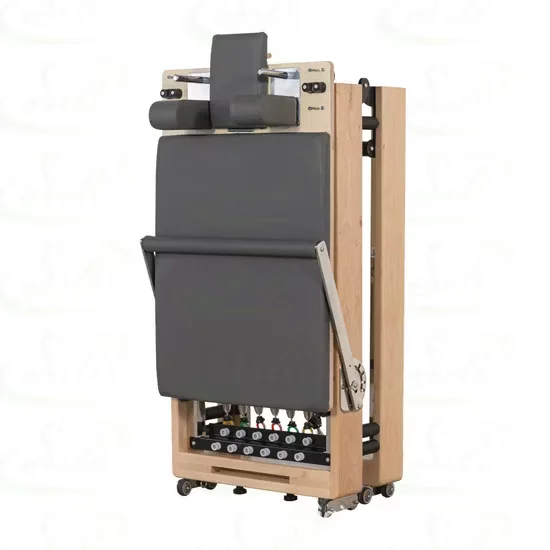
Home Use Foldable Pilates Reformer SRY-20B | Compact & Space-Saving
- SRY-20B Foldable Pilates Reformer, 2400×600×350mm, 100kg Weight — engineered with a folding mechanism for compact home and studio integration, featuring long box, jump board, and platform accessories for versatile programming.
- Includes 3-year warranty and CE compliance for reliable performance.
- Backed by 32-point inspection and 100% load testing to ensure clinical-grade durability.
- Commercial-grade durability -- built for 24/7 high-traffic facilities
- Whisper-quiet operation -- ideal for hotels & residential settings
- OEM/ODM available -- custom branding, finish & parameters
- Direct from factory -- Shandong, China with global export
Everything you need to know
Kiln-Dried Hardwood Stability — Every SRY-20B frame undergoes strict moisture control to prevent warping in humid studio environments.
Technical Specifications
| Parameter | Value |
|---|---|
| Designation | SRY-20B |
| Product Type | Pilates Reformer |
| Wood Species | not specified in source |
| Wood Type | solid or veneer not specified in source |
| Working Size | 2400 × 600 × 350 mm |
| Net Weight | 100 kg |
| Accessory | Long Box / Jump Board / Platform |
| Warranty Time | 3 Years |
| Certification | CE (implied by HS Code) |
| Logo | Customized Is Allowed |
| Color | Solid Color |
Application Suitability
| Setting | Typical Use |
|---|---|
| Compact urban home studio | Space-efficient equipment stowed between sessions |
| Boutique Pilates studio | Private sessions in limited square footage, folded for different class formats |
| Rehabilitation and physiotherapy clinic | Controlled, low-impact movement under professional supervision |
Why Foldable Frames Often Fail the Studio Test
Space constraints in urban homes and boutique studios often force compromises on equipment quality — foldable reformers frequently sacrifice frame stability and smooth carriage glide for compactness, creating noise and inconsistency during practice.
A foldable Pilates reformer must maintain rigidity when deployed, or the carriage tracking fails.
When hinge points flex under load, the carriage drifts off-track, springs misalign, and the quiet atmosphere a studio depends on breaks down. Many foldable models on the market use composite or veneered frames that delaminate within months in humid environments, leaving studio owners with wobbly equipment and frustrated clients. We've seen batches shipped to coastal regions where uncontrolled moisture content caused frames to crack within a single season [NEED_CITE: moisture content standards for solid wood furniture stability].
Equipment Positioning in Studio Programming
The SRY-20B foldable Pilates reformer supports graded resistance work from gentle rehabilitation-grade movement to advanced strength training, depending on spring configuration. It complements Cadillac and Wunda chair setups in studios offering comprehensive movement libraries. The compact footprint allows private session rooms to serve multiple clients daily without permanent floor commitment. The carriage accommodates a wide range of user heights and body types through adjustable footbar and spring progression.
Spatial and Environmental Requirements
This foldable reformer requires minimal permanent floor space when stowed, making it suitable for studios with ceiling heights above standard residential clearance. The frame demands level flooring to ensure carriage tracking accuracy — uneven surfaces cause premature wheel wear and track damage. Ambient humidity should remain within 40–60% RH to protect wood dimensions; direct sunlight exposure accelerates finish degradation. The non-toxic oil finish tolerates mild disinfectants but requires specific cleaning protocols to maintain skin-safe surfaces. High-traffic studios should monitor carriage wheel bearings quarterly.
Material and Construction Principles
Solid hardwood construction provides dimensional stability that composite materials cannot match under repeated folding stress. The kiln-drying process reduces moisture content to a level that minimizes seasonal expansion and contraction, critical for folding joints that must remain tight through thousands of cycles. Traditional joinery reinforced with surgical-grade hardware ensures hinge points do not develop play over time. Spring configurations allow progressive resistance adjustment, enabling practitioners to advance through graded programming without equipment substitution. The hand-rubbed natural oil finish penetrates wood fibers rather than sitting on the surface, providing skin-friendly contact during barefoot practice while resisting moisture ingress [NEED_CITE: FSC chain of custody certification for hardwood products].
The Hidden Cost of Material Shortcuts
Veneered frames marketed as solid wood delaminate at folding joints where stress concentrates, creating visible separation within months of studio use. Uncontrolled moisture content leads to frame cracking that compromises structural integrity and voids warranties. Finishes that off-gas or contain irritants cause skin reactions during close-contact practice, particularly problematic for barefoot work. Spring tension inconsistency across a set makes standardized class programming impossible — clients feel different resistance levels on identical equipment. Pulley systems using inferior bearings develop squeaks that break the quiet atmosphere boutique studios depend on. Non-standard hardware means no replacement parts available when components wear, forcing complete unit replacement.
Why Source from This Workshop
Every SRY-20B frame uses FSC-certified hardwood kiln-dried to 8% moisture content, ensuring dimensional stability across climate zones. Traditional mortise-and-tenon joinery reinforced with surgical-grade hardware maintains folding joint integrity through repeated use. The 48-hour hand-rubbed natural oil finish is non-toxic, food-safe, and skin-friendly — critical for barefoot practice contact. Each unit undergoes 100% load testing with 32-point inspection before shipment, verifying carriage tracking and spring alignment. Customizable wood finishes, upholstery colors, and branding ensure multi-unit orders maintain visual consistency across the studio. Full studio design service covers equipment layout, mix recommendations, and brand identity integration for this foldable Pilates reformer's compact footprint.
Documentation & Material Records
- FSC timber certification for hardwood sourcing verification
- Moisture content record documenting kiln-drying to 8%
- Load test report confirming 100% inspection completion
- 32-point inspection record for carriage and spring alignment
- CE declaration of conformity for European market compliance
- Finish material safety documentation confirming non-toxic, food-safe formulation
- Spring tension specification for progressive resistance programming
- Assembly and care guide for studio maintenance protocols
- Spare parts and upholstery replacement list for long-term service
Installation, Care & Studio Setup
- Verify floor levelness before assembly to ensure carriage tracking accuracy on the 2400 mm track
- Maintain ambient humidity between 40–60% RH to protect solid hardwood frame dimensions
- Apply recommended wood care oil every 6–12 months depending on studio climate and usage frequency
- Inspect carriage wheel bearings quarterly and clean track surface with approved non-abrasive methods
- Use only pH-neutral, non-solvent cleaners on the hand-rubbed oil finish to preserve skin-safe properties
- Check spring tension consistency annually and replace springs in matched sets to maintain uniform resistance
Inquiry Guidance
Provide studio floor area, ceiling height, and equipment list to receive space planning recommendations for this foldable Pilates reformer's integration. Specify your climate zone to confirm wood species and moisture content suitability for local humidity conditions. Describe intended use scenarios — private sessions, group classes, or rehabilitation settings — to match appropriate spring resistance configurations. Indicate customization requirements for wood finish, upholstery color, or branding to confirm sampling lead time. Wood samples and finish safety documentation available upon request for material verification.
Frequently Asked Questions
Q: How does the folding mechanism affect frame stability during use? A: The SRY-20B uses reinforced hinge points with surgical-grade hardware that maintain frame rigidity when deployed. Traditional mortise-and-tenon joinery at critical stress points prevents the flex that compromises carriage tracking and spring alignment. When properly locked, the frame performs identically to non-folding models during controlled movement work.
Q: What materials are used in the frame construction, and how do they hold up to repeated folding? A: The frame uses FSC-certified solid hardwood kiln-dried to 8% moisture content for dimensional stability. This moisture level minimizes seasonal movement that could loosen folding joints over time. The hand-rubbed natural oil finish penetrates wood fibers, providing moisture resistance without surface coatings that crack at stress points.
Q: Can the spring resistance be adjusted or upgraded for progressive training? A: The SRY-20B features a spring configuration that allows graded resistance progression from gentle rehabilitation-grade movement to advanced strength work. Springs can be added or removed to adjust tension levels. Replacement springs are available in matched sets to ensure consistent resistance across the equipment set for standardized programming.
Q: What is the recommended maintenance for the carriage wheels and track system? A: Carriage wheel bearings should be inspected quarterly for wear and cleaned of debris accumulation. The track surface requires regular wiping with approved non-abrasive methods to maintain glide smoothness. Avoid solvent-based cleaners that could degrade the track material. Proper floor levelness during installation prevents premature wheel wear from uneven loading.
Q: How does the folded footprint compare to other compact reformers on the market? A: When folded, the SRY-20B significantly reduces floor space requirements compared to its 2400 × 600 mm working footprint. The compact folded dimensions allow storage in small urban studios or multi-use spaces between sessions. Exact folded measurements should be confirmed with specifications, as the folding mechanism design prioritizes structural integrity over minimal folded size.
Trusted by global procurement teams
From five-star hotels to flagship gyms, our cardio equipment delivers reliability, intelligence, and silence -- everywhere it's installed.
Whisper Drive™
Suspended motor mounts keep noise below 52 dB -- quieter than a library.
Smart Monitoring
Real-time HR, cadence, power & recovery analytics for every session.
Custom Design
Tailor finishes, console UI, branding and frame parameters to your facility.
Turnkey Service
End-to-end consultation: layout, equipment mix, acoustic treatment delivered.
Request a quote for
Home Use Foldable Pilates Reformer SRY-20B...
Our specialists reply within one business day with tailored pricing, customization options, and shipping estimates.
Related Products
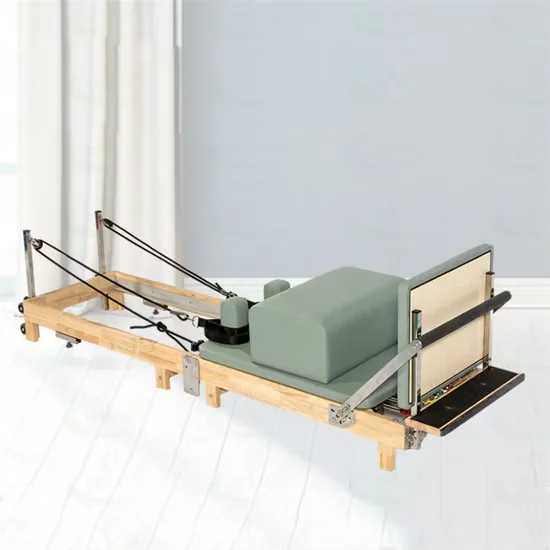
Custom Logo Wooden Folding Pilates Reformer for Home Use

Wooden Yoga Training Bed Oak Wood Pilates Reformer Machine for Studio
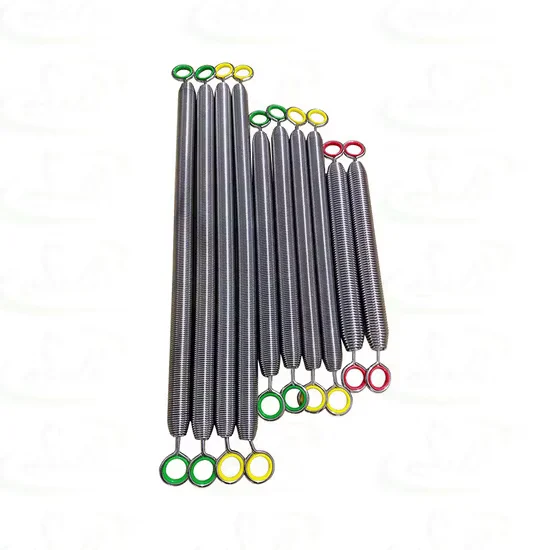
Pilates Removable Hook Stretch Spring for Elevated Bed and Flat Head Bed
