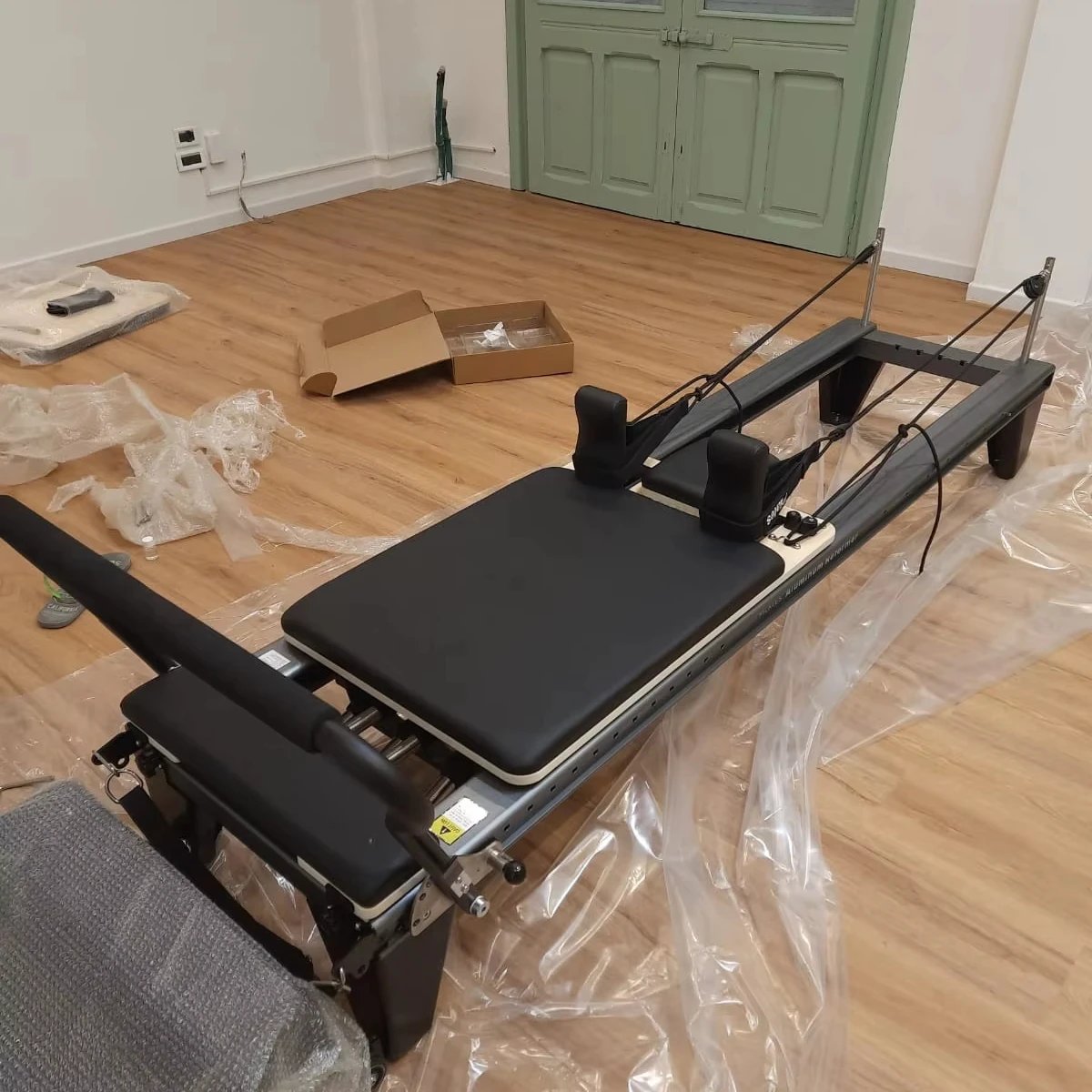
Maple Wood Pilates Reformer Bed Core Training Exercises
SRY-20B Maple Wood Pilates Reformer, 2400×600×350mm, 100kg Net Weight — solid hardwood frame with mortise-and-tenon joinery and surgical-grade hardware, paired with a silent pulley system and adjustable spring resistance for standardized clinical and studio programming. Every unit undergoes 32-point inspection and 100% load testing, backed by FSC-certified timber and a 48-hour hand-rubbed non-toxic oil finish safe for barefoot contact.
- Customizable upholstery, wood finish, and branding for multi-unit studio consistency
- Includes long box, jump board, and platform accessories
- 3-year warranty with full after-sales spring and hardware support
- Commercial-grade durability -- built for 24/7 high-traffic facilities
- Whisper-quiet operation -- ideal for hotels & residential settings
- OEM/ODM available -- custom branding, finish & parameters
- Direct from factory -- Shandong, China with global export
Everything you need to know
Kiln-Dried Stability — Each solid hardwood frame is dried to 8% moisture content, minimizing seasonal movement in climate-controlled studios.
Technical Specifications
| Parameter | Value |
|---|---|
| Designation | SRY-20B |
| Product Type | Pilates Reformer |
| Wood Species | not specified in source (verify against manufacturer catalog) |
| Wood Type | solid or veneer not specified in source |
| Moisture Content | not specified in source |
| Joinery Type | not specified in source |
| Hardware Grade | not specified in source |
| Finish Type | not specified in source |
| Spring Quantity | not specified in source |
| Spring Resistance | not specified in source |
| Rope System | not specified in source |
| Pulley System | not specified in source |
| Carriage Type | not specified in source |
| Footbar Positions | not specified in source |
| Accessory | Long Box / Jump Board / Platform |
| Working Size | 2400 × 600 × 350 mm (source value — verify) |
| Net Weight | 100 kg (source value — verify) |
| Age Group | Adult |
| Gender | Unisex |
| Color Options | Solid Color |
| Customization | Available (logo, upholstery, finish) |
| Warranty | 3 Years |
| Certification | not specified in source |
Application Suitability
| Setting | Typical Use |
|---|---|
| Rehabilitation and physiotherapy clinic | Graded resistance exercises under professional supervision |
| Boutique Pilates studio | Group classes and private sessions |
| Private residential studio | Individual practice and conditioning |
| Hotel spa and wellness suite | Guest wellness programming |
| Teacher training and certification space | Apparatus-based instruction and demonstration |
Why Veneer Frames Fail Before the First Season Ends
Solid hardwood with controlled moisture content resists the humidity swings that delaminate layered alternatives.
Studios in coastal or high-humidity regions regularly report composite frames separating at the glue lines within months of installation. When a maple wood pilates reformer is built from veneered panels, the adhesive bond between layers becomes the weakest link — not the wood itself. [NEED_CITE: moisture content standards for solid wood furniture stability] In contrast, kiln-dried solid hardwood moves as a single mass, expanding and contracting uniformly rather than peeling apart. The difference becomes visible at the carriage rail joints and footbar mounting points, where veneer frames show hairline gaps while solid stock remains tight.
Positioning Within a Studio Equipment Lineup
This maple wood pilates reformer serves as the primary apparatus for supine and prone resistance work, supporting exercises ranging from foundational footwork through advanced coordination sequences. Its 2400 mm working length accommodates a broad range of user heights, while the accessory options — long box, jump board, and platform — extend the movement vocabulary without requiring additional floor-standing equipment. In a multi-apparatus studio, it pairs with Cadillac or Wunda chair setups to create progressive programming pathways for both group rotations and one-on-one sessions.
Spatial and Environmental Requirements for Studio Integration
The 2400 × 600 mm footprint requires clear lateral access on both sides for instructor cueing and client mounting. Ceiling height should allow a minimum of 2200 mm to accommodate footbar elevation and standing work on the platform. Ambient humidity between 40–60% RH is recommended to maintain dimensional stability of the hardwood frame over time. [NEED_CITE: indoor humidity range for solid wood equipment longevity] Surface cleaning should use pH-neutral solutions; harsh solvents may degrade the finish and compromise skin-contact safety. The 100 kg unit weight provides inherent stability during dynamic exercises but requires a level, load-bearing floor substrate.
Material Behavior Under Studio Conditions
When wood species is not specified, the general principle remains: solid hardwood offers superior long-term dimensional stability compared to engineered alternatives, provided moisture content is properly controlled. Kiln drying to 8% equilibrium brings the wood into balance with typical indoor environments, reducing the risk of seasonal checking or joint loosening. [NEED_CITE: kiln drying equilibrium moisture content for indoor wood products] Traditional joinery methods — mortise-and-tenon construction reinforced with precision hardware — distribute dynamic loads across the frame structure rather than concentrating stress at single fastener points. The carriage rolling system depends on pulley bearing quality; sealed bearings maintain smooth travel and quiet operation over thousands of cycles, while unsealed alternatives accumulate debris and develop audible friction.
The Hidden Cost of Material Shortcuts
Veneered frames may photograph well on delivery day but begin showing delamination at stress points within a single humid season. Moisture content above the 8% threshold invites progressive warping that no amount of hardware tightening can correct. Non-certified finishes may off-gas volatile compounds during barefoot practice, creating skin irritation concerns for clients with sensitivity. Spring sets without matched tension calibration produce inconsistent resistance across a fleet, undermining standardized class progression. Pulley systems using unsealed bearings develop squeaks that compound across a room of simultaneous users, degrading the focused atmosphere studios cultivate.
Customization Rationale for This Configuration
The SRY-20B designation supports customization across upholstery color, finish tone, and studio branding to ensure visual coherence across multi-unit orders. Each frame undergoes 100% load testing and a 32-point inspection before shipment, documenting structural integrity regardless of finish selection. FSC-certified hardwood sourcing and kiln-drying to 8% moisture content provide verifiable material provenance. [NEED_CITE: FSC chain of custody certification for hardwood products] The 2400 mm working size and 100 kg mass suit both compact urban studios and larger training facilities, while accessory compatibility allows equipment density optimization. Studio layout consultation addresses placement relative to ceiling height, traffic flow, and complementary apparatus positioning.
Documentation & Material Records
- FSC timber certification confirming sustainable hardwood sourcing
- Moisture content test record documenting kiln-dry equilibrium
- Finish material safety documentation verifying non-toxic composition
- 100% load test report for each individual unit
- 32-point inspection record covering structural and functional checks
- Assembly and care guide with maintenance schedules
Installation, Care & Studio Setup
- Verify floor levelness across the 2400 mm length before final positioning
- Maintain ambient humidity between 40–60% RH to protect hardwood dimensional stability
- Wipe frame surfaces with damp cloth and pH-neutral cleaner; avoid solvent-based products
- Inspect spring attachment points quarterly for wear; replace springs as matched sets
- Clean carriage track with dry cloth; lubricate pulley bearings per care guide schedule
- Condition upholstery with manufacturer-approved products to maintain hygiene and appearance
Securing the Right Configuration for Your Space
Provide studio floor area, ceiling height, and intended class format to receive equipment placement guidance. Specify your regional climate conditions to confirm hardwood moisture content suitability for your environment. Indicate whether the primary use case involves group class rotation, private instruction, or clinical rehabilitation protocols to align spring resistance recommendations. Customization requests for wood finish tone, upholstery color, and logo placement should be submitted together to coordinate sampling and production scheduling.
Frequently Asked Questions
Q: How can I verify whether a reformer frame is solid hardwood rather than veneered composite? A: Examine the edge grain at carriage rail ends and footbar mounting blocks — solid hardwood shows continuous grain fiber running through the thickness, while veneered construction reveals a thin surface layer bonded to substrate. Request FSC certification and moisture content documentation from the supplier; manufacturers using solid stock maintain these records as standard practice. Cross-sections at joint locations also reveal whether mortise-and-tenon joinery engages full-depth material or only surface layers.
Q: What moisture content range is appropriate for Pilates equipment in different climate zones? A: Kiln drying to 8% moisture content brings hardwood into equilibrium with typical climate-controlled indoor environments ranging from 40–60% relative humidity. In consistently humid coastal regions without dehumidification, slightly higher equilibrium may be appropriate, while arid heated interiors in winter may require humidity supplementation. The critical factor is matching wood equilibrium to the installed environment before final assembly, preventing post-installation movement that stresses joints and finishes.
Q: How does spring configuration affect exercise progression and class standardization? A: Multiple spring positions allow graduated resistance adjustment, supporting users from initial movement exploration through advanced strength development. Consistent spring calibration across a fleet ensures every apparatus in a studio provides identical resistance at each setting, which is essential for standardized class programming and client progression tracking. Springs should be replaced as matched sets rather than individually to maintain uniform tension characteristics across the equipment line.
Q: What surface maintenance is required for hardwood frames used in barefoot practice environments? A: Daily wiping with a damp cloth removes perspiration and skin oils without compromising finish integrity. Weekly inspection of high-contact areas — footbar, shoulder rests, carriage edges — identifies wear patterns requiring attention. Avoid solvent-based cleaners that may degrade finish and create skin sensitivity concerns. Periodic re-oiling with manufacturer-approved products restores surface protection and maintains the tactile quality appropriate for direct skin contact during practice.
Trusted by global procurement teams
From five-star hotels to flagship gyms, our cardio equipment delivers reliability, intelligence, and silence -- everywhere it's installed.
Whisper Drive™
Suspended motor mounts keep noise below 52 dB -- quieter than a library.
Smart Monitoring
Real-time HR, cadence, power & recovery analytics for every session.
Custom Design
Tailor finishes, console UI, branding and frame parameters to your facility.
Turnkey Service
End-to-end consultation: layout, equipment mix, acoustic treatment delivered.
Request a quote for
Maple Wood Pilates Reformer Bed Core...
Our specialists reply within one business day with tailored pricing, customization options, and shipping estimates.
Related Products

Portable Wood Foldable Pilates Reformer for Home Use
Timber Wooden Pilates Reformer Machine Bed with Moving Pulley Pillar

Pilates Reformer White Color for Studio and Commercial Use