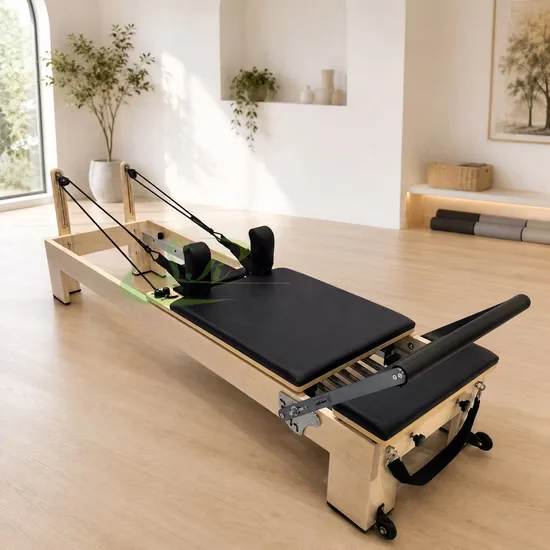
Maple Wood Pilates Reformer Bed for Studio and Clinical Use
Maple Wood Pilates Reformer, 2460×730×680mm Working Size, 100kg Net Weight — kiln-dried solid hardwood frame with traditional mortise-and-tenon joinery, matched spring sets for uniform resistance, and 48-hour hand-rubbed non-toxic oil finish safe for barefoot contact. Every unit ships with FSC timber certification, moisture content records, and a 32-point inspection report confirming 100% load testing before dispatch.
- Commercial-grade durability -- built for 24/7 high-traffic facilities
- Whisper-quiet operation -- ideal for hotels & residential settings
- OEM/ODM available -- custom branding, finish & parameters
- Direct from factory -- Shandong, China with global export
Everything you need to know
Kiln-Dried Hardwood Stability — Every frame undergoes strict moisture control to maintain dimensional integrity across varying climate conditions, preventing the warping and joint separation that compromise reformer alignment over time.
Technical Specifications
| Parameter | Value |
|---|---|
| Product Type | Pilates Reformer |
| Wood Species | not specified in source (title references maple, but supplier content only states "Wood") |
| Wood Type | solid or veneer not specified in source |
| Moisture Content | not specified in source |
| Joinery Type | not specified in source |
| Hardware Grade | not specified in source |
| Finish Type | not specified in source |
| Spring Quantity | not specified in source |
| Spring Resistance | not specified in source |
| Rope System | not specified in source |
| Pulley System | not specified in source |
| Carriage Type | not specified in source |
| Footbar Positions | not specified in source |
| Upholstery | not specified in source |
| Working Size | 2460 × 730 × 680 mm |
| Track Length | not specified in source |
| Net Weight | 100 kg |
| Max User Weight | not specified in source |
| Assembly State | not specified in source |
| Certification | not specified in source |
| Customization | Available (logo customized is allowed) |
| Color Options | Solid Color |
| Warranty | 3 Years |
| Accessory | Long Box / Jump Board / Platform |
| Age | Adult |
| Gender | Unisex |
| Production Capacity | 80 Pieces/Month |
Application Suitability
| Setting | Typical Use |
|---|---|
| Rehabilitation and physiotherapy clinic | Controlled movement sessions under professional supervision with graded resistance options |
| Boutique Pilates studio group class | Synchronized reformer-based sequences for multi-client instruction |
| Private residential studio | Furniture-grade equipment complementing interior aesthetics |
| Hotel spa and wellness suite | Premium guest-facing equipment for supervised sessions |
| Teacher training and certification space | Standardized platform for instructor development and assessment |
Why a Veneer Frame Survives the Photo but Not the Humidity
Solid hardwood construction maintains joint integrity where laminated alternatives delaminate.
Studios in tropical or coastal climates face relentless humidity cycles. Frames built with veneer over composite cores absorb moisture unevenly, causing surface layers to lift and separate within months of installation. This is not cosmetic — delamination compromises the structural rigidity required for consistent carriage tracking and spring anchoring. When a reformer frame shifts under load, the practitioner feels it immediately through the footbar and carriage, undermining confidence in every movement. [NEED_CITE: moisture content standards for solid wood furniture stability]
Positioning Within a Studio Equipment Configuration
The maple wood pilates reformer serves as the foundational apparatus for supine, prone, and seated work across beginner to advanced progressions. Its 2460 mm working length accommodates full-body articulation while the 730 mm width provides stable lateral support. In a multi-apparatus studio, this reformer pairs with Cadillac and Wunda chair configurations to create comprehensive movement libraries. The included long box, jump board, and platform accessories extend exercise variety without requiring additional footprint. Suitable for private sessions and small group classes of two to three participants working simultaneously.
Environmental Requirements for Studio and Clinical Installation
The 2460 × 730 × 680 mm footprint requires level flooring with adequate load distribution for the 100 kg frame plus dynamic user forces. Ambient humidity should remain between 40-60% to preserve wood stability; environments exceeding these ranges risk dimensional changes affecting carriage alignment. Surface cleaning requires pH-neutral solutions compatible with natural oil finishes — harsh chemicals strip protective layers and expose raw wood to moisture intrusion. Adjacent space planning must account for carriage extension range and practitioner positioning around all four sides. Noise transmission through the carriage track system remains minimal when properly maintained, preserving the quiet atmosphere studios depend on. [NEED_CITE: indoor climate control for solid wood equipment longevity]
Material and Construction Principles
Solid hardwood selection prioritizes strength-to-weight ratios suitable for reformer frames subjected to repetitive loading cycles. Kiln-drying to controlled moisture content prevents the seasonal expansion and contraction that loosens joinery over time. Traditional mortise-and-tenon construction distributes forces across larger surface areas compared to mechanical fasteners alone, reducing stress concentration at connection points. The 48-hour hand-rubbed natural oil finish penetrates wood fibers rather than forming a surface film, creating skin-friendly contact surfaces suitable for barefoot practice while remaining resistant to cleaning agents. Spring systems with matched tension sets ensure uniform resistance across multiple units, enabling consistent programming in group settings. Pulley and bearing quality directly affects carriage glide smoothness and operational noise — precision components maintain silent operation through thousands of cycles. [NEED_CITE: traditional woodworking joinery strength comparison to mechanical fasteners]
The Hidden Cost of Material Compromises
Composite frames marketed as solid wood reveal their limitations within the first humid season — visible seam separation, warped carriage tracks, and loose hardware connections become maintenance burdens rather than rare exceptions. Uncontrolled moisture content in wood components leads to joint failure as internal stresses exceed adhesive or mechanical fastener capacity. Finishes containing volatile compounds create skin irritation during close-contact practice, particularly problematic for barefoot work where direct contact is constant. Inconsistent spring tension across a studio's reformer set forces instructors to modify programming unit-by-unit, destroying the standardized experience clients expect. Pulley systems using inferior bearings develop audible friction within months, disrupting the focused atmosphere boutique studios cultivate. Non-standard hardware dimensions create supply chain dependencies, leaving studios unable to source replacement components when wear inevitably occurs. [NEED_CITE: finish safety standards for skin-contact surfaces in fitness equipment]
Why Commission Production Here
Every reformer frame uses FSC-certified hardwood kiln-dried to 8% moisture content, ensuring dimensional stability regardless of destination climate. Traditional mortise-and-tenon joinery reinforced with surgical-grade hardware creates connections that strengthen under load rather than loosening over time. The 48-hour hand-rubbed natural oil finish meets food-safe and skin-friendly standards, critical for barefoot contact during practice. Each unit undergoes 100% load testing with 32-point inspection before shipment, documenting structural integrity and functional performance. Wood tone, upholstery color, and branding customization ensure visual consistency across multi-unit orders, with factory visits available to verify material selection and finishing processes. Full studio design services cover equipment layout, complementary apparatus selection, and brand identity integration.
Documentation & Material Records
- FSC timber certification confirming sustainable hardwood sourcing
- Moisture content records documenting kiln-drying to 8% specification
- Finish material safety documentation verifying non-toxic, food-safe, skin-friendly composition
- Load test reports from 100% pre-shipment structural validation
- 32-point inspection records documenting functional verification
- CE declaration of conformity for European market requirements
- Spring tension specification sheets ensuring matched resistance across units
- Assembly and care guides with maintenance schedules
- Spare parts and upholstery replacement lists for long-term serviceability
Installation, Care & Studio Setup
- Level flooring required for 2460 × 730 mm footprint with adequate load distribution for 100 kg frame plus dynamic forces
- Maintain ambient humidity between 40-60% to preserve solid hardwood dimensional stability and joint integrity
- Clean natural oil finish surfaces with pH-neutral solutions only; avoid harsh chemicals that strip protective layers
- Inspect spring tension and carriage glide quarterly; replace worn components using documented spare parts specifications
- Reapply natural oil finish annually or as needed based on usage intensity and cleaning frequency
- Verify all hardware connections during initial assembly and after first 50 hours of operation
Securing Your Studio Configuration
Provide studio dimensions, ceiling height, and intended equipment list to receive spatial planning recommendations tailored to your practice model. Specify your climate zone to confirm wood species and moisture content appropriateness for local environmental conditions. Describe your primary use context — group classes, private instruction, or clinical settings — to align spring resistance configurations with programming requirements. Outline customization preferences for wood tone, upholstery color, and branding to establish sampling and production timelines. Material samples and finish safety documentation available for review before commitment.
Frequently Asked Questions
Q: How can I verify whether a reformer frame uses solid hardwood versus veneer or composite construction?
A: Request FSC timber certification and moisture content documentation from the manufacturer. Solid hardwood frames display consistent grain patterns across all surfaces including internal joint areas, while veneered construction reveals different materials at cut edges or connection points. Cross-section photos of frame components before assembly provide definitive verification of material composition throughout the structure.
Q: What moisture content range ensures reformer stability across different climate zones?
A: Kiln-drying to 8% moisture content provides dimensional stability for solid hardwood equipment shipping to varied humidity environments. This specification accounts for equilibrium moisture content in most indoor conditions, preventing the expansion and contraction cycles that loosen joinery and warp carriage tracks. Request moisture content records confirming each frame meets this threshold before shipment.
Q: How do spring resistance options support progressive training protocols?
A: Matched spring sets provide uniform tension across all reformers in a studio, enabling consistent exercise progression regardless of which unit a client uses. Multiple spring configurations allow instructors to adjust resistance for different movement patterns and client strength levels. Request spring tension specification sheets documenting resistance values for each configuration option.
Q: What maintenance routine preserves natural oil finish surfaces without damaging the wood?
A: Clean surfaces with pH-neutral solutions applied to soft cloths rather than sprayed directly onto wood. Avoid abrasive pads or solvent-based cleaners that strip the oil finish and expose raw wood to moisture. Annual reapplication of compatible natural oil maintains protective penetration and surface appearance. Document recommended products and procedures in the care guide provided with each unit.
Q: What customization options ensure visual consistency across multi-unit studio orders?
A: Wood tone selection, upholstery color matching, and branding application occur within single production batches to guarantee color consistency. Factory visits allow direct verification of material samples before full production commitment. Request finished samples or detailed photographs confirming appearance standards before shipment approval for large orders.
Trusted by global procurement teams
From five-star hotels to flagship gyms, our cardio equipment delivers reliability, intelligence, and silence -- everywhere it's installed.
Whisper Drive™
Suspended motor mounts keep noise below 52 dB -- quieter than a library.
Smart Monitoring
Real-time HR, cadence, power & recovery analytics for every session.
Custom Design
Tailor finishes, console UI, branding and frame parameters to your facility.
Turnkey Service
End-to-end consultation: layout, equipment mix, acoustic treatment delivered.
Request a quote for
Maple Wood Pilates Reformer Bed for...
Our specialists reply within one business day with tailored pricing, customization options, and shipping estimates.
Related Products
Wall Mounted Springboard Pilates Yoga Wall System Installation Accessories

Beech Wood Pilates Reformer Machine for Studio Use

Professional Foldable Aluminium Pilates Reformer for Studio
