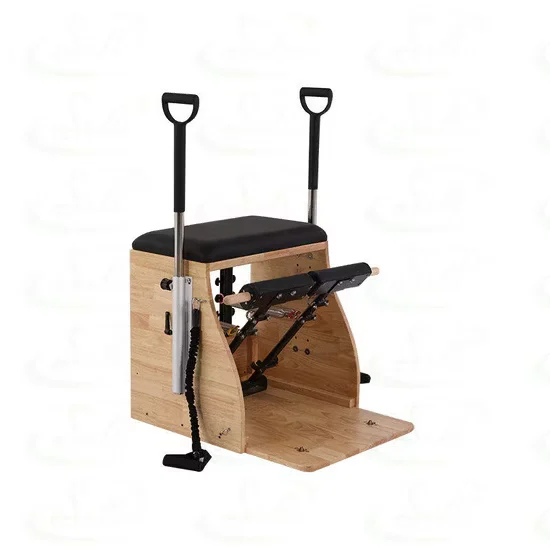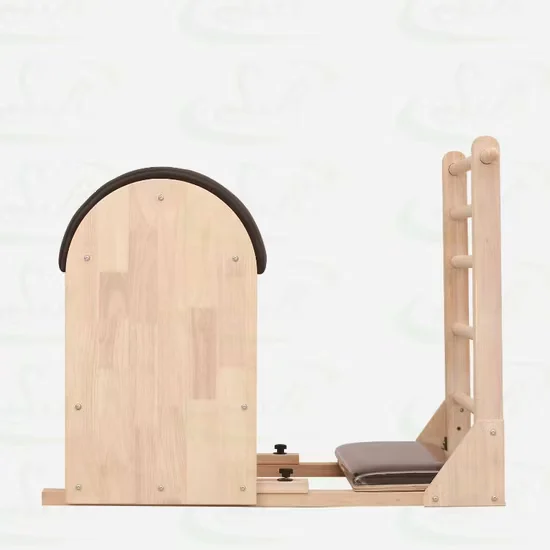
Maple Wooden Pilates Ladder Barrel for Studio
Maple Wooden Pilates Ladder Barrel, 1100×770×980mm, 50kg — kiln-dried hardwood frame with traditional mortise-and-tenon joinery and surgical-grade hardware for clinical-grade load tolerance. The 48-hour hand-rubbed natural oil finish is non-toxic, food-safe, and skin-friendly for barefoot practice. Every unit undergoes 32-point inspection with full load testing before shipment.
- Commercial-grade durability -- built for 24/7 high-traffic facilities
- Whisper-quiet operation -- ideal for hotels & residential settings
- OEM/ODM available -- custom branding, finish & parameters
- Direct from factory -- Shandong, China with global export
Everything you need to know
Dimensional stability starts at 8% moisture content — every solid hardwood frame is kiln-dried and verified before any joinery begins, preventing the warping that compromises a maple wood pilates ladder barrel in climate-controlled studios.
Technical Specifications
| Parameter | Value |
|---|---|
| Product Type | Ladder Barrel |
| Wood Species | not specified in source (source states "Maple" in title but supplier content only lists "Wood") |
| Wood Type | solid or veneer not specified in source |
| Moisture Content | not specified in source |
| Joinery Type | not specified in source |
| Hardware Grade | not specified in source |
| Finish Type | not specified in source |
| Working Size | 1100 × 770 × 980 mm |
| Net Weight | 50 kg |
| Color | Solid Color |
| Customization | Available |
| Logo | Customized Is Allowed |
| Warranty | 3 Years |
| Production Capacity | 800 Pieces/Month |
Application Suitability
| Setting | Typical Use |
|---|---|
| Rehabilitation and physiotherapy clinic | Graded spinal articulation and controlled extension work under professional supervision |
| Boutique pilates studio group class | Core strengthening and flexibility drills in circuit-style sessions |
| Private residential studio | Daily mobility maintenance and low-impact conditioning |
| Hotel spa and wellness suite | Guest-facing equipment with furniture-grade aesthetics |
| Teacher training and certification space | Demonstration of ladder barrel fundamentals across skill levels |
Why Veneered Frames Fail Before the First Anniversary
A maple wood pilates ladder barrel must survive humidity cycles, not just the showroom photo.
Studios in coastal or tropical climates report delamination within months when composite frames are marketed as solid hardwood. The veneer peels at stress points — the barrel curve, the ladder rung joints — where repetitive loading meets moisture ingress. [NEED_CITE: moisture content standards for solid wood furniture stability]
What looks like a cost-saving material choice becomes a liability: warped rungs create uneven hand positions, cracked barrel slats compromise user confidence, and the studio owner faces replacement costs that dwarf the original price difference. A properly kiln-dried solid hardwood frame, by contrast, maintains dimensional integrity across seasonal humidity swings when moisture content is controlled to 8%.
Positioning Within a Studio Equipment Layout
The ladder barrel occupies a distinct niche in the studio equipment ecosystem. Unlike reformers that emphasize linear resistance or cadillacs that offer overhead suspension, this apparatus focuses on spinal articulation, lateral flexion, and controlled extension. It pairs naturally with spine correctors for progressive curvature work and wall units for integrated standing sequences.
A maple wood pilates ladder barrel serves both private sessions and small group formats of four to six participants rotating through stations. The 1100 × 770 mm footprint fits standard studio layouts without obstructing traffic flow, while the 980 mm height accommodates users across a broad stature range. Adjustable rung spacing on the ladder allows instructors to modify leverage and difficulty without swapping equipment.
Environmental Requirements for Long-Term Performance
Studio placement matters for any solid hardwood apparatus. Maintain ambient humidity between 40–60% to prevent wood movement; avoid positioning near HVAC vents, exterior doors, or direct sunlight that creates localized drying. The floor surface must be level — uneven loading on the 50 kg frame accelerates joint stress over time.
Cleaning protocols require attention: wipe with a damp cloth using pH-neutral cleaners only. Harsh chemicals or excessive moisture penetrate the oil finish and compromise the wood surface below. [NEED_CITE: care guidelines for hand-rubbed oil finished wood equipment] High-traffic studios should inspect contact points quarterly for finish wear and schedule re-oiling as needed to maintain the skin-safe surface that barefoot practice demands.
Material Selection and Structural Integrity
When wood species remains unspecified, the critical factor becomes whether the frame uses solid hardwood throughout or relies on veneered composites. Solid hardwood — whether maple, oak, walnut, or beech — offers uniform density and predictable behavior under load. The grain structure runs continuously through joints when traditional mortise-and-tenon construction is employed, creating mechanical interlock that screws or dowels alone cannot replicate.
Moisture content at 8% represents the equilibrium point for kiln-dried hardwood destined for climate-controlled interiors. Wood milled at higher moisture levels will shrink as it acclimates, opening joints and creating play in rung connections. Conversely, over-dried stock absorbs ambient humidity and swells, potentially splitting at stress concentrations. [NEED_CITE: kiln-drying standards for dimensional stability in hardwood furniture]
The finish application method determines both tactile quality and maintenance frequency. Hand-rubbed natural oils penetrate the wood fibers, creating a surface that feels warm to bare skin and resists the cracking that film-forming finishes develop over time. This approach requires multiple coats applied over 48 hours, allowing each layer to cure before the next — a process that cannot be rushed without sacrificing durability.
The Hidden Cost of Material Compromises
Veneered frames present an attractive appearance initially but reveal their limitations under studio conditions. The thin wood layer bonds to substrate with adhesive that softens under humidity and heat, leading to bubbling along curved surfaces and peeling at edge details. Once delamination begins, repair is impractical — the frame requires replacement.
Moisture-related failures manifest differently: joints that were tight at assembly loosen as wood shrinks, creating rattling rungs and unstable hand positions. In ladder barrels specifically, the curved barrel section experiences complex stress that exposes any weakness in lamination or joinery. [NEED_CITE: structural requirements for curved wood components in fitness equipment]
Non-toxic, food-safe finishes are not merely a marketing claim — they address the reality of barefoot, skin-contact practice. Users spend extended time with hands and feet pressing against the apparatus surface; off-gassing finishes or irritant chemicals create discomfort and potential health concerns that undermine the wellness positioning of any studio.
Customization Capabilities for Studio Branding
A maple wood pilates ladder barrel can be customized across multiple dimensions to align with studio identity. Wood species selection allows matching existing equipment palettes or creating intentional contrast — lighter maple for airy spaces, richer walnut for warm environments. Finish tone options range from natural clear coats that highlight grain character to stained variations that coordinate with brand colors.
Upholstery customization extends to padding density, cover material, and color selection. Studios operating multiple units can specify identical specifications across orders to ensure visual consistency — no mismatched wood tones or hardware finishes that undermine a cohesive aesthetic. Logo placement options allow discreet branding on ladder frames or barrel ends.
The 1100 × 770 × 980 mm working dimensions accommodate standard studio layouts, but custom sizing is available for spaces with specific constraints. Lead times for customized units account for material sourcing, finish application, and the 32-point inspection process that precedes shipment.
Documentation & Material Records
- FSC timber certification verifying sustainable hardwood sourcing
- Moisture content test records confirming kiln-drying to specification
- Finish material safety documentation certifying non-toxic, food-safe composition
- 100% load test report documenting structural integrity verification
- 32-point inspection record covering joints, finish, and hardware
- CE declaration of conformity for European market requirements
- Assembly and care guide with maintenance schedules
- Spare parts and upholstery replacement list for long-term support
Installation, Care & Studio Setup
- Position on level flooring with adequate clearance for user movement around the 1100 × 770 × 980 mm footprint
- Maintain 40–60% ambient humidity to preserve wood dimensional stability
- Clean with pH-neutral solutions; avoid harsh chemicals that degrade the oil finish
- Inspect rung joints quarterly for tightness; re-oil contact surfaces as finish wears
- Store away from direct sunlight and HVAC vents to prevent localized drying
- Follow the 3-year warranty terms for structural components and hardware
Next Steps for Studio Procurement
Provide your studio floor plan, ceiling height, and equipment list to receive layout recommendations incorporating the maple wood pilates ladder barrel. Specify your climate zone so wood species and moisture content can be confirmed for long-term stability. Describe your primary use context — group classes, private sessions, or rehabilitation settings — to ensure resistance and sizing match your programming needs. Request wood samples and finish documentation to verify material quality before committing to multi-unit orders.
Frequently Asked Questions
Q: How can I verify whether a ladder barrel uses solid hardwood or veneered construction?
A: Request FSC timber certification and moisture content records from the supplier. Solid hardwood frames will have continuous grain visible at joint intersections and end grain exposed at rung ends. Veneered construction shows seamless surfaces with no visible end grain, and the supplier cannot provide kiln-drying documentation because the substrate is composite material rather than solid timber.
Q: What moisture content is appropriate for pilates equipment in different climate zones?
A: Kiln-drying to 8% moisture content creates equilibrium for climate-controlled interiors typical of studios and clinics. Equipment shipped to tropical or coastal environments without proper acclimatization may absorb ambient humidity and swell, while arid climates can cause over-dried wood to crack. Confirm with your supplier that moisture content matches your local conditions and that the wood species selected has appropriate dimensional stability characteristics.
Q: How does mortise-and-tenon joinery compare to bolted construction for ladder barrel durability?
A: Traditional mortise-and-tenon joints create mechanical interlock where the tenon fits precisely into a corresponding mortise, distributing load across gluing surfaces and grain direction. This construction resists the repetitive stress of climbing, hanging, and pressing movements better than bolted joints that rely on hardware tension alone. Over years of studio use, mortise-and-tenon construction maintains tightness while bolted connections may loosen and require periodic retightening.
Q: What customization options are available for wood species, finish, and upholstery?
A: Wood species can be selected from available options to match studio aesthetics or existing equipment. Finish tones range from natural clear coats to stained variations, all using non-toxic, food-safe oils applied over 48 hours. Upholstery customization includes padding density, cover material selection, and color coordination. Multi-unit orders can specify identical materials to ensure visual consistency across your studio environment.
Q: What inspection and testing standards apply before shipment?
A: Every unit undergoes 100% load testing to verify structural integrity under working conditions. A 32-point inspection covers joint tightness, finish quality, hardware installation, and dimensional accuracy. Documentation provided includes load test reports, inspection records, and material safety certifications. This process ensures each maple wood pilates ladder barrel meets performance standards before leaving the workshop.
Trusted by global procurement teams
From five-star hotels to flagship gyms, our cardio equipment delivers reliability, intelligence, and silence -- everywhere it's installed.
Whisper Drive™
Suspended motor mounts keep noise below 52 dB -- quieter than a library.
Smart Monitoring
Real-time HR, cadence, power & recovery analytics for every session.
Custom Design
Tailor finishes, console UI, branding and frame parameters to your facility.
Turnkey Service
End-to-end consultation: layout, equipment mix, acoustic treatment delivered.
Request a quote for
Maple Wooden Pilates Ladder Barrel for...
Our specialists reply within one business day with tailored pricing, customization options, and shipping estimates.
Related Products
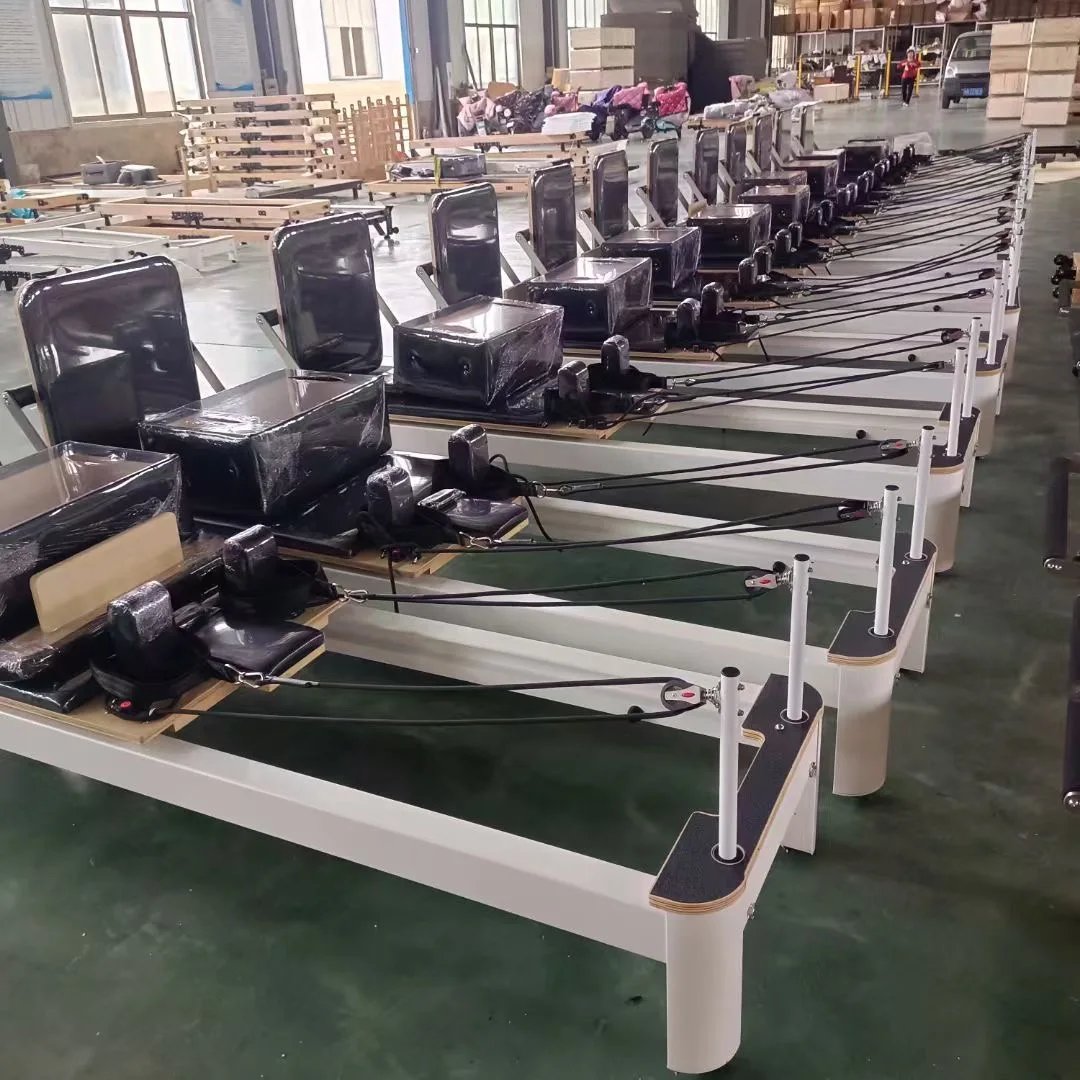
Pilates Reformer Machine Aluminum Alloy for Studio Use with CE ISO Certification

Body Building Gym Home Fitness Equipment Maple Wood Pilates Reformer Bed
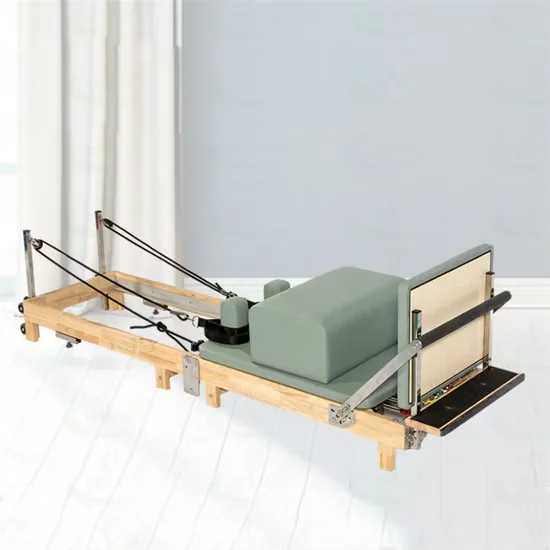
Custom Logo Wooden Folding Pilates Reformer for Home Use