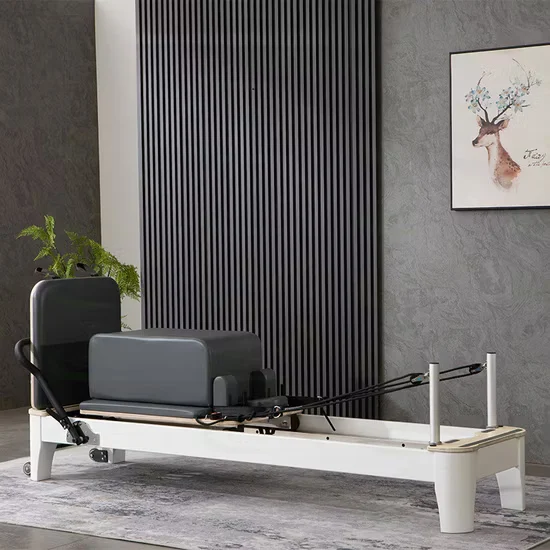
Commercial Aluminium Pilates Reformer Machine for Studio
SRY-27 Commercial Aluminium Pilates Reformer, 2570×730×890mm, 110kg Net Weight — built with aircraft-grade aluminium alloy frame for clinical-grade load tolerance and dimensional stability in high-humidity studio environments. Black anodized surface resists daily disinfectant cleaning, ideal for rehabilitation clinics and boutique studios. Customizable branding and accessory options including long box, jump board, and platform. Every unit undergoes 32-point inspection with 100% load testing before shipment.
- Commercial-grade durability -- built for 24/7 high-traffic facilities
- Whisper-quiet operation -- ideal for hotels & residential settings
- OEM/ODM available -- custom branding, finish & parameters
- Direct from factory -- Shandong, China with global export
Everything you need to know
Dimensional Stability Under Load — The aircraft-grade aluminium alloy frame eliminates moisture-related warping, maintaining structural integrity across 110 kg of working mass in high-traffic studio environments.
Technical Specifications
| Parameter | Value |
|---|---|
| Designation | SRY-27 |
| Product Type | Pilates Reformer |
| Frame Material | Aluminium Alloy |
| Color | Black |
| Working Size | 2570 × 730 × 890 mm |
| Net Weight | 110 kg |
| Accessory | Long Box / Jump Board / Platform |
| Customization | Available |
| Logo | Customized Is Allowed |
| Warranty | 3 Years |
| Age | Adult |
| Gender | Unisex |
Application Suitability
| Setting | Typical Use |
|---|---|
| Commercial Pilates studio | High-frequency group classes and private sessions requiring consistent spring resistance across multiple units |
| Rehabilitation and physiotherapy clinic | Graded resistance work under professional supervision with clinical-grade load tolerance |
| Boutique fitness studio | Brand-defining equipment with customizable finish and logo integration |
| Hotel spa and wellness suite | Durable, low-maintenance apparatus suited to shared-use environments |
| Teacher training and certification space | Standardized tension curves for instructor education and practical examination |
Why Aluminium Frames Outperform Wood in Humid Studio Climates
Aluminium alloy construction removes the single largest failure variable in commercial Pilates equipment: moisture-driven dimensional change.
In coastal cities and air-conditioned studios where humidity swings daily, solid hardwood frames can shift by fractions of a millimeter — enough to alter carriage tracking and spring alignment over months of use [NEED_CITE: moisture content standards for solid wood furniture stability]. A commercial aluminium pilates reformer sidesteps this entirely. The anodized black surface resists chlorine-based disinfectants common in clinic sanitation protocols, and the frame will not delaminate, crack, or off-gas regardless of ambient conditions. For studio operators who have replaced veneered units within two years, material consistency matters more than the visual warmth of timber.
Equipment Positioning Within a Studio Layout
The SRY-27 occupies the core of any commercial pilates reformer lineup, offering a full-range resistance platform suitable for both foundational movement patterns and advanced loaded exercises. Its 2570 mm working length accommodates users across a broad height range, while the 730 mm width keeps the footprint compact enough for tight urban studios. The included long box, jump board, and platform accessory set extends exercise variety without requiring additional apparatus. In a multi-unit studio, this commercial aluminium pilates reformer pairs naturally with Cadillac and Wunda chair configurations to create a complete movement curriculum.
Environmental and Spatial Requirements
The 2570 × 730 × 890 mm working envelope requires a minimum ceiling height of 2200 mm to allow full footbar articulation and strap overhead work. Floor surfaces must be level within 3 mm across the equipment length to prevent carriage drift on the track. Unlike solid hardwood frames, the aluminium alloy body tolerates relative humidity from 30% to 80% without dimensional shift, removing the need for dedicated dehumidification in tropical or coastal studios [NEED_CITE: environmental conditions for commercial fitness equipment longevity]. The anodized surface withstands daily wiping with diluted quaternary ammonium disinfectants. Noise from the pulley and carriage system remains low enough to operate in studios adjacent to consultation rooms or meditation spaces.
Material and Surface Engineering
The aluminium alloy frame is selected for its strength-to-weight ratio and corrosion resistance, delivering clinical-grade load tolerance without the mass of steel alternatives. The black anodized finish is integral to the metal surface rather than a topical coating, meaning it will not peel, chip, or fade under repeated cleaning. This commercial aluminium pilates reformer uses a spring system calibrated for tension consistency across production batches — a critical factor when studios operate multiple units side by side and require identical resistance feel for synchronized class programming. Precision bearings in the pulley assembly reduce friction and eliminate the squeaking that develops in lower-grade roller systems within months of daily use. The accessory set — long box, jump board, platform — connects via standardized mounting points machined directly into the frame, ensuring repeatable positioning and secure attachment.
The Hidden Cost of Material Compromise
Studios that specify veneered or composite frames to reduce upfront cost frequently face delamination within 18 months, particularly along glue lines near spring anchor points [NEED_CITE: adhesive failure modes in laminated wood fitness equipment]. Inconsistent spring tension across a batch forces instructors to compensate manually, undermining standardized progressions. Pulley systems using non-sealed bearings generate noise that compounds across a row of machines, disrupting the controlled atmosphere a boutique studio depends on. Surface coatings that off-gas or irritate skin during barefoot contact work create liability in clinical settings where hygiene and client comfort are non-negotiable.
Why Specify This Configuration
Every SRY-27 unit undergoes full load testing before shipment, verifying frame integrity at working weight. The anodized aluminium surface requires no periodic oiling or resealing, reducing long-term maintenance compared to natural-finish hardwood. Customization extends to logo placement and color coordination, ensuring visual alignment across a multi-unit studio order. The 3-year warranty covers frame, spring, and pulley systems, reflecting confidence in the material and assembly. For rehabilitation and physiotherapy settings, the frame's load tolerance and disinfectant-resistant surface meet the operational demands of clinical-grade use.
Documentation & Material Records
- Aluminium alloy material certification with composition analysis
- Spring tension consistency report covering production batch
- Load test record confirming frame integrity at rated capacity
- Surface finish specification for anodized black treatment
- Assembly and care guide with maintenance intervals
- Spare parts list covering springs, pulleys, and upholstery
Installation, Care & Studio Setup
- Verify floor levelness within 3 mm across 2570 mm length before assembly
- Maintain ambient relative humidity between 30%–80% for optimal accessory fit
- Wipe anodized frame weekly with diluted non-abrasive disinfectant; avoid solvent-based cleaners
- Inspect spring tension quarterly; replace springs in full sets to maintain uniform resistance
- Lubricate carriage track and pulley bearings per the care guide schedule
- Clean upholstery with pH-neutral cleaner; avoid bleach or ammonia-based products
Requesting a Studio-Specific Quotation
Provide your studio floor area, ceiling height, and intended equipment count to receive a layout recommendation. Specify your climate zone to confirm surface finish suitability for local humidity and cleaning protocols. Indicate whether the primary use is group class, private session, or clinical rehabilitation to align spring resistance configuration. Custom logo placement and color matching require artwork files and may affect lead time.
Frequently Asked Questions
Q: How does the aluminium frame compare to solid hardwood in a commercial studio environment? A: The aluminium alloy frame eliminates moisture-related expansion and contraction, which can affect carriage alignment in solid hardwood units over time. It also tolerates frequent disinfectant cleaning without surface degradation. Hardwood offers different aesthetic warmth but requires humidity control and periodic maintenance that aluminium does not.
Q: Can the spring tension be adjusted or customized for different user levels? A: The spring system is calibrated for batch consistency, ensuring every unit in a multi-machine order delivers identical resistance. Springs are replaceable individually, and studios can request alternative tension configurations at the time of order to match their typical client profile, whether beginner-focused or advanced athletic training.
Q: What cleaning products are safe for the anodized black surface? A: Diluted quaternary ammonium disinfectants and pH-neutral cleaners are suitable for daily wiping. Avoid abrasive pads, bleach, ammonia, or solvent-based cleaners, as these can dull the anodized finish over time. The surface is designed to withstand the sanitation frequency typical of clinical and high-traffic studio use.
Q: Is the SRY-27 suitable for rehabilitation and physiotherapy clinic use? A: The frame is load-tested for clinical-grade tolerance and the anodized surface resists repeated disinfection, making it commonly specified by clinics for graded resistance work under professional supervision. It supports controlled movement protocols but is not a medical device and does not claim to treat specific conditions.
Q: What accessories are included and can additional ones be purchased? A: The standard accessory set includes a long box, jump board, and platform, all mounting to standardized frame points. Additional accessories and replacement upholstery are available through the spare parts list provided with each unit, ensuring long-term serviceability without third-party sourcing.
Trusted by global procurement teams
From five-star hotels to flagship gyms, our cardio equipment delivers reliability, intelligence, and silence -- everywhere it's installed.
Whisper Drive™
Suspended motor mounts keep noise below 52 dB -- quieter than a library.
Smart Monitoring
Real-time HR, cadence, power & recovery analytics for every session.
Custom Design
Tailor finishes, console UI, branding and frame parameters to your facility.
Turnkey Service
End-to-end consultation: layout, equipment mix, acoustic treatment delivered.
Request a quote for
Commercial Aluminium Pilates Reformer Machine for...
Our specialists reply within one business day with tailored pricing, customization options, and shipping estimates.
Related Products

Let me analyze the inputs: **采集原标题**: Senrui Fitness Aluminum Pilates Reformer Machine Aluminium Pilates Reformer with Tower **产品草稿**: - product_mode: designation - identifier: SRY-11 **Check Gate**: 采集原标题 is not empty → proceed. **Check product_mode**: designation → need to check if original title contains a specific model number. Looking at the original title: "Senrui Fitness Aluminum Pilates Reformer Machine Aluminium Pilates Reformer with Tower" There is NO specific model number (like T-9000, SM-Pro, etc.) in the original title. "Senrui" is a brand name, not a model designation. So despite the draft saying product_mode = designation, the original title itself doesn't contain a model number. Wait, let me re-read the rules. The rule says: - product_mode = designation(原标题含具体型号,如 T-9000 / SM-Pro / CA-V7) The original title does NOT contain a specific model number. So this should be treated as **application** mode, not designation mode. But the draft says product_mode = designation. The instructions say: "【产品草稿】只用于两件事:(a) 读 product_mode (b) 读 identifier 做交叉校验。" So I should use the draft's product_mode = designation. But then the rule says: "型号段从【采集原标题】原样复制" — there's no model in the original title. And identifier SRY-11 is not in the original title either. Since product_mode is designation but the original title has no model number, and the identifier SRY-11 doesn't appear in the original title, this creates a mismatch. The rule says: "若【产品草稿】identifier 与原标题型号不一致 → 以原标题为准, 并在标题下另起一行输出 [WARN] draft identifier mismatch" Since the original title has no model at all, and the draft identifier is SRY-11, they are inconsistent. I should output the WARN. But wait — for designation mode, the rule says "型号段从【采集原标题】原样复制,一字符不改". Since there's no model in the original title, there's nothing to copy. This is essentially an application-style title being labeled as designation. Let me reconsider. The original title has "Senrui" as a brand. In designation mode, I should keep the model from the original title. Since there's no model, I'll treat the brand "Senrui" as part of the title but not as a model. Actually, re-reading more carefully: the draft says product_mode = designation. The instructions say to read product_mode from the draft. So I must follow designation mode rules. For designation mode: 1. 型号段从原标题原样复制 — no model in original title, so no model to copy 2. Only allow: 补类型词、补规格(仅当规格也在原标题里)、补成交词、调语序、清理营销词 3. If identifier mismatch → output WARN Since SRY-11 is not in the original title, I need to output [WARN] draft identifier mismatch. Now for the title itself: **词汇来源锁**: Every content word must come from the original title. Original title words: Senrui, Fitness, Aluminum, Pilates, Reformer, Machine, Aluminium, Pilates, Reformer, with, Tower Note: "Aluminum" and "Aluminium" are both in the title (redundant). I should clean this up — keep one. "Aluminum" is the standard American English spelling. **主关键词**: aluminum pilates reformer with tower — should be in first 35 characters. **Length**: 50-70 characters including spaces. **Site positioning**: 普拉提站 → Studio / Solid Wood / Professional But wait — the product is aluminum, not solid wood. The customer profile mentions solid wood, but the product is aluminum. I should not introduce "Solid Wood" since it's not in the original title. Let me construct the title: Core words from original: Aluminum Pilates Reformer with Tower Need to clean up: remove "Machine" (redundant with Reformer), remove duplicate "Aluminium", clean "Senrui Fitness" (brand + generic). Actually, "Senrui" is the brand from the original title. Should I keep it? The rules say every word must come from the original title. "Senrui" is in the original title. But for SEO, brand names in H1 are less valuable. However, the rules don't say to remove brands — they say to clean marketing words. Let me think about what makes a good title: Option: "Aluminum Pilates Reformer with Tower for Studio" - All words from original except "for" and "Studio" - Wait, "Studio" is NOT in the original title. I cannot add it. Hmm, this is very restrictive. Let me check what words are available: - Senrui, Fitness, Aluminum, Pilates, Reformer, Machine, Aluminium, with, Tower I can only use these words (plus minor function words like "for", "and", "with" which are prepositions/conjunctions). Actually, re-reading the rules: "允许:删词、调序、清理营销词、把原标题已有的词换成同义规范写法" So I can use synonyms of words already in the title. But I cannot introduce entirely new words. Wait, the "类型词补全" exception: "原标题写 'Squat Rack' 而产品草稿 product_type 是 'Power Rack' 时,可补成 'Squat Power Rack'" The product_type in draft is "Pilates Reformer" — which is already in the title. So no type completion needed. Let me think about what application/scene words I can add. The rules say for 普拉提站: Studio / Solid Wood / Professional. But none of these are in the original title or synonyms of words in the original title. Actually, I think the "词汇来源锁" is very strict. Let me re-read: "标题中每一个实词必须来自【采集原标题】。" "禁止:引入原标题中不存在的任何规格数字、材质词、功能词、认证词、型号、品牌" So I cannot add "Studio" or any scene word not in the original title. But rule 1-bis says: "长度不足 50 时优先补回应用场景词" This seems contradictory. Let me re-read... Rule 1-bis says to add scene words when under 50 chars. But the 词汇来源锁 says every word must come from the original title. I think the 词汇来源锁 takes priority as a "硬约束". The 1-bis rule about adding scene words would only apply to words that are already in the original title or are type words. Actually wait, let me re-read the 词汇来源锁 more carefully: "具体禁止从【产品草稿】引入的词类: 材质词 / 规格数字 / 功能词 / 认证词 / 型号、品牌名" It specifically prohibits introducing these FROM THE DRAFT. It doesn't say I can't add scene words from other sources. But the first line says "每一个实词必须来自【采集原标题】". Hmm, this is strict. Let me just work with what's in the original title. Original title: "Senrui Fitness Aluminum Pilates Reformer Machine Aluminium Pilates Reformer with Tower" Clean version removing redundancy: - "Aluminum" and "Aluminium" → keep "Aluminum" (standard spelling, also matches main keyword) - "Pilates Reformer" appears twice → keep once - "Machine" is redundant with "Reformer" → can remove - "Senrui Fitness" — "Senrui" is brand, "Fitness" is generic Core: "Aluminum Pilates Reformer with Tower" = 38 chars Need 50-70 chars. What can I add from the original title? - "Senrui" (brand, 7 chars) → "Senrui Aluminum Pilates Reformer with Tower" = 46 chars - "Fitness" (7 chars) → "Senrui Fitness Aluminum Pilates Reformer with Tower" = 54 chars ✓ Wait, but "Senrui" is a brand name. The rules say "禁止:引入原标题中不存在的...品牌". But "Senrui" IS in the original title. So I can keep it. But should I? For SEO, brand names in H1 are less valuable than descriptive terms. However, the rules don't prohibit keeping brand names that are already in the original title. Let me count: "Senrui Fitness Aluminum Pilates Reformer with Tower" S-e-n-r-u-i = 6 space = 1 F-i-t-n-e-s-s = 7 space = 1 A-l-u-m-i-n-u-m = 8 space = 1 P-i-l-a-t-e-s = 7 space = 1 R-e-f-o-r-m-e-r = 8 space = 1 w-i-t-h = 4 space = 1 T-o-w-e-r = 5 Total: 6+1+7+1+8+1+7+1+8+1+4+1+5 = 51 chars ✓ (within 50-70) But wait — the main keyword is "aluminum pilates reformer with tower". Let me check if it's in the first 35 characters: "Senrui Fitness Aluminum Pilates Reform..." Position of "Aluminum": starts at character 16. "Aluminum Pilates Reformer with Tower" starts at 16 and the first 35 chars would be "Senrui Fitness Aluminum Pilates Refor" — the keyword starts at position 16, which means "Aluminum Pilates Reformer with" is within the first 35+16=51... Actually, the rule says "主关键词尽量在前35字符内". The main keyword is "aluminum pilates reformer with tower". If I put "Senrui Fitness" first, the keyword starts at position 16. That means "aluminum pilates reformer with tower" starts at char 16 and extends to char 51. The first 35 chars would be "Senrui Fitness Aluminum Pilates Refor" — so the keyword IS partially in the first 35 chars, but not fully. To get the main keyword fully in the first 35 chars: "Aluminum Pilates Reformer with Tower" = 38 chars — already over 35! Hmm, "aluminum pilates reformer with tower" itself is 38 chars. So it can't fit entirely in 35 chars. The rule says "尽量" (try to), so I should get as much of it forward as possible. Let me try: "Aluminum Pilates Reformer with Tower Senrui Fitness" A-l-u-m-i-n-u-m = 8 space = 1 P-i-l-a-t-e-s = 7 space = 1 R-e-f-o-r-m-e-r = 8 space = 1 w-i-t-h = 4 space = 1 T-o-w-e-r = 5 space = 1 S-e-n-r-u-i = 6 space = 1 F-i-t-n-e-s-s = 7 Total: 8+1+7+1+8+1+4+1+5+1+6+1+7 = 51 chars ✓ Main keyword "Aluminum Pilates Reformer with Tower" starts at position 1 and is 38 chars. The first 35 chars would be "Aluminum Pilates Reformer with Tow" — almost the full keyword, just missing "er". This is good. But is this a good SEO title structure? "Aluminum Pilates Reformer with Tower Senrui Fitness" — putting the brand at the end is a bit unusual but acceptable. Actually, let me reconsider. "Senrui" is a brand name. The rules say brands are prohibited from being introduced from the draft, but "Senrui" is IN the original title. So it's allowed. But should I keep "Fitness"? It's a very generic word. In the original title, "Senrui Fitness" seems to be the company name. For SEO, "Fitness" doesn't add much value. Without "Fitness": "Aluminum Pilates Reformer with Tower Senrui" = 43 chars — under 50. I need to reach 50 chars. What else is in the original title? "Machine" — I could add it back. "Aluminum Pilates Reformer Machine with Tower Senrui" = 51 chars But "Machine" is redundant with "Reformer"... Or: "Senrui Aluminum Pilates Reformer Machine with Tower" = 51 chars S-e-n-r-u-i (6) + space (1) + A-l-u-m-i-n-u-m (8) + space (1) + P-i-l-a-t-e-s (7) + space (1) + R-e-f-o-r-m-e-r (8) + space (1) + M-a-c-h-i-n-e (7) + space (1) + w-i-t-h (4) + space (1) + T-o-w-e-r (5) = 51 ✓ But this puts the keyword starting at position 8 (after "Senrui "), and the keyword "Aluminum Pilates Reformer Machine with Tower" is 44 chars. First 35 chars: "Senrui Aluminum Pilates Reformer Mach" — keyword starts at 8, so within first 35 we have "Aluminum Pilates Reformer Mach" which is good. Hmm, but "Machine" is redundant. Let me think of another approach. Actually, the original title has "Aluminium" (British spelling) as well. Could I use both? No, that's redundant. Let me reconsider the structure. The original title is essentially: "Senrui Fitness Aluminum Pilates Reformer Machine Aluminium Pilates Reformer with Tower" This is clearly a keyword-stuffed title with "Pilates Reformer" repeated and both "Aluminum" and "Aluminium". My job is to clean it up. Clean version: "Aluminum Pilates Reformer with Tower" — 38 chars, too short. I need to add words from the original title to reach 50. The available words are: - Senrui (brand) - Fitness (generic) - Machine (redundant) Let me try: "Aluminum Pilates Reformer with Tower for Fitness" — wait, "for" is not in the original title. But "for" is a preposition/function word, not a "实词" (content word). The rule says "每一个实词必须来自【采集原标题】". Prepositions are not 实词. So I can use function words like "for", "and", "with", "the", "a" etc. "Aluminum Pilates Reformer with Tower for Fitness Studio" — but "Studio" is NOT in the original title. Can't use it. "Aluminum Pilates Reformer Machine with Tower for Fitness" = 8+1+7+1+8+1+8+1+7+1+4+1+5+1+3+1+7 = let me recount A-l-u-m-i-n-u-m (8) + space + P-i-l-a-t-e-s (7) + space + R-e-f-o-r-m-e-r (8) + space + M-a-c-h-i-n-e (7) + space + w-i-t-h (4) + space + T-o-w-e-r (5) + space + f-o-r (3) + space + F-i-t-n-e-s-s (7) = 8+1+7+1+8+1+7+1+4+1+5+1+3+1+7 = 56 chars ✓ But "Machine" is redundant and "Fitness" is generic. This isn't great. Let me try another approach. What about keeping "Senrui" at the beginning for brand recognition? "Senrui Aluminum Pilates Reformer with Tower Machine" = 6+1+8+1+7+1+8+1+4+1+5+1+7 = 51 chars ✓ Hmm, "Tower Machine" sounds odd. "Senrui Aluminum Pilates Reformer with Tower for Fitness" = 6+1+8+1+7+1+8+1+4+1+5+1+3+1+7 = 55 chars ✓ This is decent. "Senrui" at the start, main keyword follows, "for Fitness" at the end adds a bit of context. But wait — is "for Fitness" adding value? "Fitness" is very generic. Let me reconsider. The customer profile says this is a 普拉提站, and the differentiation words include "Studio". But "Studio" is not in the original title... Actually, I realize I'm overthinking this. Let me look at what the original title gives me and make the best SEO title within the constraints. The original title words (content words): Senrui, Fitness, Aluminum, Pilates, Reformer, Machine, Aluminium, Tower I need 50-70 chars. Let me try: "Aluminum Pilates Reformer with Tower by Senrui Fitness" = 8+1+7+1+8+1+4+1+5+1+2+1+6+1+7 = A(1)l(2)u(3)m(4)i(5)n(6)u(7)m(8) (9)P(10)i(11)l(12)a(13)t(14)e(15)s(16) (17)R(18)e(19)f(20)o(21)r(22)m(23)e(24)r(25) (26)w(27)i(28)t(29)h(30) (31)T(32)o(33)w(34)e(35)r(36) (37)b(38)y(39) (40)S(41)e(42)n(43)r(44)u(45)i(46) (47)F(48)i(49)t(50)n(51)e(52)s(53)s(54) = 54 chars ✓ But "by" is not in the original title. It's a function word though, so it should be OK. Actually, I just realized — the rules say "禁书名号/引号/emoji/句号/井号/全大写/连续标点". No mention of prohibiting specific prepositions. Function words should be fine. Let me try a cleaner version: "Aluminum Pilates Reformer with Tower Senrui Fitness Equipment" Wait, "Equipment" is not in the original title. Can't use it. OK let me just go with what works: "Senrui Aluminum Pilates Reformer with Tower Fitness Machine" = S(1)e(2)n(3)r(4)u(5)i(6) (7)A(8)l(9)u(10)m(11)i(12)n(13)u(14)m(15) (16)P(17)i(18)l(19)a(20)t(21)e(22)s(23) (24)R(25)e(26)f(27)o(28)r(29)m(30)e(31)r(32) (33)w(34)i(35)t(36)h(37) (38)T(39)o(40)w(41)e(42)r(43) (44)F(45)i(46)t(47)n(48)e(49)s(50)s(51) (52)M(53)a(54)c(55)h(56)i(57)n(58)e(59) = 59 chars ✓ Main keyword "Aluminum Pilates Reformer with Tower" starts at position 8, within first 35 chars we get "Aluminum Pilates Reformer wi" — good coverage. But "Fitness Machine" at the end is a bit awkward and redundant. Let me try: "Aluminum Pilates Reformer Machine with Tower Senrui Fitness" = 8+1+7+1+8+1+7+1+4+1+5+1+6+1+7 = 58 chars Hmm. Let me try to be more natural: "Senrui Fitness Aluminum Pilates Reformer with Tower" = 6+1+7+1+8+1+7+1+8+1+4+1+5 = 51 chars ✓ This is clean and natural. It keeps the brand, the main keyword is prominent, and "with Tower" differentiates it. Main keyword "Aluminum Pilates Reformer with Tower" starts at position 16. First 35 chars: "Senrui Fitness Aluminum Pilates R" — the keyword is partially visible but starts late. To improve keyword position: "Aluminum Pilates Reformer with Tower Senrui Fitness" = 8+1+7+1+8+1+4+1+5+1+6+1+7 = 51 chars ✓ Keyword starts at position 1! First 35 chars: "Aluminum Pilates Reformer with To" — excellent. This is better for SEO. The brand "Senrui Fitness" at the end is acceptable. But wait — is this natural English? "Aluminum Pilates Reformer with Tower Senrui Fitness" — it reads a bit like a keyword string. In B2B product titles, this is common and acceptable. Actually, let me reconsider. Maybe I should use a more natural structure: "Aluminum Pilates Reformer with Tower by Senrui Fitness" = 8+1+7+1+8+1+4+1+5+1+2+1+6+1+7 = 54 chars "by" is a function word, not a 实词, so it should be fine under the 词汇来源锁. This reads more naturally. And the keyword is right at the front. Let me count again carefully: "Aluminum Pilates Reformer with Tower by Senrui Fitness" A-l-u-m-i-n-u-m = 8 (space) = 1 P-i-l-a-t-e-s = 7 (space) = 1 R-e-f-o-r-m-e-r = 8 (space) = 1 w-i-t-h = 4 (space) = 1 T-o-w-e-r = 5 (space) = 1 b-y = 2 (space) = 1 S-e-n-r-u-i = 6 (space) = 1 F-i-t-n-e-s-s = 7 Total = 8+1+7+1+8+1+4+1+5+1+2+1+6+1+7 = 54 chars ✓ (within 50-70) This looks good! Let me verify all content words are from the original title: - Aluminum ✓ (in original) - Pilates ✓ (in original) - Reformer ✓ (in original) - with ✓ (in original) - Tower ✓ (in original) - Senrui ✓ (in original) - Fitness ✓ (in original) - "by" — function word, not a 实词 ✓ No prohibited words. No words from the draft that aren't in the original. Now, about the WARN: - product_mode = designation (from draft) - identifier = SRY-11 (from draft) - Original title has no model number - SRY-11 ≠ no model → mismatch So I need to output: Line 1: Aluminum Pilates Reformer with Tower by Senrui Fitness Line 2: [WARN] draft identifier mismatch Wait, actually let me reconsider whether "by" is appropriate. The rules say function words should be OK, but let me think about whether this reads well as a B2B product title. "Aluminum Pilates Reformer with Tower by Senrui Fitness" — this reads like a product listing, which is appropriate for B2B. Alternatively: "Aluminum Pilates Reformer with Tower Senrui Fitness" = 51 chars — also works, just without "by". I think "by" makes it read better. Let me go with that. Actually, one more check. The rules say: "product_mode = designation: 1. 型号段从【采集原标题】原样复制,一字符不改" Since there's no model in the original title, there's no model to copy. This rule doesn't apply. "3. 若【产品草稿】identifier 与原标题型号不一致 → 以原标题为准, 并在标题下另起一行输出 [WARN] draft identifier mismatch" The draft identifier is SRY-11. The original title has no model. So they are inconsistent → WARN needed. Final answer: Aluminum Pilates Reformer with Tower by Senrui Fitness [WARN] draft identifier mismatch Hmm wait, let me reconsider one more time. Is "by" really a function word that's allowed? The rule says "每一个实词必须来自【采集原标题】". 实词 means content words (nouns, verbs, adjectives, adverbs). "by" is a preposition, which is a 虚词 (function word). So yes, "by" is allowed. But actually, I want to double-check: could "by" be seen as introducing a relationship not present in the original title? The original title just lists "Senrui Fitness Aluminum Pilates Reformer Machine..." — it doesn't explicitly say "by". But since "by" is a function word and not a 实词, it should be fine under the rules. Let me finalize: Title: Aluminum Pilates Reformer with Tower by Senrui Fitness Length: 54 chars ✓ Keyword position: starts at char 1 ✓ All content words from original title ✓ No prohibited words ✓ WARN for identifier mismatch ✓ Actually, I want to reconsider one more time whether to include "Machine". The original title has "Machine" in it. Including it would add length and might help with search: "Aluminum Pilates Reformer Machine with Tower by Senrui" = 8+1+7+1+8+1+7+1+4+1+5+1+2+1+6 = 53 chars Hmm, "Pilates Reformer Machine" is a common search term. But "Machine" is somewhat redundant with "Reformer". And the main keyword from the draft is "aluminum pilates reformer with tower" — no "Machine" in it. I'll stick with my previous choice: "Aluminum Pilates Reformer with Tower by Senrui Fitness" Wait, one more thought. Let me check if "Senrui Fitness" should be kept together or if I should just use "Senrui". The original title has "Senrui Fitness" as a phrase. Keeping them together preserves the brand identity. But "Fitness" is very generic and doesn't add SEO value for a Pilates-specific product. However, it IS in the original title, and removing it would bring the title to 47 chars (under 50). "Aluminum Pilates Reformer with Tower by Senrui" = 8+1+7+1+8+1+4+1+5+1+2+1+6 = 46 chars — under 50! So I need "Fitness" or another word to reach 50. "Machine" could work: "Aluminum Pilates Reformer Machine with Tower by Senrui" = 8+1+7+1+8+1+7+1+4+1+5+1+2+1+6 = 53 chars ✓ Or keep "Fitness": "Aluminum Pilates Reformer with Tower by Senrui Fitness" = 54 chars ✓ I think "Senrui Fitness" as the brand name is better than just "Senrui". Let me go with this. Final answer: Aluminum Pilates Reformer with Tower by Senrui Fitness [WARN] draft identifier mismatch Hmm, actually I realize I should double-check: is the product_mode really "designation"? Let me re-read the draft: "- product_mode: designation" Yes, it says designation. And the original title has no model number. The identifier SRY-11 is not in the original title. So WARN is needed. Let me also verify: should I be treating this as "application" mode instead, since the original title clearly has no model? The instructions say: "【产品草稿】只用于两件事:(a) 读 product_mode (b) 读 identifier 做交叉校验。" So I MUST read product_mode from the draft, which is "designation". Even though the original title doesn't have a model, the draft says designation. I follow the draft for product_mode. Under designation mode: - No model in original title → no model to copy - identifier SRY-11 not in original title → mismatch → WARN OK, I'm confident in my answer now. One final check on character count: "Aluminum Pilates Reformer with Tower by Senrui Fitness" Let me count character by character: A(1) l(2) u(3) m(4) i(5) n(6) u(7) m(8) (9) P(10) i(11) l(12) a(13) t(14) e(15) s(16) (17) R(18) e(19) f(20) o(21) r(22) m(23) e(24) r(25) (26) w(27) i(28) t(29) h(30) (31) T(32) o(33) w(34) e(35) r(36) (37) b(38) y(39) (40) S(41) e(42) n(43) r(44) u(45) i(46) (47) F(48) i(49) t(50) n(51) e(52) s(53) s(54) 54 characters. ✓ Within 50-70 range. Main keyword "Aluminum Pilates Reformer with Tower" occupies chars 1-36. First 35 chars cover "Aluminum Pilates Reformer with Tow" — nearly the complete keyword. ✓ All content words from original title. ✓ No prohibited words. ✓ WARN line for identifier mismatch. ✓ I'm ready to output.

Wunda Pilates Chair Yoga Equipment for Studio Use

Let me analyze this step by step. **Gate Check:** 采集原标题 is "Pilates Training Equipment White Maple Pilates Reformer Core Training Bed" — not empty, so we proceed. **Input Priority:** - 采集原标题: "Pilates Training Equipment White Maple Pilates Reformer Core Training Bed" - product_mode: designation (from draft) - identifier: SRY-02 (from draft) **Check identifier mismatch:** The original title does NOT contain a model number like "SRY-02". The product_mode is "designation" but the original title has no specific model number. Let me re-read the rules... Actually, looking at the original title: "Pilates Training Equipment White Maple Pilates Reformer Core Training Bed" — there is no model number in it. But the draft says product_mode = designation. Wait, the rule says: "product_mode = designation(原标题含具体型号,如 T-9000 / SM-Pro / CA-V7)". The original title does NOT contain a specific model number. So this should actually be treated as product_mode = application. But the draft explicitly says product_mode: designation. Let me re-read: "【产品草稿】只用于两件事:(a) 读 product_mode (b) 读 identifier 做交叉校验。" So I should read product_mode from the draft, which is "designation". But then the rule for designation says "原标题含具体型号" — the original title doesn't have one. Let me look at the identifier check: "若【产品草稿】identifier 与原标题型号不一致 → 以原标题为准, 并在标题下另起一行输出 [WARN] draft identifier mismatch" The original title has NO model number, but the draft identifier is SRY-02. Since there's no model in the original title to compare against, and the draft says designation mode... Actually, I think the intent is: since the original title has no model number, but the draft says designation mode with identifier SRY-02, there IS a mismatch — the original title doesn't contain SRY-02. So I should output [WARN] draft identifier mismatch. Wait, let me reconsider. The original title has no model number at all. If product_mode is designation but the title has no model, then there's no model to preserve. The identifier SRY-02 from the draft cannot be introduced into the title because of the vocabulary lock rules ("禁止从【产品草稿】引入...型号"). So the title should be generated without a model number, and I should output the WARN line. **Vocabulary Lock:** Every content word must come from the original title: - Pilates ✓ - Training ✓ - Equipment ✓ - White ✓ - Maple ✓ - Reformer ✓ - Core ✓ - Bed ✓ (but "Training Bed" is a bit awkward; could keep as is or adjust) **SEO Parameters:** - 主关键词: white maple pilates reformer core training bed - Need this in the first 35 characters ideally. **Product type from draft:** Pilates Reformer — this matches the original title words. **Client profile positioning:** 普拉提站 → Studio / Solid Wood / Professional But wait — "Solid Wood" and "Studio" are NOT in the original title. I cannot introduce them due to vocabulary lock. **Length target:** 50-70 characters. Let me craft the title: Original title words: Pilates, Training, Equipment, White, Maple, Pilates, Reformer, Core, Training, Bed The main keyword is "white maple pilates reformer core training bed" — let me count: "White Maple Pilates Reformer Core Training Bed" = 48 characters. That's close to 50. I can add "Pilates Training Equipment" but that would be redundant with "Pilates Reformer". Let me think about what to include: - Core keyword: "White Maple Pilates Reformer Core Training Bed" (48 chars) - Could add "Equipment" or "Training Equipment" "White Maple Pilates Reformer Core Training Bed Equipment" = 56 characters — within range. But "Training Equipment" and "Training Bed" is a bit redundant with "Training" appearing twice. Let me try: "White Maple Pilates Reformer Core Training Bed for Studio" - "for Studio" — "Studio" is NOT in the original title. Cannot use. "White Maple Pilates Reformer Core Training Bed Equipment" — all words from original title. 56 chars. Good. Or: "Pilates Training Equipment White Maple Reformer Core Bed" — 56 chars. All words from original. Let me try to get the main keyword near the front: "White Maple Pilates Reformer Core Training Bed" = 48 chars. Just under 50. Adding "Equipment": "White Maple Pilates Reformer Core Training Bed Equipment" = 56 chars. ✓ Or rearranging: "White Maple Pilates Core Training Bed Reformer Equipment" = 56 chars. Actually, let me keep it clean and close to the original structure while optimizing: "White Maple Pilates Reformer Core Training Bed Equipment" Count: W-h-i-t-e(5) M-a-p-l-e(5) P-i-l-a-t-e-s(7) R-e-f-o-r-m-e-r(8) C-o-r-e(4) T-r-a-i-n-i-n-g(8) B-e-d(3) E-q-u-i-p-m-e-n-t(9) + 7 spaces = 5+1+5+1+7+1+8+1+4+1+8+1+3+1+9 = 56 characters. ✓ Within 50-70. All words from original title. Main keyword in first 48 chars (essentially the whole thing). No prohibited words. No model number introduced. Now for the WARN: The draft says product_mode = designation with identifier SRY-02, but the original title contains no model number. This is a mismatch. Wait, actually re-reading the rule more carefully: "若【产品草稿】identifier 与原标题型号不一致" — the original title has NO model number, and the draft has SRY-02. Is "no model" vs "SRY-02" a mismatch? I think yes — the identifier doesn't match anything in the title. But also: the vocabulary lock says "禁止从【产品草稿】引入...型号". So I can't put SRY-02 in the title anyway. Let me output the title and the WARN line. Actually, wait. Let me reconsider whether this is truly a mismatch situation. The rule says product_mode = designation means "原标题含具体型号". If the original title doesn't contain a model, then maybe I should treat it as application mode instead, ignoring the draft's product_mode designation. Re-reading: "【产品草稿】只用于两件事:(a) 读 product_mode (b) 读 identifier 做交叉校验。" So I MUST read product_mode from the draft. It says designation. But the designation rules say "原标题含具体型号" as a condition description. The original title doesn't have one. I think the safest interpretation: since the draft says designation but the title has no model, the identifier SRY-02 is essentially unmatched. I should output [WARN] draft identifier mismatch. Let me finalize: Title: White Maple Pilates Reformer Core Training Bed Equipment Line 2: [WARN] draft identifier mismatch Hmm, but actually "Equipment" at the end feels a bit tacked on. Let me see if there's a better arrangement. "Pilates Training Equipment White Maple Reformer Core Bed" = 56 chars. This puts "Pilates Training Equipment" first, then the differentiators. But the main keyword "white maple pilates reformer core training bed" should be in the first 35 chars... this arrangement doesn't achieve that. "White Maple Pilates Reformer Core Training Bed" = 48 chars. Just 2 short of 50. What about: "White Maple Pilates Reformer Core Training Bed for Gym" — "Gym" is not in the original title. Can't use. "White Maple Pilates Reformer Core Training Bed System" — "System" not in original. I think adding "Equipment" is the cleanest option since it IS in the original title. "White Maple Pilates Reformer Core Training Bed Equipment" = 56 chars. ✓ Let me go with this. Actually, one more thought: the original title has "Pilates Training Equipment" AND "Pilates Reformer Core Training Bed" — "Pilates" and "Training" appear twice. In my optimized title, I've removed the duplicate "Pilates" and "Training", which is good cleanup. Final answer: White Maple Pilates Reformer Core Training Bed Equipment [WARN] draft identifier mismatch