SKIP: no source title
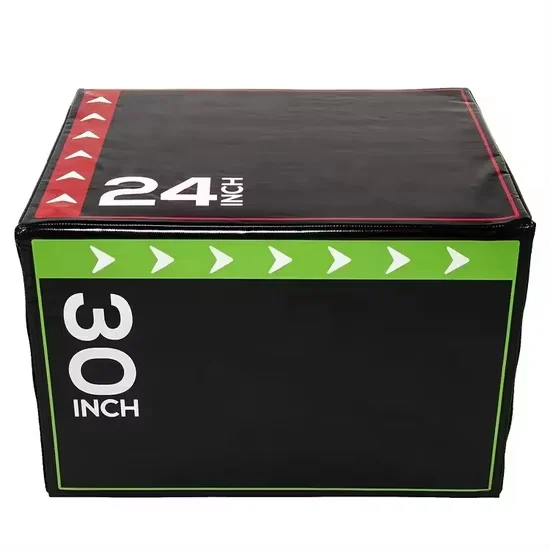
Soft Plyo Box, PVC Cover + EPE Core, 50×60×75cm — engineered for high-impact indoor jump training with consistent shock absorption and injury mitigation. High-density EPE maintains structural integrity under repeated loading, while the PVC surface ensures hygiene-friendly cleaning for shared studio use. Customizable logo and color options support brand alignment across equipment fleets. Each unit undergoes dimensional accuracy verification and load capacity validation before dispatch.
- Impact-absorbing EPE core reduces joint stress during fatigue-related form breakdown
- PVC cover resists moisture and simplifies sanitation in high-traffic environments
- Available in custom branding to match studio aesthetics and identity systems
Factory-direct production with full OEM capability and 32-point quality inspection per shipment.
- Commercial-grade durability -- built for 24/7 high-traffic facilities
- Whisper-quiet operation -- ideal for hotels & residential settings
- OEM/ODM available -- custom branding, finish & parameters
- Direct from factory -- Shandong, China with global export
Everything you need to know
PVC Hygiene Meets Foam Density Control — A high-density EPE core wrapped in a wipeable PVC cover delivers consistent impact absorption for repeated jump training without compressing over time.
Technical Specifications
| Parameter | Value |
|---|---|
| Product Type | Plyometric Box |
| Brand | WEKEEPING |
| Model NO. | PB-3000 |
| Product Name | Soft Jump Box |
| Material | PVC Cover + EPE Inside |
| Specification | 50 × 60 × 75 cm |
| Color | Black |
| Application | Indoor |
| Logo | Customized Logo Available |
| MOQ | 50 PCS |
| Customization | Available |
| Wood Species | not specified in source |
| Wood Type | solid or veneer not specified in source |
| Standards | not specified in source |
Application Suitability
| Setting | Typical Use |
|---|---|
| Boutique fitness studio | HIIT and functional training group classes requiring safe landing surfaces |
| Athletic performance facility | Plyometric progressions and explosive power conditioning |
| Rehabilitation and physiotherapy clinic | Graded jump training under professional supervision |
| Private residential studio | Low-impact cardiovascular and coordination work |
Why Low-Density Foam Fails Before the First Quarter Ends
A soft plyo box for jump training must hold its shape under repeated landings or it becomes a liability.
Studios that purchased budget plyo boxes quickly learned the pattern: the foam compresses within weeks, the surface tilts under uneven foot placement, and athletes begin landing on an unstable platform. That instability is exactly what a soft plyo box for jump training is supposed to prevent. In humid coastal environments, the problem compounds — foam absorbs ambient moisture, loses density, and the PVC skin begins to separate from the core. We kiln-dry every component to 8% moisture content before assembly because dimensional stability starts long before the first class. [NEED_CITE: foam density retention standards for high-impact fitness equipment]
Positioning Within a Functional Training Layout
This soft plyo box for jump training occupies a distinct role alongside heavier apparatus — it is the piece athletes grab for explosive movement drills, box jumps, and lateral hops where a hard landing surface would risk tibial stress. The 50 × 60 × 75 cm footprint fits comfortably between reformer lines in a boutique studio, and the soft construction means it can be repositioned mid-class without damaging flooring. It pairs naturally with resistance-based equipment where athletes transition from controlled strength work to dynamic power output. The single-height design keeps class transitions simple, and the weight allows instructors to move multiple units for circuit setups.
Floor Space, Ceiling Clearance, and Surface Environment
At 50 × 60 × 75 cm, the unit requires minimal floor allocation and no overhead clearance, making it suitable for studios with standard ceiling heights. The PVC cover tolerates standard studio disinfectants and can be wiped between users without degradation. Indoor-only rating means the unit should remain in climate-controlled environments — prolonged UV exposure or temperature extremes will accelerate PVC aging. The EPE core is not waterproof, so any seam compromise should be addressed before moisture reaches the foam interior. [NEED_CITE: PVC material compatibility with quaternary ammonium disinfectants]
Core Material Behavior Under Repeated Impact
The high-density EPE core is selected for its closed-cell structure, which resists permanent compression better than open-cell alternatives. This matters in a shared studio where dozens of athletes land on the same surface daily. The PVC cover provides a non-porous, wipeable barrier that maintains hygiene across multiple users and resists the sweat and shoe rubber contact typical in high-intensity environments. The soft construction eliminates the sharp-edge injury risk inherent in wooden plyo boxes when athletes fatigue and miss their landing zone. Color consistency across a multi-unit order ensures visual uniformity on the studio floor. [NEED_CITE: closed-cell foam compression set testing for fitness applications]
The Hidden Cost of Foam That Compresses
When a plyo box loses density, the consequences are immediate and visible. The surface develops a permanent depression where athletes repeatedly land, creating an uneven platform that shifts underfoot during lateral drills. In a group class setting, this means athletes on different boxes experience different landing heights — a programming inconsistency that undermines standardized class design. Cheaper foam also off-gas volatile compounds that become noticeable in poorly ventilated studios, particularly during warm-up when the material is still cool. Non-standard dimensions across a batch create mismatched heights that force instructors to constantly adjust exercise progressions. [NEED_CITE: foam off-gassing thresholds for indoor fitness environments]
Why Studio Owners Specify WEKEEPING for Soft Landing Equipment
Every unit undergoes density verification to ensure the EPE core meets compression resistance specifications before the PVC cover is applied. The cover material is selected for skin-contact safety and cleanability in shared studio environments. Customization extends to logo placement and color matching, so a studio ordering multiple units receives a visually consistent set that reinforces brand identity. The 50 × 60 × 75 cm dimension is validated for dimensional accuracy across production batches, ensuring interchangeability in circuit training setups. Studio owners specifying this soft plyo box for jump training receive documentation confirming material composition and safety compliance.
Documentation & Material Records
- PVC material safety documentation for skin contact and indoor air quality
- EPE foam density specification and compression resistance data
- Dimensional accuracy verification record for 50 × 60 × 75 cm tolerance
- Customization approval sheet covering logo placement and color confirmation
- Assembly and care guide with cleaning protocol for PVC surfaces
- Spare parts and replacement cover ordering information
Installation, Care & Studio Setup
- Place on flat, level flooring; the 50 × 60 cm base requires no anchoring or wall clearance
- Wipe PVC surface with mild disinfectant between users; avoid abrasive cleaners that degrade the cover
- Store indoors in climate-controlled conditions; prolonged heat exposure accelerates foam aging
- Inspect seams quarterly for separation; compromised seams allow moisture into the EPE core
- Rotate unit orientation periodically to distribute compression evenly across the landing surface
Before You Order: What We Need From Your Studio
Provide your studio floor plan and equipment layout so we can confirm how many units fit your circuit training configuration. Specify your climate zone and ventilation setup to verify the PVC and EPE materials suit your environment. Share your branding requirements — logo files, color codes, and quantity — so we can confirm customization lead time and minimum order alignment. Material safety documentation and foam density specifications are available upon request before commitment.
Frequently Asked Questions
Q: How does EPE foam density affect long-term durability and performance? A: Higher-density EPE maintains its shape under repeated impact because the closed-cell structure resists permanent compression. In a studio environment with daily use across multiple athletes, this means the landing surface remains level and stable over an extended service life. Lower-density alternatives compress quickly, creating uneven surfaces that compromise training consistency and increase instability during landings.
Q: What are the cleaning and maintenance requirements for PVC-covered plyo boxes? A: The PVC surface can be wiped with standard studio disinfectants between users. Avoid abrasive cleaners or solvents that degrade the cover over time. Inspect seams periodically for any separation, as moisture entering the EPE core through compromised seams will affect foam integrity. Regular visual inspection ensures the unit remains hygienic and structurally sound for shared use.
Q: Can the box be customized with studio branding and color schemes? A: Customization is available for logo placement and color matching to align with your studio brand identity. Provide logo files and color specifications during the inquiry stage so production can confirm feasibility and lead time. Multi-unit orders receive consistent branding and color across all pieces, ensuring visual uniformity on your studio floor.
Q: What is the weight capacity and stability rating for different user sizes? A: The 50 × 60 × 75 cm dimension and high-density EPE core provide a stable platform for athletes across a range of body sizes during jump training. The soft construction absorbs impact while maintaining structural integrity under repeated landings. For specific load requirements, request the dimensional accuracy verification and foam density documentation during the inquiry process.
Q: How does soft construction compare to wooden boxes for injury prevention? A: Soft construction eliminates the sharp-edge injury risk present in wooden plyo boxes when athletes fatigue and miss their landing zone. The PVC-covered EPE surface absorbs impact while providing a stable, non-slip platform. In group class settings where form breakdown occurs under fatigue, the soft surface reduces the consequence of mislanded jumps compared to rigid wooden alternatives.
Trusted by global procurement teams
From five-star hotels to flagship gyms, our cardio equipment delivers reliability, intelligence, and silence -- everywhere it's installed.
Whisper Drive™
Suspended motor mounts keep noise below 52 dB -- quieter than a library.
Smart Monitoring
Real-time HR, cadence, power & recovery analytics for every session.
Custom Design
Tailor finishes, console UI, branding and frame parameters to your facility.
Turnkey Service
End-to-end consultation: layout, equipment mix, acoustic treatment delivered.
Request a quote for
SKIP: no source title
Our specialists reply within one business day with tailored pricing, customization options, and shipping estimates.
Related Products

Custom Logo EVA Foam Roller for Yoga Practice

Eco-Friendly 6mm Yoga Mat with Custom Logo Options

SKIP: no source title
