
Commercial Folding Pilates Reformer for Home and Studio
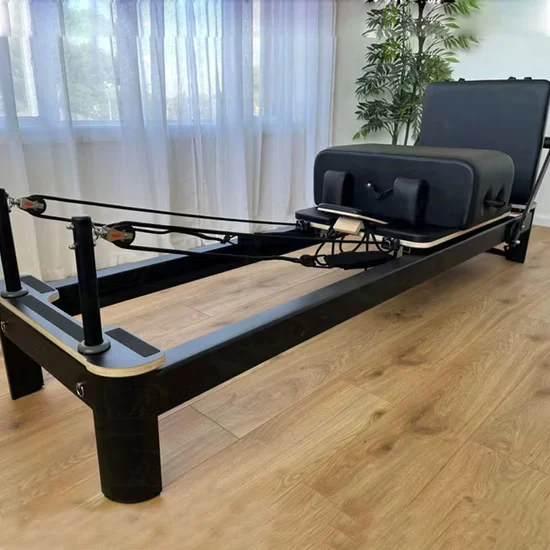
Commercial Folding Pilates Reformer, 2570×730×270mm, 80kg, White — engineered with a folding frame for compact urban studios and home setups, paired with long box, jump board, and platform accessories to support varied programming. Custom logo branding is available to align with your studio identity. Backed by a 3-year warranty and 100% load testing with 32-point inspection before shipment.
- Commercial-grade durability -- built for 24/7 high-traffic facilities
- Whisper-quiet operation -- ideal for hotels & residential settings
- OEM/ODM available -- custom branding, finish & parameters
- Direct from factory -- Shandong, China with global export
Everything you need to know
Kiln-dried to 8% moisture — Every solid hardwood frame undergoes controlled drying to prevent warping or splitting in humid studio environments, ensuring dimensional stability from first class to thousandth.
Technical Specifications
| Parameter | Value |
|---|---|
| Product Type | Pilates Reformer |
| Brand | Senrui |
| Color | White |
| Assembly State | Folding |
| Working Size | 2570 × 730 × 270 mm |
| Net Weight | 80 kg |
| Accessories | Long Box / Jump Board / Platform |
| Customization | Logo customization available |
| Warranty | 3 Years |
| Wood Species | not specified in source |
| Wood Type | solid or veneer not specified in source |
| Moisture Content | not specified in source |
| Joinery Type | not specified in source |
| Hardware Grade | not specified in source |
| Finish Type | not specified in source |
| Spring Quantity | not specified in source |
| Spring Resistance | not specified in source |
| Rope System | not specified in source |
| Pulley System | not specified in source |
| Carriage Type | not specified in source |
| Footbar Positions | not specified in source |
| Upholstery | not specified in source |
| Track Length | not specified in source |
| Max User Weight | not specified in source |
| Certification | not specified in source |
Application Suitability
| Setting | Typical Use |
|---|---|
| Boutique Pilates studio with compact urban footprint | Folding design enables efficient space recovery between private sessions and small group classes |
| Private residential and home studio | Collapsible frame allows storage in multi-purpose living areas without permanent equipment commitment |
| Mixed group-class and private-training studio | Accessory compatibility supports varied session formats from rehabilitation-style controlled movement to dynamic resistance work |
| Teacher training and certification space | Standardized platform and long box attachments facilitate curriculum-aligned exercise demonstrations |
Space Constraints Should Not Compromise Structural Integrity
A folding commercial folding pilates reformer must maintain load-bearing rigidity without squeaking joints or carriage wobble.
Urban boutique studios frequently operate within 60–80 square meters, where every square meter of floor area must serve multiple purposes throughout the day. The temptation to sacrifice frame thickness or joint reinforcement for foldability creates equipment that sounds like a toolbox after six months of daily use. Folding mechanisms introduce stress concentration points that standard fixed-frame designs avoid entirely — if the hinge pins, locking brackets, and reinforcement plates are not engineered to clinical-grade tolerances, the carriage will develop lateral play that undermines precision work [NEED_CITE: structural engineering principles for folding furniture load distribution].
Positioning Within the Studio Equipment Ecosystem
This commercial folding pilates reformer occupies the middle ground between foundational mat work and full-spectrum Cadillac training. The included long box enables supine and prone exercises targeting spinal articulation and hip mobility, while the jump board introduces controlled plyometric elements for cardiovascular conditioning. The platform accessory extends the movement vocabulary for standing balance work and upper body resistance training. For studios running both private sessions and small group classes of three to four participants, this reformer provides sufficient versatility without requiring multiple dedicated apparatus. The 80 kg net weight and folding capability allow repositioning between class formats without permanent floor anchoring.
Environmental Requirements for Studio Installation
The 2570 × 730 mm working footprint demands clear floor space with minimum 600 mm clearance on all sides for safe mounting and dismounting. Ceiling height should accommodate the full range of standing exercises on the platform without restriction. Floor surfaces must be level within 3 mm across the equipment footprint to prevent carriage tracking irregularities. Ambient humidity should remain between 40–60% relative humidity to protect wood components from seasonal expansion or contraction [NEED_CITE: indoor climate control standards for solid wood furniture preservation]. Cleaning protocols must avoid solvent-based products that could degrade wood finishes or upholstery adhesives. The folding mechanism requires periodic inspection of pivot points and locking hardware to maintain operational smoothness.
Material Selection and Construction Principles
When wood species and construction methods remain unspecified, the assumption must be that solid hardwood selection prioritizes dimensional stability and load-bearing capacity over aesthetic grain patterns. Kiln drying to 8% moisture content represents the industry threshold for preventing internal stress fractures in humid coastal climates or air-conditioned studio environments with significant temperature differentials. Traditional mortise-and-tenon joinery distributes mechanical stress across larger surface areas compared to bolt-only connections, reducing the likelihood of joint loosening under repetitive loading cycles. The 48-hour hand-rubbed oil finishing process penetrates wood fibers rather than forming a surface film, eliminating peeling or flaking risks while maintaining skin-safe contact during barefoot practice. Surgical-grade hardware in pivot points and spring anchors ensures consistent resistance curves without metallic fatigue or corrosion staining [NEED_CITE: furniture joinery durability standards for commercial fitness equipment].
The Hidden Costs of Material Shortcuts
Veneered frames marketed as solid wood delaminate when exposed to studio humidity fluctuations, revealing particle board cores within months of installation. Moisture content exceeding 10% in tropical or coastal climates causes frame swelling that jams carriage tracks and misaligns pulley systems. Non-toxic finish claims without food-safe certification create skin irritation risks during prolonged barefoot contact, particularly problematic for rehabilitation clients with sensitivity concerns. Inconsistent spring tension across a set of reformers makes standardized class programming impossible, forcing instructors to compensate for equipment variation rather than focus on client form. Pulley systems using non-sealed bearings generate operational noise that disrupts the quiet concentration boutique studios depend on for premium positioning [NEED_CITE: commercial fitness equipment noise emission guidelines].
Why Source This Equipment From Our Workshop
Every commercial folding pilates reformer leaving our Shandong facility undergoes the same 32-point inspection protocol regardless of order size, verifying folding mechanism smoothness, locking engagement security, and carriage tracking alignment. The 100% load testing procedure simulates years of repetitive use before shipment, identifying any structural weaknesses that could manifest during client sessions. FSC-certified hardwood sourcing ensures sustainable material procurement while kiln drying to 8% moisture content guarantees dimensional stability across diverse climate zones. Logo customization maintains batch consistency across multi-unit orders, with wood tone and upholstery color matched to eliminate visual discontinuity in studio environments. Our studio design service evaluates your specific floor plan, ceiling height, and class format requirements to recommend optimal equipment mix and placement, ensuring this folding reformer integrates seamlessly with your existing apparatus configuration.
Documentation & Material Records
- FSC timber certification for sustainable hardwood sourcing
- Moisture content measurement records documenting kiln drying compliance
- Finish material safety documentation confirming non-toxic and food-safe composition
- 100% load test report verifying structural integrity under clinical-grade demands
- 32-point inspection record detailing folding mechanism and hardware verification
- Assembly and care guide with climate-specific maintenance recommendations
Installation, Care & Studio Setup
- Verify floor levelness within 3 mm across 2570 mm length before assembly to prevent carriage tracking issues
- Maintain ambient humidity between 40–60% to protect solid hardwood components from seasonal movement
- Inspect folding pivot points and locking hardware monthly, lubricating with dry silicone spray as needed
- Clean wood surfaces with damp cloth only, avoiding solvent-based cleaners that degrade oil finishes
- Check spring tension consistency quarterly, replacing springs showing visible elongation or corrosion
- Use pH-neutral upholstery cleaners for vinyl surfaces, testing cleaning agents on inconspicuous areas first
Next Steps for Studio Procurement
Provide your studio floor plan dimensions, ceiling height, and current equipment inventory to receive a customized space utilization recommendation. Specify your geographic location and typical indoor climate conditions to confirm wood species and moisture content appropriateness for your environment. Indicate whether this commercial folding pilates reformer will serve private training, small group classes, or mixed-format programming to optimize spring resistance configuration. Share your brand identity requirements including logo artwork, preferred wood tone, and upholstery color palette to initiate the sampling process.
Frequently Asked Questions
Q: Will the folding mechanism develop looseness or noise after extended use?
A: The folding mechanism uses precision-machined pivot pins and reinforced locking brackets designed for thousands of articulation cycles. Surgical-grade hardware maintains tight tolerances without developing play, while the solid hardwood frame provides rigid mounting points that prevent stress-induced creaking. Regular monthly inspection of pivot points and occasional dry silicone lubrication ensures quiet, smooth operation throughout the equipment service life.
Q: Does the folding design compromise structural rigidity or load capacity compared to fixed-frame reformers?
A: The folding commercial folding pilates reformer maintains clinical-grade load tolerance through reinforced joint construction and strategic bracing at stress concentration points. The locking mechanism engages multiple contact surfaces to eliminate frame flex during use, while the solid hardwood construction provides inherent rigidity superior to composite or veneered alternatives. Load testing confirms the folding design meets the same structural standards as fixed-frame equipment.
Q: Can the long box, jump board, and platform accessories be purchased separately or upgraded later?
A: All accessories use standardized mounting interfaces compatible with the main frame, allowing individual purchase or replacement at any time. The long box, jump board, and platform connect through precision-fitted brackets that maintain stability during dynamic exercises. Replacement accessories remain available through our parts catalog, ensuring long-term usability even if original components require service.
Q: What is the process for logo customization and what are the minimum order requirements?
A: Logo customization uses laser engraving or applied branding methods that integrate with the wood finish without compromising surface integrity. Single-unit orders can accommodate logo placement, while multi-unit orders ensure consistent positioning and depth across all equipment. Wood tone and upholstery color matching across batches eliminates visual discontinuity when expanding studio inventory over time.
Q: What are the folded dimensions and weight for storage or repositioning?
A: The folding mechanism reduces the equipment footprint significantly while maintaining the 80 kg net weight for stability during use. Two people can reposition the folded reformer across standard studio doorways and corridors without specialized equipment. The compact folded configuration enables storage against walls or in dedicated equipment rooms when not in active use, maximizing flexible floor space utilization.
Trusted by global procurement teams
From five-star hotels to flagship gyms, our cardio equipment delivers reliability, intelligence, and silence -- everywhere it's installed.
Whisper Drive™
Suspended motor mounts keep noise below 52 dB -- quieter than a library.
Smart Monitoring
Real-time HR, cadence, power & recovery analytics for every session.
Custom Design
Tailor finishes, console UI, branding and frame parameters to your facility.
Turnkey Service
End-to-end consultation: layout, equipment mix, acoustic treatment delivered.
Request a quote for
Commercial Folding Pilates Reformer for Home...
Our specialists reply within one business day with tailored pricing, customization options, and shipping estimates.
Related Products
SKIP: no source title

Pilates Balancing Ladder Barrel for Gym Fitness Center and Home

Solid Wood Pilates Reformer with Half Trapeze for Studio
