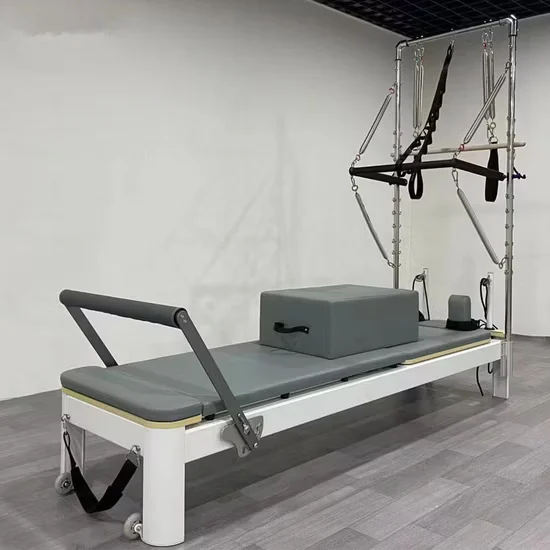
Pilates Reformer with Tower Half Trapeze for Yoga Studio Use
SRY-12 Pilates Reformer with Tower & Half Trapeze, 2570×730×1850mm, 130kg Net Weight — solid hardwood frame with mortise-and-tenon joinery, surgical-grade hardware, and customizable upholstery for studio branding. Each unit undergoes 32-point inspection and 100% load testing before shipment, ensuring clinical-grade stability for rehabilitation and boutique studio use.
- FSC-certified hardwood, kiln-dried to 8% moisture content for dimensional stability
- 48-hour hand-rubbed natural oil finish, non-toxic and skin-friendly
- Includes long box, jump board, and platform; 3-year warranty
- CE compliant; logo customization available
Every reformer ships with FSC timber certification, moisture content records, and load test reports — verified craftsmanship for studios demanding furniture-grade quality and clinical precision.
- Commercial-grade durability -- built for 24/7 high-traffic facilities
- Whisper-quiet operation -- ideal for hotels & residential settings
- OEM/ODM available -- custom branding, finish & parameters
- Direct from factory -- Shandong, China with global export
Everything you need to know
Kiln-Dried Stability — 8% moisture content prevents warping in humid studio climates.
Technical Specifications
| Parameter | Value |
|---|---|
| Designation | SRY-12 |
| Product Type | Pilates Reformer with Tower / Half Trapeze |
| Brand | Senrui |
| Color | White |
| Target User | Adult, Unisex |
| Logo | Customized is allowed |
| Accessory | Long Box / Jump Board / Platform |
| Working Size | 2570 × 730 × 1850 mm |
| Net Weight | 130 kg |
| Warranty | 3 Years |
| Production Capacity | 80 Pieces / Month |
| Wood Species | not specified in source |
| Wood Type (solid or veneer) | not specified in source |
| Moisture Content | not specified in source |
| Joinery Type | not specified in source |
| Hardware Grade | not specified in source |
| Finish Type | not specified in source |
| Spring Quantity | not specified in source |
| Spring Resistance | not specified in source |
| Rope System | not specified in source |
| Pulley System | not specified in source |
| Carriage Type | not specified in source |
| Footbar Positions | not specified in source |
| Upholstery | not specified in source |
| Track Length | not specified in source |
| Max User Weight | not specified in source |
| Assembly State | not specified in source |
| Certification | CE (implied — verify against manufacturer catalog) |
Application Suitability
| Setting | Typical Use |
|---|---|
| Rehabilitation and physiotherapy clinic | Graded resistance exercises and controlled movement protocols under professional supervision |
| Boutique Pilates studio — group class | Full-body reformer sessions with tower-assisted spring work for intermediate to advanced participants |
| Private residential studio | Personal practice with half trapeze accessory for upper-body and spinal articulation work |
| Hotel spa and wellness suite | Guest-facing equipment where furniture-grade aesthetics complement the interior design |
| Teacher training and certification space | Multi-level exercise demonstration using tower and half trapeze attachment points |
Why Veneer Frames Fail the Humidity Test Long Before the Warranty Expires
Solid hardwood, properly kiln-dried, resists the swelling and delamination that veneered composites cannot survive in moisture-heavy studio environments.
Studio owners across subtropical and coastal regions report frames marketed as solid wood beginning to separate at the edges within months of daily use. The core issue is moisture: composite substrates expand at different rates than their veneer skins, creating internal stress that eventually cracks the surface or lifts the laminate entirely. When a pilates reformer with tower half trapeze sits in a room where humidity fluctuates between air-conditioned dryness and open-door dampness, only genuine solid hardwood with controlled moisture content can maintain dimensional integrity over years of service. [NEED_CITE: moisture content standards for solid wood furniture stability in tropical climates]
Positioning the SRY-12 Within a Studio Equipment Layout
This pilates reformer with tower half trapeze occupies the mid-to-full spectrum of resistance training, supporting exercises from gentle mobilization to high-load spring work. The tower structure adds vertical spring lines for standing and kneeling sequences, while the half trapeze extends overhead reach options. In a studio floor plan, it pairs naturally with a mat station for warm-up flow and a Wunda chair for lower-body isolation. The 2570 × 730 mm footprint accommodates standard studio ceiling heights, and the working height of 1850 mm requires clearance verification for overhead rigging. It suits both private sessions and small-group formats of four to six participants when multiple units are deployed.
Environmental Requirements for Studio and Clinic Installation
The SRY-12 demands a level, load-bearing floor capable of supporting 130 kg of static weight plus dynamic user force. Ambient humidity should remain between 40% and 60% to protect the wood frame from seasonal expansion or contraction. Direct sunlight on the frame should be minimized to prevent finish degradation and wood tone shifting over time. Cleaning agents must be compatible with the surface finish — harsh solvents can break down natural oil coatings and compromise the skin-contact safety of the frame. In multi-unit studio environments, consistent ventilation across all rooms prevents uneven moisture exposure that leads to mismatched wood tone across the fleet. [NEED_CITE: indoor humidity range recommendations for solid wood exercise equipment]
Material and Construction Principles Behind the Frame
When wood species and solid-or-veneer status are not confirmed by the manufacturer, buyers should request cross-section samples and FSC documentation before committing to a bulk order. The distinction matters: solid hardwood frames, kiln-dried to approximately 8% moisture content, resist the warping and joint separation that plague composite constructions in active studio environments. Traditional mortise-and-tenon joinery, reinforced with surgical-grade hardware, distributes load across the grain rather than relying on single-point fasteners that loosen over time. The pulley and carriage system determines both the smoothness of movement and the acoustic footprint of the equipment — sealed bearings and precision-machined tracks eliminate the squeaking that disrupts the quiet concentration a studio depends on. Surface treatment with hand-rubbed natural oils, cured over an extended period, creates a finish that is non-toxic, food-safe, and gentle on bare skin during close-contact practice. [NEED_CITE: traditional mortise-and-tenon joinery durability in high-frequency furniture applications]
The Hidden Cost of Material Shortcuts
Frames constructed from veneered particleboard begin showing edge lift and surface bubbling within a single humid season, particularly in studios without climate control. Coatings that have not passed food-grade safety testing can cause skin irritation during barefoot, hands-on practice — a liability that triggers batch returns and reputational damage. Spring sets with inconsistent tension across units make standardized class programming impossible, as instructors cannot predict resistance levels when rotating between machines. Non-standard pulley hardware means replacement parts become unavailable once the original supplier discontinues the line, forcing full carriage replacement instead of a simple bearing swap. [NEED_CITE: skin safety standards for finishes on bare-contact exercise equipment]
Why Studio Owners Specify Customization at the Source
The SRY-12 supports logo customization, allowing studio brands to integrate their identity directly into the equipment. When ordering multiple units, batch-matched wood tone and upholstery color ensure visual consistency across the studio floor. Buyers should communicate their climate zone during the specification phase so that moisture content and finish selection can be adjusted accordingly. The factory provides studio design consultation covering equipment layout, mix recommendations, and brand alignment — a service that accounts for the SRY-12's 2570 mm working length and 1850 mm tower height when planning ceiling clearance and traffic flow. Every unit undergoes 100% load testing and a 32-point inspection before shipment, with documentation available for review prior to deposit.
Documentation & Material Records
- FSC timber certification for hardwood traceability and sustainable sourcing
- Kiln-dried moisture content record confirming dimensional stability preparation
- Finish material safety documentation verifying non-toxic, food-grade surface treatment
- 100% load test report for each individual unit prior to shipment
- 32-point inspection record covering structural, mechanical, and cosmetic criteria
- CE declaration of conformity for European market regulatory alignment
- Spring tension specification sheet for resistance calibration reference
- Assembly, care guide, and spare parts replacement list included per shipment
Installation, Care & Studio Setup
- Verify floor levelness and load capacity for the 2570 × 730 mm footprint and 130 kg net weight before placement
- Maintain ambient humidity between 40%–60% to protect the solid hardwood frame from seasonal movement
- Clean the frame surface with mild, non-solvent cleaners compatible with natural oil finishes to preserve skin-safe properties
- Inspect spring tension and pulley smoothness quarterly; replace springs in full sets to maintain resistance consistency
- Wipe carriage track with a dry cloth after each session; avoid abrasive tools that could damage the rail surface
- Reapply manufacturer-recommended natural oil to the wood frame annually or as needed based on usage frequency and climate
Next Steps for Studio Procurement
Share your studio floor area, ceiling height, and target equipment list to receive a layout proposal covering the SRY-12 placement and complementary pieces. Indicate your regional climate zone so that wood moisture content and finish specifications can be matched to your environment. Specify your usage context — group class, private instruction, or clinical setting — to align spring resistance configuration with your programming needs. Request wood finish samples and coating safety documentation to verify material compatibility before placing a production order.
Frequently Asked Questions
Q: How can I verify the frame is solid hardwood rather than veneered composite? A: Request a cross-section sample or factory visit to inspect the edge grain pattern. Solid hardwood shows continuous grain through the thickness, while veneered composite reveals a layered substrate beneath a thin surface skin. Ask for FSC certification and moisture content records as supporting evidence of genuine solid wood sourcing and proper kiln-drying preparation.
Q: What humidity range should my studio maintain to protect the wood frame? A: Solid hardwood performs best when ambient relative humidity stays between 40% and 60%. Below this range, the wood can lose moisture and develop surface checking or joint gaps. Above it, the frame absorbs excess moisture and may swell, affecting carriage alignment and spring anchor points. Consistent climate control across all studio rooms prevents uneven exposure that leads to visual and structural mismatch over time.
Q: Can the wood tone and upholstery color be matched across a multi-unit order? A: Yes. When ordering multiple units in a single production batch, the factory coordinates wood selection and upholstery dye lots to ensure visual consistency. Specify your color preferences during the quotation stage and request pre-production color confirmation samples. This process prevents the tonal variation that occurs when units are produced in separate runs with different material batches.
Q: What surface cleaning products are safe for the frame finish? A: Use only mild, non-solvent cleaners recommended by the manufacturer. Harsh chemicals, alcohol-based sanitizers, and abrasive scrubbing pads can degrade the natural oil finish, exposing raw wood to moisture and compromising the skin-safe surface. Wipe with a damp cloth and dry immediately. For studio-grade disinfection between clients, confirm with the factory which approved products maintain the finish integrity without voiding the warranty.
Trusted by global procurement teams
From five-star hotels to flagship gyms, our cardio equipment delivers reliability, intelligence, and silence -- everywhere it's installed.
Whisper Drive™
Suspended motor mounts keep noise below 52 dB -- quieter than a library.
Smart Monitoring
Real-time HR, cadence, power & recovery analytics for every session.
Custom Design
Tailor finishes, console UI, branding and frame parameters to your facility.
Turnkey Service
End-to-end consultation: layout, equipment mix, acoustic treatment delivered.
Request a quote for
Pilates Reformer with Tower Half Trapeze...
Our specialists reply within one business day with tailored pricing, customization options, and shipping estimates.
Related Products

Professional Oak Pilates Reformer with Full Trapeze for Studio
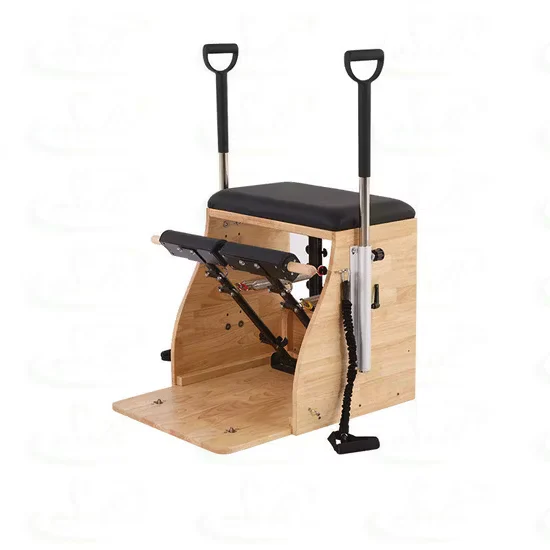
Natural Oak Pilates Combo Chair Wooden Pilates Equipment for Studio Use
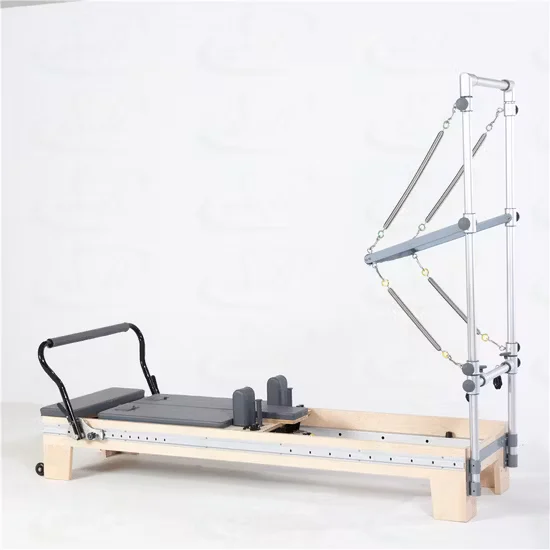
Solid Wood Core Align Pilates Reformer for Studio
