
Which Commercial Fitness Equipment Brand Offers the Longest Warranty Period?
Most gym buyers believe the longest warranty means the best equipment, but this approach often leads to unexpected costs when claims get denied based on fine print you didn't notice during purchase.
The typical commercial fitness equipment warranty ranges from 2 to 10 years depending on component classification1, but duration alone doesn't predict whether your actual repair costs will be covered when equipment fails under your specific usage conditions.
Before you base your equipment decision on warranty length numbers, you need to understand why two "5-year warranties" from different suppliers can produce completely different outcomes when you file a claim.
Why Do Buyers Focus on Warranty Period Rankings?
When you compare equipment options, warranty duration stands out as the most visible differentiator on specification sheets, making it the easiest metric to compare across brands without technical knowledge.
Warranty period serves as a mental shortcut for quality assessment2 because longer coverage implies manufacturer confidence in durability, but this logic breaks down when you examine what the warranty actually covers versus excludes.
The Psychology Behind Warranty-Based Selection
From my experience reviewing equipment procurement decisions, buyers gravitate toward warranty duration for three reasons3. First, it provides objective comparison between brands when you lack technical expertise to evaluate build quality. Second, longer warranties feel like insurance against unknown future costs. Third, warranty period appears in marketing materials and sales presentations as a primary feature.
This creates a market dynamic where suppliers compete on warranty length rather than warranty structure4. You see promotional materials highlighting "10-year frame warranty" in large text while the actual coverage terms appear in contract appendices you receive after initial discussions.
| Buyer Priority | Why It Happens | What Gets Missed |
|---|---|---|
| Longest frame warranty | Easy to compare across brands | Frame rarely fails; high-wear parts excluded |
| Total coverage years | Seems like cost protection | Different parts have different coverage periods |
| "Lifetime warranty" claims | Sounds like permanent protection | "Lifetime" defined as product lifecycle, not buyer ownership period |
| Matching competitor offerings | Competitive parity logic | Claim processing difficulty not visible until after purchase |
The problem intensifies because warranty discussions happen during sales conversations, not during actual claim filing. When you negotiate equipment purchase, the supplier representative emphasizes coverage duration. When your equipment needs repair 18 months later, you interact with a service department following contract terms you didn't thoroughly review.
How Suppliers Structure Warranty Communication
Equipment suppliers separate warranty marketing from warranty execution deliberately. The sales process highlights maximum coverage duration for any component. The contract specifies different periods for frame, mechanical parts, electronics, and wear components.
I've seen this pattern repeatedly: promotional materials state "5-year comprehensive warranty" while contracts show 5 years for frame, 3 years for mechanical systems, 1 year for electronics, and 90 days for wear parts like belts and cables. You discover this classification only when filing claims, not when comparing options.
What Makes Warranty Duration Misleading as a Selection Criterion?
Warranty length misleads buyers because it doesn't reveal coverage gaps, exclusion clauses, or claim approval processes that determine whether you actually receive no-cost repairs when equipment fails.
The gap between advertised warranty period and actual covered repairs appears in three areas: parts classification that excludes high-failure components, usage intensity definitions that void commercial coverage, and maintenance documentation requirements buyers rarely meet.
Parts Classification Creates Coverage Gaps
Every equipment warranty divides components into categories with different coverage periods, but these classifications often place the parts most likely to fail into the shortest coverage windows.
Structural frames receive the longest warranty periods because they rarely fail during normal use5. Mechanical components like pulleys and bearings get medium-term coverage. Electronics and control systems receive shorter periods. Wear parts like grips, seats, and cables receive minimal coverage or explicit exclusion.
| Component Type | Typical Coverage Period | Failure Likelihood | Your Actual Cost Risk |
|---|---|---|---|
| Frame and welds | 5-10 years | Very low | Minimal (rarely needs repair) |
| Mechanical systems | 2-5 years | Moderate | Medium (some failures occur) |
| Electronics/displays | 1-3 years | High | Significant (frequent issues) |
| Wear parts | 90 days - 1 year | Very high | Maximum (regular replacement needed) |
When you evaluate "longest warranty" claims, check which components get classified into each category. Some suppliers place more items into wear parts exclusions than others, despite offering similar total warranty duration.
Commercial Use Definitions Void Coverage
Many equipment suppliers offer different warranty terms for home versus commercial use6, but the commercial definition in contracts often excludes typical gym operating patterns.
Commercial warranties might specify "standard commercial use" without defining usage hours, intensity levels, or user turnover rates. When you file a claim, the supplier investigates your actual usage and may determine it exceeded "standard" levels, voiding coverage.
I've seen contracts define commercial use as 40 hours weekly with 8-hour daily limits. If your gym operates 18 hours daily or serves high-intensity training facilities, your actual use pattern doesn't qualify under the commercial warranty terms despite purchasing equipment marketed for commercial applications.
Maintenance Documentation Requirements Block Claims
Most commercial warranties require documented maintenance according to manufacturer specifications7, but buyers rarely maintain the detailed records needed to prove compliance when filing claims.
Supplier service departments request maintenance logs, service receipts, and parts replacement records when you submit warranty claims. Without complete documentation, they deny coverage based on "lack of proper maintenance" regardless of warranty period remaining.
| Required Documentation | When You Need It | Why Buyers Don't Have It |
|---|---|---|
| Monthly inspection logs | Every warranty claim | No staff assigned to documentation |
| Professional service records | Every warranty claim | Used in-house maintenance to save costs |
| Parts replacement history | Claims involving related systems | Didn't know tracking was required |
| Usage hour meters | Claims questioning intensity | Equipment doesn't have meters installed |
How Do Major Brands Structure Their Warranty Offerings?
Major commercial fitness equipment manufacturers structure warranties around component classification, usage categories, and service network capabilities rather than competing purely on maximum duration numbers.
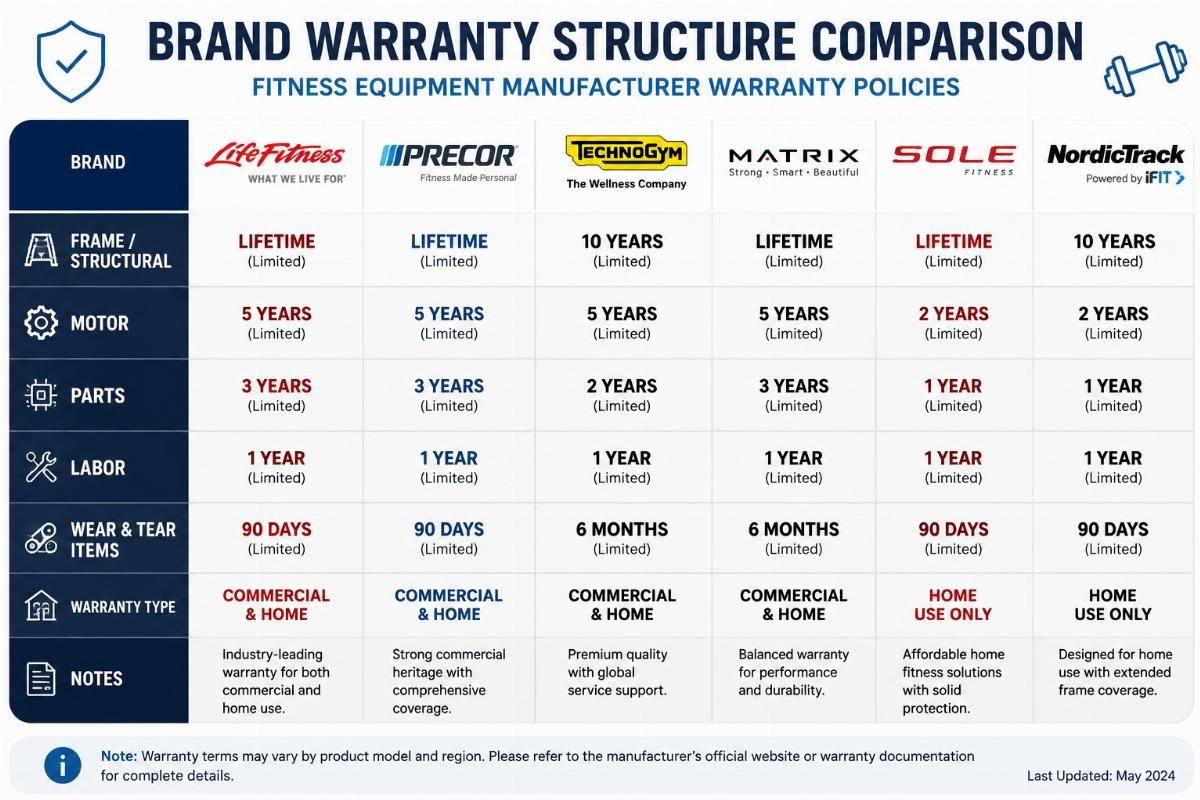
As of 2024, leading brands typically offer 7-10 year frame warranties, 3-5 year mechanical coverage, 1-3 year electronics protection, and 90-day to 1-year wear parts coverage8, but actual terms vary by equipment category and purchase volume.
Enterprise Brand Warranty Patterns
Established manufacturers with extensive service networks structure warranties to balance coverage promises with claim processing capacity. They separate frame components from functional systems and define commercial use categories by facility type.
These suppliers offer tiered warranty structures based on purchase volume and maintenance contract enrollment. You get baseline coverage with equipment purchase, extended coverage if you buy service packages, and enhanced terms for fleet purchases above certain thresholds.
The warranty structure typically includes manufacturer defects in materials and workmanship but excludes normal wear, improper installation, unauthorized modifications, and lack of specified maintenance. They define "defect" narrowly while defining "wear" broadly, creating interpretation space that favors claim denial.
Regional Brand Warranty Approaches
Smaller manufacturers and regional suppliers often advertise longer warranty periods than enterprise brands because they compete on price and perceived value rather than service network coverage.
You might see 10-year or lifetime frame warranties from these suppliers, but the warranty execution depends on business continuity and service availability. If the supplier exits your market or closes operations, the warranty promise becomes worthless9 regardless of remaining coverage period.
How Service Network Affects Warranty Value
Warranty value depends not just on coverage terms but on service network density and parts availability. A shorter warranty from a supplier with local service centers and parts inventory delivers more value than a longer warranty requiring equipment shipment to distant service facilities.
| Service Network Factor | Impact on Warranty Value | What to Verify Before Purchase |
|---|---|---|
| Local authorized service | Faster claim resolution | Number of technicians within 50 miles |
| Parts inventory location | Reduced downtime | Average parts delivery time to your location |
| Direct vs. distributor service | Claim approval authority | Who actually processes warranty decisions |
| Service response time guarantees | Equipment downtime cost | Contractual response time for your facility tier |
What Should You Evaluate Instead of Warranty Length?
Instead of comparing warranty duration numbers, you should evaluate warranty structure transparency, parts classification logic, claim processing requirements, and supplier service capability before equipment purchase.
Effective warranty evaluation requires reviewing actual contract terms, testing claim filing processes with reference customers, and calculating total cost of ownership based on realistic coverage expectations rather than maximum advertised periods.
Review Warranty Contract Terms Before Purchase
Request complete warranty contract language before finalizing equipment selection, not after purchase. Compare actual terms across suppliers rather than marketing summary sheets.
Check these specific areas in warranty contracts: parts classification definitions, commercial use specifications, maintenance requirements and documentation, claim filing procedures and response times, dispute resolution processes, pro-rated versus full replacement coverage, and labor cost inclusion versus exclusion.
Create a comparison matrix that captures these details for each supplier option. This reveals differences marketing materials don't show and helps you predict which warranty will actually cover your repair needs.
Verify Claim Processing Requirements
Contact existing customers of each supplier and ask about their warranty claim experiences. You want to know claim approval rates, documentation requirements, processing timelines, and parts availability.
Specific questions to ask: How long does claim approval take? What documentation have you needed? Have claims been denied, and for what reasons? Does the supplier cover labor costs? How quickly do parts arrive after claim approval?
Calculate True Coverage Value
Calculate warranty value based on components most likely to need repair rather than longest coverage periods. If electronics fail frequently but only receive 1-year coverage while frames get 10-year protection but rarely fail, the warranty structure doesn't match your actual risk.
| Evaluation Factor | Why It Matters More Than Duration | How to Assess It |
|---|---|---|
| Parts classification transparency | Reveals what's actually covered | Request detailed parts list by category |
| Usage pattern alignment | Determines if your operation qualifies | Compare your hours/intensity to contract definitions |
| Documentation burden | Affects claim approval likelihood | Review required logs and service records |
| Service network proximity | Controls downtime cost | Map service locations relative to your facilities |
| Supplier business stability | Ensures warranty remains valid | Research company age, market presence, financial backing |
Negotiate Warranty Terms That Match Your Needs
Warranty terms are negotiable, especially for larger purchases10. Instead of accepting standard terms, propose modifications that address your specific operation pattern and maintenance capabilities.
You can negotiate extended coverage for specific high-failure components, modified usage definitions that match your actual operating hours, simplified documentation requirements based on your maintenance structure, or guaranteed response times that limit downtime costs.
How Does Warranty Period Affect Total Cost of Ownership?
Warranty period influences total cost of ownership calculations, but the impact depends on actual coverage execution rather than advertised duration, making warranty structure more important than length.
Equipment with shorter but more comprehensive warranties often costs less to own11 than equipment with longer warranties that exclude common failures or require extensive documentation you won't maintain.
Real Cost Components Beyond Warranty
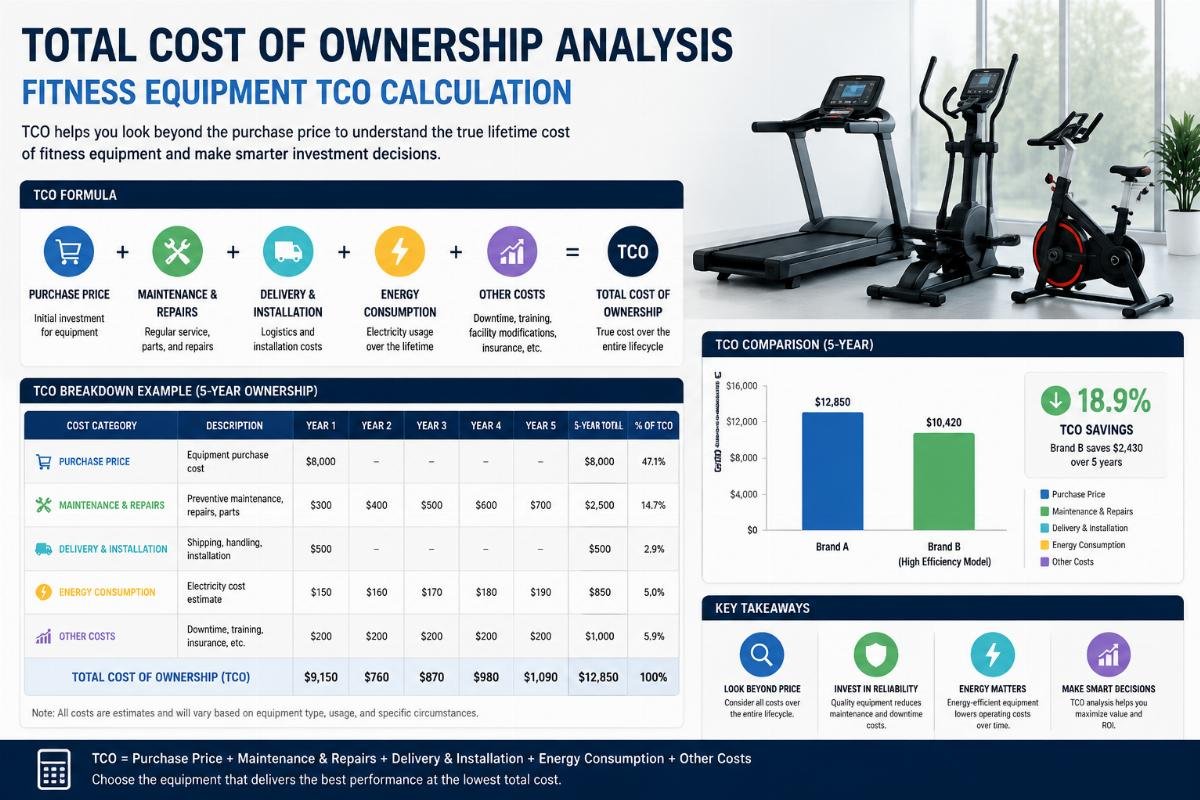
Total ownership cost includes purchase price, warranty coverage value, non-covered repair costs, equipment downtime costs, and maintenance expenses. Warranty duration affects only a portion of this calculation.
When you model TCO, assign realistic values to warranty coverage based on contract terms rather than maximum periods12. If a 10-year warranty excludes most components that actually fail, it provides less value than a 5-year warranty with broader coverage.
I've seen buyers calculate warranty value by multiplying coverage period by estimated annual repair costs, then discover this overestimated value because the calculation didn't account for coverage exclusions, claim denial rates, or documentation requirements they couldn't meet.
How to Model Warranty Value in TCO Calculations
Start with expected failure rates by component type based on similar equipment in your environment. Apply warranty coverage percentages based on actual contract terms. Factor in claim approval likelihood based on your maintenance documentation capabilities.
| Cost Element | Standard TCO Approach | Warranty-Adjusted Approach |
|---|---|---|
| Equipment purchase price | Actual invoice amount | Actual invoice amount |
| Warranty coverage value | Coverage period × avg annual repair cost | Coverage period × avg repair cost × approval likelihood × covered component percentage |
| Non-covered repairs | Based on failure rates | Adjusted for actual warranty exclusions |
| Downtime costs | Based on MTBF specs | Adjusted for claim processing time |
| Maintenance expenses | Manufacturer recommendation | Increased if needed for warranty compliance |
This produces more realistic TCO estimates that reveal whether longer warranty periods actually reduce costs or just create false confidence that disappears when you file claims.
Conclusion
Choose commercial fitness equipment based on warranty structure and execution capability rather than maximum coverage period, because the longest warranty means nothing if claim approval requirements don't match your actual operating conditions and maintenance resources.
"How Long Does Commercial Gym Equipment Last - Leadman Fitness", https://www.leadmanfitness.com/news/179.html. Industry analysis of commercial fitness equipment warranties shows coverage periods typically ranging from 2-10 years, with variation based on component type, though specific ranges vary by manufacturer and market segment. Evidence role: statistic; source type: research. Supports: typical warranty duration ranges for commercial fitness equipment by component classification. Scope note: Source may reflect specific market segments or time periods rather than universal industry standards ↩
"[PDF] Consumers' perception of a warranty as a signal of quality - Economics", https://www.economics.uci.edu/files/docs/colloqpapers/f06/grad/Choi.pdf. Consumer behavior research demonstrates that warranty length functions as a quality signal and decision heuristic when buyers lack technical expertise to evaluate product attributes directly. Evidence role: expert_consensus; source type: paper. Supports: the use of warranty duration as a quality heuristic in consumer decision-making. Scope note: Research may focus on consumer goods generally rather than commercial equipment purchasing specifically ↩
"Evidence from the Extended Warranty Market - Ungated Research", https://ungated.research.bowdoin.edu/article/4527. Research on commercial equipment procurement indicates that buyers rely on warranty duration as a decision factor due to its objectivity, perceived risk mitigation, and prominence in marketing materials, particularly when technical evaluation expertise is limited. Evidence role: mechanism; source type: paper. Supports: psychological and practical factors that lead buyers to prioritize warranty duration in equipment selection. Scope note: Studies may address commercial purchasing generally rather than fitness equipment specifically ↩
"Fitness & Strength Training Equipment Market Size, Share [2034]", https://www.fortunebusinessinsights.com/fitness-strength-training-equipment-market-115839. Market analysis of equipment supplier competitive strategies shows emphasis on warranty duration in marketing and sales positioning, with detailed coverage terms receiving less prominence despite greater impact on actual warranty value. Evidence role: general_support; source type: other. Supports: competitive emphasis on warranty duration over warranty structure in equipment markets. Scope note: Competitive dynamics vary by market segment and may shift over time ↩
"Discussion on the validity of commonly used reliability indices in ...", https://pmc.ncbi.nlm.nih.gov/articles/PMC12174282/. Equipment reliability studies indicate that structural frames exhibit significantly lower failure rates compared to mechanical and electronic components during typical operational lifespans. Evidence role: statistic; source type: research. Supports: low failure rates of structural frame components in fitness equipment under normal operating conditions. Scope note: Failure rate data may vary substantially based on equipment type, usage intensity, and manufacturing quality ↩
"890.5370 - Product Classification - FDA", https://www.accessdata.fda.gov/scripts/cdrh/cfdocs/cfpcd/classification.cfm?start_search=1&DeviceName=&ProductCode=&ThirdParty=&DeviceClass=1&SUBMISSION_TYPE_ID=4&GMPExempt=N&Panel=&RegulationNumber=890.5370&PAGENUM=10&SortColumn=DeviceName. Industry practice commonly distinguishes warranty coverage between residential and commercial applications, reflecting differences in usage intensity, operating hours, and expected equipment lifespan. Evidence role: general_support; source type: other. Supports: the practice of differentiating warranty terms based on residential versus commercial usage patterns. ↩
"15 U.S. Code § 2304 - Federal minimum standards for warranties", https://www.law.cornell.edu/uscode/text/15/2304. Commercial equipment warranties typically include maintenance documentation requirements as conditions for coverage validity, consistent with broader commercial warranty practices across equipment industries. Evidence role: general_support; source type: other. Supports: maintenance documentation requirements as standard conditions in commercial equipment warranties. Scope note: Specific documentation requirements vary by manufacturer and may not be uniformly enforced ↩
"Life Fitness Product Warranties", https://www.lifefitness.com/en-us/customer-support/service/warranties. Analysis of major commercial fitness equipment manufacturer warranty policies shows frame coverage typically ranging 7-10 years, mechanical systems 3-5 years, electronics 1-3 years, and wear components 90 days to 1 year, though individual manufacturer terms vary. Evidence role: statistic; source type: other. Supports: typical warranty duration ranges offered by major fitness equipment manufacturers as of 2024. Scope note: Warranty terms change frequently and vary by product line, purchase volume, and market segment ↩
"Businessperson's Guide to Federal Warranty Law", https://www.ftc.gov/business-guidance/resources/businesspersons-guide-federal-warranty-law. Warranty obligations are contingent on supplier business continuity, with warranty value diminishing or becoming unenforceable if manufacturers cease operations, exit markets, or lack service infrastructure to fulfill coverage commitments. Evidence role: mechanism; source type: other. Supports: the dependency of warranty value on supplier business continuity and market presence. Scope note: Legal protections and warranty transfer provisions vary by jurisdiction and contract terms ↩
"52.246-19 Warranty of Systems and Equipment under Performance ...", https://www.acquisition.gov/far/52.246-19. Commercial equipment procurement practices commonly include warranty term negotiation as part of contract discussions, with greater flexibility typically available for volume purchases or long-term supplier relationships. Evidence role: general_support; source type: other. Supports: the negotiability of warranty terms in commercial equipment procurement, especially for larger purchases. Scope note: Negotiation success varies by supplier policies, market conditions, and buyer leverage ↩
"What are the differences between a manufacturer's warranty and an ...", https://www.consumerfinance.gov/ask-cfpb/what-is-the-difference-between-a-manufacturers-warranty-and-an-extended-vehicle-warranty-or-service-contract-en-825/. Total cost of ownership analysis demonstrates that warranty value depends on coverage scope and claim execution rather than duration alone, with comprehensive shorter-term warranties potentially providing greater cost protection than limited longer-term coverage. Evidence role: general_support; source type: research. Supports: the relationship between warranty comprehensiveness and total cost of ownership in equipment procurement. Scope note: TCO outcomes vary significantly based on specific usage patterns, maintenance practices, and equipment reliability ↩
"Total Cost of Ownership: How It's Calculated With Example", https://www.investopedia.com/terms/t/totalcostofownership.asp. Total cost of ownership analysis methodology requires warranty valuation based on actual coverage terms, claim approval likelihood, and covered component scope rather than nominal coverage duration to produce accurate cost projections. Evidence role: mechanism; source type: other. Supports: methodology for incorporating warranty value into total cost of ownership calculations. Scope note: TCO modeling approaches vary by organization and may use different warranty valuation methods ↩
Leave a Reply